





 |
| The Dark Gets In |
A missing girl, a worried family – and a series of small revelations which build up to turn everything you thought you knew on its head. The Dark Gets In, which just had its UK première at Frightfest, is a deceptively clever genre thriller masquerading as a true crime documentary. Meeting its director, Sean Hogan, I asked him how he managed to capture that type of documentary so well.
“It was something the producers were very intent on,” he says. “The film was born out of the ashes of another film we were going to do, which was basically killed by lockdown. We were prepping it, we cast it, we were doing camera tests, and then Covid hit and lockdown, and it essentially killed the film. And the producers, who are old friends of mine – we've known each other for 30 years – we met after lockdown lifted and they were very apologetic about what happened with the previous film, but they didn't think they'd be able to resurrect it at that time just because of financial restrictions.
“They'd been watching a lot of true crime documentaries and they started talking about that and it would be interesting to do something like that. But we agreed that in order to. In order to tackle something like that, you need a story, which we didn't have. So then I essentially said, ‘Well, why don't we fictionalise something and why don't we then take it in an unexpected direction?’ So they were actually more focused on the true crime aspect than I was initially. It wasn't something that I was hugely well versed in. So I had to go back and look at some of them to get an idea of what the conventions were before I sat down to write it.
“They really wanted to make it feel as much like one of those documentaries as possible. The idea was always that if you stumbled across this film without knowing what it was, you would, for a while at least, believe it was a real true crime documentary, so they were very conscious about trying to use the conventions of Netflix documentaries, all the impressionistic B-roll and all that kind of thing. So, yeah, that was always on the cards, but that was very much driven by them because they were familiar with that sort of format more than I was. I was more interested in telling the story that I wanted to tell.”
The film is full of little clues whose importance may take a while to become clear. It's something people are going to have to watch a second time, isn't it?
“I hope so, yeah. That was the trick, and I guess whether or not it works for people depends on how patient they are, because it is a deliberately slow burn. It's constructed in such a way that the first 30 minutes or so are a relatively conventional missing person's crime documentary, and then you start to weave in the strangeness, and that was something that was there in the script all along. The film does utilise, to a large degree, improvisation because, again, we were trying to capture that feeling of naturalism.
“Although there was a script which all the actors were given, and I gave them character notes and everything as well, a lot of the interviews were improvised. So I said to the actors, ‘Based on what's in the script, based on the background information I've given you, I'm going to interview you in character and let's see what we get. If anything interesting comes out that wasn't planned, we can go with it and if it doesn't work, we can cut it out, but maybe we'll get some interesting stuff.’”
The film seems to touch on a number of real life cases, with reference to how they were treated by the UK press. The identification of a teacher as a suspect, for instance.
“Yeah, I mean, I think we're familiar with cases like that. And because there is that whole thematic strain in the film about the Internet, about online behaviour and what it can lead to, it was very important for me to get that in there. But at the same time, like a lot of things in the film, it's left somewhat ambiguous. I wanted to try and avoid definite statements about things as much as possible. So although, as you say, the initial accusation comes on some dubious grounds, it does emerge that he might possibly be a slightly shady character. I wanted to leave things open in the film and leave it up to viewers to decide where they come down on certain things. But, yeah, that was all entirely intentional.”
All of the characters are ambiguous to some extent – except that the documentary strives to deny that where the missing girl, Ash is concerned. She's presented as a wholly innocent character, but she's obviously got more depth, and she's at that age where people are trying to treat her as a child and she's becoming an adult. I observe that documentaries like that tend to really infantalise women who go missing, and girls especially.
“Yeah,” he agrees. “She's presented as this angelic sort of figure who's gone missing and the family idealise her, but as it goes on, she becomes a more complex character. I always wanted her to be slightly unknowable, and by the end of the film you're still not entirely sure why certain things have happened and how much of a willing participants she was or was not. That was all very much deliberate. I didn't want her to be an easily definable character. I wanted her to be a bit slippery.
“At the end of the film, you might think ‘Oh, what happened to her was tragic,’ or you might think ‘Well, maybe there was a part of her that was looking to disappear and looking to get out,’ as the psychologist character in the film says. It sets up this argument where some people think she was taken unwillingly and other people are like, ‘Well, maybe she wasn't.’ I never wanted to answer that question for sure. And, yeah, as you say again, that ambiguity was always very important.”
The film is full of misdirection, and some characters seem keen to be misdirected in order to have something simple to believe in.
“Again, we were trying to play with the tropes of true crime documentary. There’s always misdirection. There are always red herrings. They present people or situations that you think are going to be important, which are not, in order to build suspense, so we did a lot of that deliberately just because we wanted to make it fit that format. But again, I think it ties in nicely with that whole theme of ambiguity and unknowability that's in the film. It's like you're never quite sure who everyone really is.
“Sometimes they're not even sure who they are. Even the shady medium character, who was very much based on stuff I've seen with my own family – because I lost my brother about 10 years ago, very suddenly, and saw situations like that happen. It’s something I'm very skeptical about. But even with that character, there's still the moment where she does the second reading and she's obviously disturbed by it and she says ‘Stop.’ That second one was too real. It's almost suggesting that maybe she did see something genuine, even if only once.”
It also that she could be a character who is, at some level, trying to provide actual comfort, I venture, and he nods.
“Which I'm sure a lot of these people do. They don't see themselves as crooks or fraudsters. They would see themselves as providing an actual service if they're bringing comfort.”
We talk about the function of the police in the film.
“Obviously, you'd expect to see that sort of figure in one of the documentaries,” he says, “but given the thrust of the film and the way that it eventually goes from something which we would consider a real life mystery to something that's stranger than that, you’d expect that the cops would be useless in a situation like that. We present this figure as essentially impotent, and that's partly because they're not in a position to be able to solve this crime, but also partly because of a very restrictive viewpoint on what's actually happening here, and their own prejudices, against who this girl is and what she's done.
“I think you see in a lot of genre films that the police are presented as impotent or useless because in such a situation they probably would be. I wanted to go with that, but for there to be some level of critique of the police in it as well, because, as you see in real life cases like this, so often their own biases and prejudices come into it.”
He reflects on how the character of the missing girl developed.
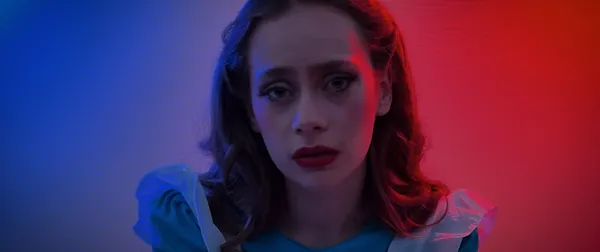
“Kezia Cotterrell, she filmed a lot of the video diaries herself without me being in the room. She was just sending me material and I would feed back and give her prompts and things. The Alice stuff was different. We filmed that in the room together, but those initial video diaries she was developing herself, and I think finding her own way into the character and coming up with her own take on things.
“That really helped build that sense because, you know, I'm not a teenage girl. It would be very difficult for me to write a convincing teenage girl. I have an idea about the character, but it was difficult for me to actually create that character on the page. So by the time we came to actually film on set together, she had a very good idea of what the character was. I was obviously taking the lead from her, so it really helped build a convincing portrait of who Aisling is.
“I guess that's the nature of documentary, really. You're presenting her as two separate characters in a way. But then also there's these refracting, different viewpoints about who she is as well, and it comes back to that idea of unknowability, that we're not quite sure who she is. We're given so many different points of view that you have to sort them out and decide for yourself.”
I first saw the film when it was screening at BeyondFest, I tell him. How does he feel about the way it's been received by festival audiences?
“I really had no idea about how it would be received. I didn't know if people would find it too slow, whether they would stick with it, but it seems to have been received really well. I mean, I watched it for the first time with an audience at BeyondFest. They seem to react in the right places. It was quite an audible audience, and the Q&A session afterwards was pretty lively, and people on the whole seemed to really enjoy it.
“So much modern horror is about instant gratification, and with the whole increasing trend towards having cold opens in films, we don't really get that slow build anymore. It's like people don't trust audiences to sit with a film for a while until something happens. It's like you have to get them on the hook within the first five minutes. This film doesn't do that. So I guess you're always slightly nervous about how that's going to be received, but so far, it seems to be working.”