




Eye For Film >> Movies >> Letters from the Silenced Country (2026) Film Review



The right to protest is one of those luxuries that many in the West rarely think about. On the whole, people can go to a peaceful demonstration without fear of any repercussions.
In Belarus, however, it's a different story. In August 2020, when autocrat Alexander Lukashenko was re-elected for a sixth term, the result was heavily disputed and the streets filled with protesters, triggering a violent crackdown from his regime. Political prisoners were scooped up in their thousands and, following the making of his short film, Walls, which focused on those seeking news of the detained, and When Flowers Are Not Silent, which offered a female-centric consideration of the protests' aftermath, Andrei Kutsila was exiled to Poland.
Now Kutsila has returned with another powerful documentary, winner of the Impact Golden Globes Prize for Documentary at Venice Film Festival and now screening at festivals including Dok Leipzig, Tallinn and IDFA. It hears first-person perspectives from political prisoners, an exiled former cop, who turned on the regime and a dissident still in hiding in Belarus. A film constructed of unsettling fragments, it blends footage from within Belarus, including surveillance video, with still photography and animation based on, and incorporating, the drawings of Kasia Budzko, who is one of the film's subjects.
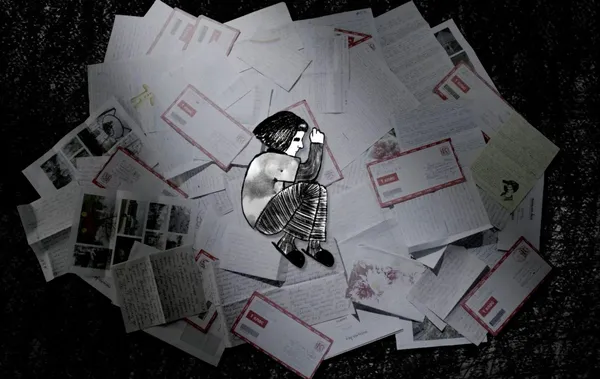
Among the most heartrending elements are letters exchanged between Vitold Ashurak and a family member. The tone of them is, considering he was in a penal colony at the time, surprisingly light, as his correspondent muses on the difficulty of selecting photos to send him, while he sounds upbeat. It's a conversation in stark contrast to the CCTV footage we see of him, so weak that he falls, and testimony from others who witnessed him receiving severe beatings before his death in custody.
Vitold masks the fear that otherwise runs through Letters like a dangerous and unpredictable electric current, emphasised by the stark black and white animation, the black crosshatching and sharp strokes of which feel like distilled violence in themselves. The animation presents the conditions in the prison in stark form, where the only colour is the red border of the letters the prisoners receive. It also, as it did in everything from Waltz With Bashir to Flee, is used to expand the film into the psychological space of what Kasia, in particular, is feeling while imprisoned.
Kutsila frequently uses still images, which he zooms in on, highlighting the highly surveilled nature of Belarussian society. It’s something the anonymous activist who remains in the country thinks about all the time, staying to be close to his daughter but calculating how long it is before he is located by the authorities. Sometimes the zooming results in imagery having an impressionistic quality, which allows the focus to remain fully on what is being said. The documentary’s melancholy mood is matched by the throbbing industrial electroscore from Vygintas Kisevičius and Paulius Kilbauskas, both menacing and sad.
The Belarussian regime is thriving on silence, this film speaks up to remind us that behind each of the more than 65,000 arrests that have happened since 2020, there is a life and family that deserve to be heard.
Reviewed on: 30 Oct 2026