 |
| How To Divorce During The War |
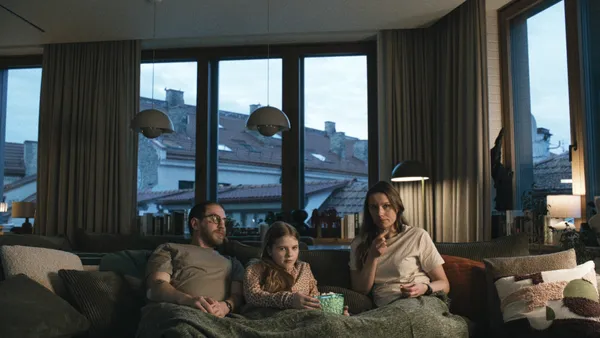
Lithuanian director Andrius Blazevicius' black comedy How To Divorce During The War, is set in Vilnius, Lithuania in 2022 during the first months of the Ukraine war. It revolves around Marija (Zygimante Elena Jakstaite), a successful executive, who, the day before Russia invades Ukraine, decides to tell her husband Vytas (Marius Repsys), a struggling film director, that she wants a divorce.
The separation presents each with challenges. While Vytas is forced to live with his Russophile parents, Marija finds the war impacts her professional life. Then there's the couple's daughter Doville, who witnesses her home life fracturing while the war brings the refugee crisis into her home.
Blazevicius made his feature debut with The Saint (Sventasis), set in a small Lithuanian town during the 2008 economic crisis, which follows the escapades of a man recently laid off. His sophomore feature Begike, is about a woman who goes in search of her boyfriend when he disappears after suffering a psychotic episode.
In conversation with Eye For Film, Blazevicius discussed cinematic memories, switching off his director's brain, filling a thematic hole, human contradictions, being both excited and a little afraid, and more.
The following has been edited for clarity.
Paul Risker: Why filmmaking as a means of creative expression? Was there an inspirational or defining moment for you personally?
Andrius Blazevicius: I always loved watching films, and I can still clearly remember the time my mother took me to the cinema to see Tim Burton's Batman. It was still the Soviet-era cinema with uncomfortable wooden chairs, but still, I loved that film.
During the Nineties, Lithuania was going through a difficult time as it transitioned from socialism to capitalism. Our parents were working a lot, and so, they'd leave us at home. I'd watch television and I remember the first thing I really wanted to do was to be an actor, because I thought the actors were the ones who created the films. I didn't know that there was somebody behind the camera; I didn't even know there was a camera. Then, when I was around 10-years-old, I learnt from somewhere that there is such a guy as a director or a writer. It was then that I decided on my dream profession.
It's sad when I think about it now, because I thought my dream was only a dream and I should do something practical like law or business management. And when I was 16 or 17-years-old, I realised that maybe I should try to reach for my dream. I did, and I was lucky to get into film school and everything started from there.
PR: The way we watch films when we're young changes as we enter adulthood. Maybe there's something about becoming more aware of time and expanding responsibilities that plays its part in this shift. I still look back and miss how effortless it was to consume films when I was younger. Do you recognise any such shift?
AB: To be completely honest, I can still, not that often, lose myself in a film when my director's brain switches off. To say it's when a film is good is not the right word. Instead, when I watch a Hollywood film, I'll sometimes realise I'm just following the story, and I've forgotten everything else, such as how it's made. I really appreciate this, and it would be sad to lose it.
Before and after film school, I was still more a film fan than a film director. I wasn't thinking enough about how they were made because I was going very much on intuition. Then, when I was 30-years-old, I tried to understand more fully why something is shot the way it is, and how it changes if you do it another way. So, I came to this stuff late.
PR: What was the genesis of How To Divorce During The War?
AB: I took from what was happening in real life. It's a combination of everything I've heard, and me, my friends, and family have experienced. I'd been thinking about doing something around divorce because I had been hearing a lot about it. I myself am separated and lots of people in my circle are divorced or are getting divorced. I still think there are not enough films that tackle this subject given the number of people separating.
There was the war and, before that, Covid. There are so many divisions everywhere in the world and divorce or separation is a form of division of family, which can merge with what else is happening into one interesting story. But the main part of the idea came with the start of the war in Ukraine, because we ourselves were occupied for 50 years. I imagine our reaction to it is different to that of the United Kingdom, given how close we are to it.
PR: I imagine it's true that different audiences across the world will engage with the film differently. For example, the experience of audiences in the Baltic countries compared to the UK and the US. And when you consider European countries and their shared history of colonialism, one's national history could also shape the response.
AB: That's true, and this is something I'm looking forward to, although I'm also a little scared about it. What I noticed travelling around festivals and meeting audiences, and it's still strange, is that people living further from the war zone understand it better. Why, I don't know. Maybe it's too close for people living in the Baltic region or countries like the Czech Republic.
The film will have a release in September here in Lithuania and the first reactions from those that have seen it are warm, but their focus is directed toward totally different themes. Whereas, when we premiered at Sundance or when I was in Hong Kong or Ireland, for example, it seemed that people understood what I was trying to do with the film. So, I'm somehow scared about the Lithuanian premiere and also future screenings in Latvia and Estonia. But I'm still very curious about how they will react.
PR: How To Divorce During The War is a film that has a deliberately patient rhythm, drawing on its observational nature. It's a film that does not hide from the bleak reality, which could challenge some audiences who will find it too confronting, despite its humour.
AB: My approach to the style came from a saying we have here in Lithuania: if you want to understand yourself, you need to look at yourself from a distance. So, this was the approach for the style, because when we did a test scene with the actors, we shot and edited it in a classical way (master shot, close-ups, and medium shots), and somehow, it didn't work. It just felt wrong.
Left to try to find a visual concept that would be right for the film, I realised I needed to observe them. I needed to have this distance because I didn't want to judge the characters, which the distance helps with. Of course, the audience will judge them, and how you judge them will depend on your moral and life values. And when we shot the scene in this style, it worked perfectly — it was more interesting to watch.
We also discussed the colour palette a lot with the production designer. We were trying to create this kind of conformist apartment. It's a very abstract idea — what is this conformist apartment? How do you place it in the context of real life, because we don't want to make it sterile or too clean? So, we tried to represent those people who have this belief that they are better than they actually are. And one other important element was that I wanted the story to be in real time, from when the war started, during those first four or five months.
Waiting for the war to start, the atmosphere in the country was very dark, and then, when the war started, it seemed everything just became darker. The war was everywhere; everyone was talking about it. But I realised that the film needed to have some humour, otherwise it would just be depressing — this also informed the visual approach.
PR: If I were to choose a word to describe this film, it would be "contradiction." The husband and wife are both guilty of contradicting themselves, whether how he presents himself or her wanting out of the marriage only to bring other people into her life — then she wants them gone. It feels like the wife in particular is trying to understand herself, which means confronting her contradictions.
AB: This is something I'm interested in, and maybe you will disagree with me, but from observing other Lithuanians, it seems that people on social media, what they write and how they represent themselves, people think a lot of themselves. But they don't see how, in situations, they contradict this. Often, people will do bad things, and they just don't see it.
We're aware of climate change because the summer is so hot and the winter is so cold, but then people don't want to recycle. This is only a small example, but it tells you a lot because people are not willing to make sacrifices when they need to. And I think this is a Western thing, actually. The European Union supports Ukraine, but to a point where we can't go further because nobody wants to sacrifice comfort.
This was one of the main themes of the film. These contradictions make the characters more interesting, at least for me, because you see authentic people, who are usually very hypocritical.
PR: When we suffer a loss or dreadful things happen, we feel we should stop everything. Life, however, carries on — it has too. We see this in the film, where, in the shadow of the war, day-to-day life continues. It's interesting because coming to the film, I expected it to be more about the war, or for the war to have a more dominant presence. This reflects on the idea of the need for compartmentalisation, which itself can be contradictory.
AB: Exactly, I totally agree with you, and I don't even know how to describe it. For me, it's this tragedy for us, because we actually need to go on. We need to live and there's basically no other option. Well, there are options, but they're not good.
You can't change what's happening in the world, but you can try. The reason people are relating to this film is because they feel those characters are trying to do the right thing, but it's just so hard — it's almost impossible.
PR: What do we need most from cinema at this moment in time? What purpose does cinema serve?
AB: Oh, it's a difficult question. I don't know how to answer it properly because I know what I need from cinema, but I can't generalise.
For me, it serves two purposes. With the help of films, I want to understand other human beings and to connect with them, because I remember during my teenage years, during difficult times, it was good to have somebody you could connect with. And films, books, and music helped a lot. The other thing is, sometimes I want to relax and have a good time, which is so very simple. But this idea of connection is the most important thing for me. There are people who see film as a business, but I just want to understand human beings.
How To Divorce During The War opened at the IFC, New York on August 21, and opens in LA at the Laemmle Royal on August 28. A national expansion will follow.