 |
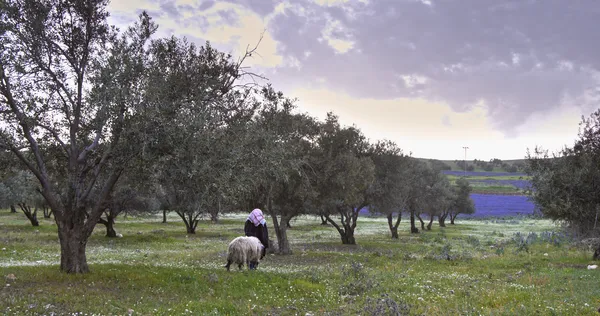
| Hakima and Badrya. Asmahan Bkerat: 'They really became my family. At some point, I saw them more than my own family' |
Bkerat began her career as a photographer and social justice advocate but says that telling the family’s story was the inspiration behind her move into filmmaking.
“I learned how to make films to make this film,” she says. “I became a filmmaker by coincidence in the process of making Concrete Land. I actually didn't have a full knowledge about documentaries. I thought they were just interviews and on historical topics that we see on TV. I had no idea the creative documentary world existed, and I had the chance to see my first observational film, an Afghan film called Laila At The bridge, and it really inspired me so much. So I did become a filmmaker.”
Her relationship with the Najars began after she encountered the family matriarch, Hakima, walking her pet sheep Badrya in 2016. And
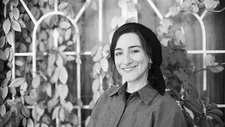 |
| Asmahan Bkerat: 'I think they changed my life more than anything' Photo: Asmahan Bkerat |
Badrya, who is now 15, became a member of the family shortly after Hakima, who had already lost all of her family in Gaza, had also lost her mother.
“By coincidence, Awad was on his truck route, and he found Badrya abandoned on the road and Hakima took her in and it was like a replacement of her mother’s love and now it’s a very strong bond,” says Bkerat.
When there was a call from a film commission for a short documentary, Bkerat saw the chance to focus on that bond with a short film, Badrya, before moving on to the feature.
She adds: “I understood that Al Jazeera commissioned some projects, so I thought if we film the process of the displacement and how the area will change, we could get a commission from Al Jazeera, get the money and then give it to the family. That was the basic idea, and that was when I talked to them. It was a collaborative process. I went to them and said, ‘How about you do this? We can try. If it works, it works. If it doesn't, then it doesn't’. And that's how it started. I think I'm lucky to have them because they have such an open mentality, and I was very surprised by how understanding they were. I actually think they understood the process better than I did. And I've learned a lot through them. Yeah, yeah, so it was a very collaborative process.”
The feature was shot over eight years, with Bkerat acquiring more than 400 hours of footage and visiting the family, on average, about three times a week.
“I was adopted by the sheep!” she says with a laugh. “Sometimes she’s so moody she wouldn’t let me film. She would head butt me because she demands to be petted the whole time, and she always hits the tripod, she's like, ‘No, not today’. They really became my family. At some point, I saw them more than my own family.”
The filmmaker says even though she knew what the family were up against in terms of where they live and their livelihoods and the education of their daughter Eman, who becomes a teenager through the course of the film, she was still surprised by the level of prejudice they faced.
She adds: “I was also surprised about what I learned about myself. Because the Palestinian part of the story was never part of the original story. I also am a Palestinian living in the diaspora in Jordan, and then I realised that, yes, there's different experiences for Palestinians. I learned through them and I became more aware of the Palestinian experience in Jordan through them. I feel like I'm more aware of it now than I was when I started filming because it wasn't something in the forefront.
“I had no idea that I would get to a point where the root cause of their displacement is that they lost their original home, and they don't have a tribal land that they can be on. Jordanian Bedouins in Jordan have their own tribes, they have their own systems, and they have their own land, and they can exist within that system. But once you take a Bedouin out of that system, then they become displaced and lost. That is also reflected in the Arabic title of the film, which means ‘the lost’ or a person who is in a constant state of being lost and never finding their home.
“So I learned a lot. I learned how to make a film through this film, I learned about my identity. I honestly, I think they changed my life more than anything.”
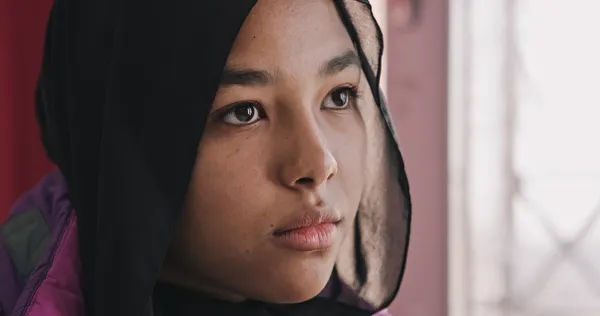 |
| Eman. Asmahan Bkerat: 'If she gets to university and finds a new life, I’ll be happy' |
“I intended it to be a film that has humour and love but it is also a sad story. We decided to leave it as an open ending to reflect the state of Palestinians who are displaced everywhere, because it's not just about this family, it's about a lot of Palestinian families who were displaced. Unfortunately, there are a lot of refugees in the world. We see the moment of displacement but we don't know what happens to them. It's something that stays with you for the rest of your life. They’re now living in the same cycle. It's just happening all over again.”
Another key element of film is music, with Hakima and the family patriarch Abu-Awad frequently expressing their feelings through song.
“That’s also something I learned along the route of making this film,” explains Bkerat. “The Bedouins have a song called a hajani. It’s a song where they express what they’re feeling in the moment or that is passed through the generations and memorised. It's always there at the harvest, singing to pass the time and keep themselves entertained. When Hakima sings, she is also expressing her grief. So the songs are organic to the Bedouins and it's part of their culture and how they express themselves, and what they're feeling.”
The main goal of the film, Bkerat says, was to ensure that Eman was able to continue her education no matter what, and after showing the film to some people, one volunteered to pay for her continuing studies through university.
Bkerat adds: “Honestly, this is enough for me, even if the film doesn’t go anywhere, if she gets to university and finds a new life, I’ll be happy.”
Eman will be the first in her family to get an education, which will hopefully open doors as the film shows how much ingrained prejudice the family faces and which leads to a lack of job opportunities. Eman’s father, for example, doesn’t have a formal education, so the only work he has is as a truck driver for a construction company.
“He’s coincidentally enough, working in the same system that's displacing them,” says Bkerat “It's a reflection also of how we survive. I mean, we hate the system, but we have to be part of the system to survive. In our society people always had a small house and a huge amount of land but now it’s just the house.”
Now Bkerat hopes to have a sustainable career within the documentary film world.
“I’m producing two projects – one called If These Stones Could Talk about a Palestinian family’s archive and another called Landwards, about farmers in Jordan. I'm also developing my second feature film. It's also about displacement and identity, because it's a theme that I really care about.”