




 |
| A Safe Distance Photo: Fantasia International Film Festival |
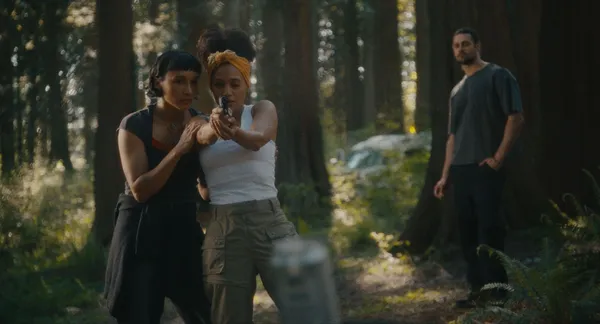
Screening during the last few days of Fantasia 2026, director Gloria Mercer’s A Safe Distance is an engaging thriller which stars Bethany Brown as Alex, a woman abandoned in the woods by her boyfriend when she feels unable to accept his marriage proposal. Lacking outdoor skills, she’s lucky to encounter a couple camping nearby, but they are in a complicated situation of their own, and as she grows closer to them, Alex finds her life changing in unexpected and dramatic ways.
The script was written by Aidan West, so when I meet Gloria, I ask if she had any input in its development.
“Yeah,” she says. “I was really involved in the script because I've worked with Aidan West, the screenwriter, quite a bit. We had made short films in the past unrelated to this film, and then we also made a short concept for this film as well. When we made that, in 2021, at the time he had already written a draft of the feature film, which would then go on to change quite a bit. I was really privileged because he brought me into the development process and I got to give a lot of feedback and talk about my personal experiences, which sort of work their way into the film.”
There’s a Patricia Highsmith reference in there which suits the tone of the story.
“It was just like a cheeky little nod,” she says. “I guess we were inspired largely by lovers on the run films and the materials that you might expect, like Bonnie and Clyde. I've talked about Thieves Like Us as like a big inspiration, but with Patricia Highsmith, it was not necessarily modernising, but just giving a sort of signalling. The film is obviously trying to take on these crime thrillers and lovers on the run stories with a feminist edge and a different perspective.”
We’re joined by Bethany, who talks about why she enjoyed the role of Alex so much.
“It was my first time building a character like that,” she says. “Oftentimes I play characters who have a lot of dialogue, and they're very charismatic and verbose, so it was really beautiful to sit back and create a really rich inner world. Clearly there's a lot going on inside of her. And then she’s still choosing to say the right thing or the thing people expect or the thing that's more people pleasing, which is, I think, what she's practiced her whole life. So it was a big challenge, but I had about a month to prepare, so I really took that time with Gloria, with Aidan, with the rest of the team to really bake in this, so we all were on the same page with this really rich inner world that she doesn't feel comfortable sharing. And then, you know, throughout the film, she starts to share it.”
There have been quite a lot of films out over the past few years which look at coming of age as something that doesn't necessarily just happen to people in their teens. Alex feels like she's at a moment in her life where she's going through quite a big transition in terms of who she is.
“Absolutely, yeah. I think for Alex, there was really this map of who she should be and how relationships should go, and she was following that map to a T. But then she comes to the space of realising ‘But is this making me happy? Is this what I want? And do I even know what I want? This was the prescription given to me and what I've been doing, but am I really satisfied?’ I think that for the most part, she didn't even know what her needs were because she hadn't looked inward.
“I used the analogy of Alex had this sort of headlamp that was pointing outward and studying people and recognising their needs and their wants and their desires, maybe meeting them before that person knew that they even had them. But she'd never really turned that lamp inward. That's the turning point, taking that headlamp facing outwards and turning it inwards and going ‘Who am I and what do I want?’”
That's interesting in light of what she says about her boyfriend at the start, that he's only talking about himself. Perhaps she has been aiding and abetting that in a way, without understanding it.
“Yeah. I think it's the recognition of her invisibility, but that recognition, for me, was realising she was also invisible to her, and looking to become visible, and looking to have somebody actually be able to see her.”
Something that I found interesting about the is that it's built around three sex scenes, all focused on Alex's face. The one at the start where she's obviously miserable and really doesn't want to be there. The one in the middle where she's kind of explaining, exploring possibilities, and then later on where she's happy for a little while.
“It's funny because when we were working on the film, it wasn't like we set out to make these moments,” says Gloria. “It was sort of a weird, happy accident. Once we recognised that, it was a really fun opportunity to show these points in Alex's life, in her dream journey, and what she's feeling at each point in the film.
“Once it was there, we talked about it and we talked with the intimacy coordinator as well, about how to shoot it to convey just the way Alex is changing and not changing throughout. And also, strangely, this is the first film on which I've ever personally shot a sex scene, so it was like a crash course. Like ‘Okay, this is how you do this. Oh, okay, this is how you do it in very close quarters in the woods, in a tent, etc.’”
People tell me that intimacy coordinators are really helpful with that kind of thing, I say.
“Yes. Our intimacy coordinator Tolmie Greaves, who's wonderful, said it brings safety to the experience, or at least that's the hope. In our case, I feel that it did – and a feeling of comfort for everyone involved. But it also brings a lot of logistical benefits that I feel like a lot of people don't think about. Part of her role was just helping me, just making it smoother and making it so that we are getting the best version of what we can get.
“Intimacy coordinators, it's a highly technical role, like a stunt coordinator. They are manoeuvring bodies and making it so that it's choreographed and it's not super awkward, both for the people involved and for the camera and the crew. We loved having her.”
Tolmie and Gloria created a very safe environment, Bethany says, adding that this doesn’t always happen on set. “I've had the pleasure of acting for quite a long time, since before Intimacy coordinators, where it felt far more unsafe and a little bit like the Wild West. You know, I had a director at one point say ‘Go in and take what you want,’ and I was like, ‘I don't want a thing. I feel very awkward.’ So, you know, it wasn't maybe the most helpful thing for me to hear at that point. Again, that was a long time ago, and things have changed so much.
“With this script, you're right, there are three. It's very beginning, middle, and end. I wanted every single scene, including intimacy and sex and jealousy, to serve theme and to serve the arc of ‘Where are we at in this storytelling? Where are we at emotionally?’ In the beginning, this is what Alex had been doing: somebody wants something and she's going shopping in her mind, because that's where she's at. It has this interesting conversation on consent because clearly it's within the expectation of the relationship that they're going to have some level of intimacy, but I really wanted - because we're talking about a safe distance – like, what about safety? What about consent in that environment?
“In the next scene, it was really this question of ‘Can Alex actually embrace desire?’ And for this first time, feeling this welling of desire. So what will that look like? Well, that actually feels quite out of control. Also very exciting, when somebody's meeting you clearly with enthusiastic consent. And then the next layer really was a far deeper layer, a far more emotionally connected layer that has another texture in it. It's another conversation and form of communication that is just deeper. So, yeah, I think these are really three pinnacle moments in the movie.”
The other big scene in the film, from a directing and acting perspective, involves a drug experience.
“I was really stressed out about that sequence in prep,” Gloria admits. “That's such a big sequence because it leads from one thing into the next thing. I think we shot that pretty early in the shoot, and I just wanted it to be great. Such a boring thing to say, but I did. I definitely beat my head against the wall trying to figure out how we could do this in a fun way that feels like it's not sitting back on the tropes of how we've seen drug experiences portrayed in film, but also feels evocative.
“We talked about this a lot because the intimacy blends into that sequence. I just was like, I think that this should be fun and they should be laughing and maybe they're not laughing the whole time, but, like, if you do mushrooms, it’s a very giggly time.”
They both laugh, and she continues “I feel like we're adding joy and then that blends into the intimacy and just the weird whimsicalness of this experience. So from a performance level, I tried to kind of put that in, and then I just was lucky. I worked with the cinematographer, Devan Scott, quite a bit in prep, and he's very open to testing stuff. We just had this fun idea, and the forest also affords this great opportunity to play with putting lights in the trees, making things feel like they're sort of crackling and alive.
I guess the last thing I'll say is just like, that sequence was so fun to do with the composer, who's amazing. He really felt that film, really quickly, and a lot of the cues he was sending us really jumped out. That sequence, it wasn't very different. He did a couple passes on it. It was one that we fine tuned a little more than others because it's such a tonal tightrope to walk, I guess. But it's one of my favourite moments in the film for a lot of reasons. It felt like that was the part where we all worked together and got to have a lot of fun and got to experiment a little bit. There were a lot of moving pieces, but it was very fun in the end to see it all come together.”
“It's funny that you said it was stressful in prep because it was probably one of the most fun scenes to shoot,” says Bethany. “It felt really simple. I felt really held in the scene. Gloria just said ‘Okay, you're going to be sitting here and then you're going to walk through here,’ you know, so that's what I did. But for Alex as a character, it was one of the first times, at least in the film, where she's really thrust inside of her own body and really feeling what's happening in her own body. Mushrooms is such a sensory experience. I think she'd been so cut off from her body for so long, and so just up in her head for so long, that's why the scene really stood out to me. But then watching it with everyone at Frameline, it's just so – like you're saying the whimsy is there, the joy. There's such a childlike return. It's really a pleasure to watch.”
“I can speak to that too,” says Gloria. “To me, Alex has been so controlled, and this isn't necessary the end of the journey, but it is a moment where that control slips and she is feeling things in these waves. It was fun for me to play with it.”
I suggest that the balance of the film is between those whimsical, fun bits, and Alex’s awareness that this can't go on forever. Something is going to go wrong sooner or later.
“Yeah,” says Bethany. “I think the weight that Alex carries in the beginning of the film is the weight of consequences, of cause and effect. She’s stuck in her mind, having this list of all these things that could go wrong, and then hedging based on not wanting things to go wrong. And so now when she's in this space that's really live and she's exploring things, there is this [feeling of] well, when is the other shoe going to drop? This really deep knowledge that there will be consequences.
“Obviously, she doesn't know what they are, and when they're experienced, they're possibly far worse than she could have imagined, but I wanted there to be this experience of ‘Oh, that's why you don't live, that's why you don't let things happen.’ That's why she was in the box that she was in the beginning, because it was safe, you know? So when I did my script breakdown, I had a lot of that contemplation in there, for sure. I think by the end of the film, she'll have a more nuanced approach. But I think with anything, when we live so far one side of the pendulum then we swing so hard to the other side of the pendulum. And then you find the middle along the way. So I think by the end of the film, maybe she's swinging more towards the middle path.”
Obviously at the start when she's abandoned in the woods, she's in a very vulnerable situation. But in some ways, it's not so different when you're shooting in the woods with all the things that can go wrong. What was the shoot like?
“We were right on the edge of civilisation,” Bethany says. “We were lucky because there were a few houses out there, and those folks were so generous and lovely at certain points and let me use their bathroom, you know. It was definitely forest embedded. Glo, I'll let you speak to the technical aspects of that because you had it on lock. You did such a great job.”
“Well – I've said this before – this film would not exist if it wasn't for just incredible community support. We shot outside of Vancouver in Canada on the west coast, so you don't have to go very far to find really dense forest. In that sense we were very much on the edge of civilisation, but in the forest. We were really lucky because we basically went around this area inside Vancouver and just asked people if we could shoot on their property, because it was more accessible than in some ways trying to shoot in a public park.
“They let use their bathroom and then we had a little basement space basically on a large farm with a bunch of forests on the back of it, where we shot a lot of the campsite. They were super generous and just let us be there for ten days or something like that, and then we shot other forests elsewhere. Also shout out to the firefighters. There's a fire hall that we shot, and I just want to say that because firefighters have been very nice to us over my lifetime and have let us shoot in their locations. We have a pre-existing relationship.
“I guess my point is when you go to B.C. you don't have to go very far to find a lot of forests and a lot of people who live in that forest. We did have a bear encounter. It was a peaceful bear. I think there was a mum and a couple of cubs who came by one or two days and they saw us and then they hightailed it out of there pretty quick. So we were really in the forest, but not too far from being able to buy towels or propane or whatever if we needed it, which we did. But luckily, like, we just had great hosts, so we were able to use those spaces for a pretty reasonable amount of money and get to do what we did.”
Was it smooth shooting in general?
“Yeah, it was swift,” says Bethany. “We're all Canadian on the film. We all live so close to forests and bears and rivers and fish that I think there was this...” She shrugs. “The beginning of the film was harder. I lived on a 100 acre farm that was all backed onto the forest, so I feel so comfortable in the forest, but Alex isn't comfortable in the forest and this is definitely not her strong suit. But as Glo said, we were on the edge of people's properties. The river was on the edge of somebody's property. You just have to load in the gear. But it's still precarious because it's still a forest and it's still down a huge hill, and people got their steps in for sure.”
“And there were mosquitoes,” says Gloria. “It's still the forest, even if we've got some stuff nearby. There was a thunderstorm one day that we just had to kind of sit and wait for.”
“We just drank Starbucks and waited,” says Bethany. “But yeah. Anytime you see bugs in a scene, those are real bugs.”
Finally, we talk about Fantasia.
“I feel so honoured,” Bethany says. “This film has had such a beautiful life and festival run and it's being so wonderfully and warmly received that, you know, I think so much as an actor, you sit like a snake in the grass, really, beat by beat, because you don't want to overly foreshadow what's going to come. You want it to just be the consequence of the action. And then you get to sit back and watch other people receive the fullness of how it all came together. And yeah, I'm just over the moon, thrilled.”
“Yeah, it's thrilling,” Gloria agrees. “I mean, especially because it's a Canadian film and we've so far played festivals outside of Canada, so to bring it home is really exciting. To be there and be one of the Canadian projects amongst some amazing other films – we stand amongst such great filmmakers, so it's just thrilling and exciting.”