 |
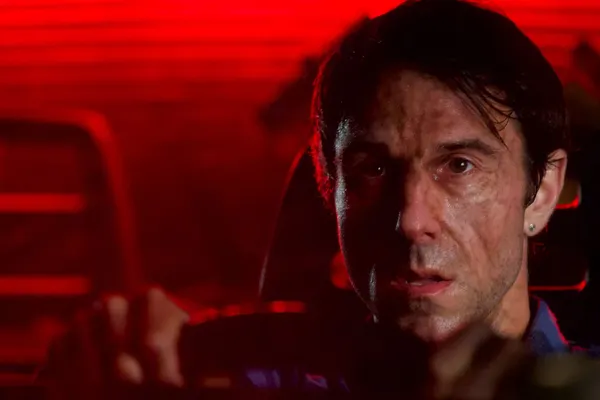
| Niko Photo: Fantasia International Film Festival |
Set in a near-future world but very much haunted by the shadows of our own, Julien Birban Levy’s Niko tells the story of one of the last romantics, a woman en route to taking an action which will shock and enrage, all in the name of love. It was warmly received at Fantasia and I was pleased to have the opportunity to speak with Julien later. I began by asking him about his previous short, Home Is Where Your Heart Aches, which also addresses romance and is set in Niko’s hometown of New York. Are the two films related?
“Yeah, they are related, I think,” he says. “I really wanted the character of Niko to be a little bit lost in Korea, so I thought that it would be good to make her kind of between two countries. And yeah I lived in New York for a long time – for six years. I live in Japan now. So I'm always going from one language to another, and I wanted the characters in my movie to be like this. I think the message I had was which language we talk is not that important. It's more about the message and what people feel. Also, it happened that the actress we found for Niko, Tiffany [Young], she was born in America as well, and she lives in Seoul, so it was perfect.”
So why choose to shoot in Seoul?
“A few years ago I shot a short film there, called First Date, Last Date. It was very small project. We shot in two nights. And when I was writing Niko, I really wanted the character of Niko to be attacked by the city, by what's around her. She's such a romantic person. She's so cute in the way she thinks, in a way I was born in Paris. I thought Paris is way too cute for that story. Even Tokyo is too cute. It's too clean, in a way.
“So when I shot this short film a few years ago, I already had the story of Niko in my head and I thought ‘Oh, this is the place. This is great.’ It's a massive city. It's relentless, it's loud, and people are also very kind. So I thought, ‘This is perfect for Niko.’ And also, it fits with my visual style. The city, this kind of very bright lights everywhere in the distance, but also very dark corners. I thought it was just great for me. Then I finished writing the script, and I searched for a producer in Korea, and I found one.”
It’s also a city which can very easily be made it feel like it's in the near future and part of a dying world..
“True. That's true, yeah. For most of the outdoor scenes, we didn't really change anything. We turned off some lights and put some new lights on instead, and that's it kind of it. And we didn't shoot in the rich areas, the cool areas. We shot in darker, more indefinite neighbourhoods. Those are places that are changing. There was a lot of closed shops, etc., wherever we shot, so we didn't have to do too much. And also we used a lot of sound effects to create that mood anyway. From the start we knew it would be this kind of near future, with this feeling we would create with sounds as well.”
I tell that I find that interesting because an awful lot of directors I talk to have lots of visual ideas but don't get very involved with sound. I think sound is tremendously important.
“Yeah, I totally agree with you. I used to be musician a long time ago. I was playing in bands. And for me, of course, sound is so important. Music is so important. I would say the first filmmaker who really shocked me was probably Wong Kar Wai, and Wong Kar Wai's music is always incredibly well picked. So yeah, from the start, I knew what the music would be like, what would be the soundscape of the film. Actually now I'm writing the next one and I'm already thinking about the sounds and the music.
“I also think sound people, the sound engineers, the people who do the sound mix are geniuses. It's so incredible to watch them work. We did the sound mix in Korea as well, and I really asked the sound mix staff to make it very believable. When I did the editing first, I was using some kind of sound effects, and I was like, ‘Feel free to change everything so it feels natural and really believable for Korean audience as well.’”
We learn a lot about Niko from the way that she dresses and the way her style is expressed in the spaces she inhabits.
“I think the staff we worked with on costume and set design are literally geniuses. With the costume, I told them ‘Imagine someone who doesn't have any money, but she would definitely spend a lot of time in second hand stores and try to find stuff, or just borrow things from friends, etc. So her outfits kind of go all over the place. It's a bit punk, but not too much. I let the costume designers search for a lot of different things and then we tried a lot of stuff. The actress, Tiffany, she was an idol for years before being an actress, so she's also very good at picking clothes. So we did that together.
“Set design was so important. I think Niko's apartment is like the most important location of the film. I worked with this set designer called Mumu. She's really popular in Korea. She does a lot of clothes, Kpop music videos, etc. This was her first feature film, actually. I told her, ‘We really have to focus on the set design of the apartments of the characters; It's such an important part of the storytelling.’ And she did an amazing job. Niko’s apartment, we actually built it from scratch because the apartment I was describing in the screenplay, we did so much location scouting and it never worked. And after a while, Mumu told me ‘You know what? Let's just build it.’ And I was like, ‘Yeah, let's do it.’ So it's kind of crazy, but we built it from scratch.
“Most people so far talk to me about this location. Like, ‘What is this place? It's so cool.’ And it means a lot. Niko is someone who's always home. She doesn't have a lot of money. I mean, she goes out at night, but she doesn't have a steady job, etc. So her home is full of little objects, little things she found on the street, etc. It's a beautiful mess.”
I tell him that what really fascinates me about the film is how well we get to know Niko, how close we get to her internal processes. Women like her in films tend to be there usually to be looked at and admired from a distance, and we don't get to know them.
“Thank you,” he says. “Yeah, I think so, too. It's the kind of character that, as you say, in most movies it's the kind of mysterious, sexy but tortured girl, and it's kind of boring. That's not important. I think what's important is, like, what does she think? What's her struggle? So in most scenes of the film, the camera is really close to her. I tried to portray that kind of character in a new way. I didn't want to objectify her. I didn't want to fantasise about this tortured young actress, young artist, etc. That was very important. I actually asked a lot of my female staff to kind of check what I wrote. I didn't want to write anything with my male gaze, so I was very careful about that.
“Tiffany was amazing for that. She was really helpful sometimes, saying, ‘I don't think that girl would say that.’ She changed some of the lines and that was wonderful.”
This almost makes things harder for the boyfriend character because he is seeing her very much through his gaze, and he makes a lot of mistakes.
“Yeah, he makes mistakes. He was a difficult character to build because from the start I really wanted him to be really kind. On paper, he's a good boyfriend. He really loves her. He's doing his best, but there is this discontent in Niko. She thinks it's not enough. She wants more. And I think one of the source of the problem is, as you say, he makes some mistakes. He doesn't really listen to deep inside what she wants. And when they fight and when she disappears for a while, it's because he doesn't really listen to her question.
“That's the kind of guy I wanted to write, and then actually in the script, this character, like Jeremy is even kinder. But the actor, Sandor [Funtek], he was like, ‘No, let's turn the volume up and let's make him a bit more upset sometimes.’ At some point when they talk, when they're stuck at the opposite side of the window, he gets really angry at her. That was something we talked about and decided to do it after a while because first his character was even more kind, very in love with her, but just not enough.”
And then there's Niko’s friend Ji-eun, who struggles to make space for herself in a film where she risks being a third wheel.
“Yeah, I love that character too. She's kind of living her life through Nikos. As soon as she meets Niko, she's obsessed with her. And yeah, Ji-eun is a character that's kind of furious. At the beginning she sounds stronger than she is. She's kind of like a victim of this whole story, I feel. But this is also a character I built with the actress, Soy Kim. She's a wonderful actress and she had so many ideas about the character as well. There is a scene where she plays guitar. This is just an idea she had a few days before we shot.
“The character of Ji-eun is very complex. What I feel now from the feedback I had so far is people can feel that character in very different ways, which is great. Some people understand her. Some people are like, ‘Okay, that's crazy what she's doing.’ So I love that.”
Niko makes a big decision at the end of the film, which we don't want to talk about because we don't want to give it away, but how well does he feel that people have understood what he was trying to say with that?
“So far, it's going great,” he says. “I didn't write Niko as a crazy character. I thought of her as a very smart, intense person who is so dissatisfied with life that she's going to do something huge. And so far, what the audience is telling me is that they understand why. They understand, actually, why she does something so insane. But also what I really like so far is that people told me ‘We saw that love story. We were so focused in the love story, and at the end you betrayed us and you made the film switch into something that's like, not horror, but it's suddenly very dark.’ And I love that. That's exactly what I wanted to do.
“That's also how we shot the last part of the film. The last 15 minutes are shot in a different way. Suddenly it's very silent. It's very different. I feel like so far, people get it. No one thinks you should do that, of course, but people can understand the process that lead her to that. I'm very happy because we had endless talks with the producers about how to make it work. It's a very original, unique storyline. Something I really enjoyed in Fantasia, where the audience is very reactive, is that when we realise what she did, a lot of people like” – he sucks in air loudly. “I could hear it. I was in the room for the first screening, and I was like, ‘Oh, this is great. This is perfect. That's what I wanted to do.’”