




 |
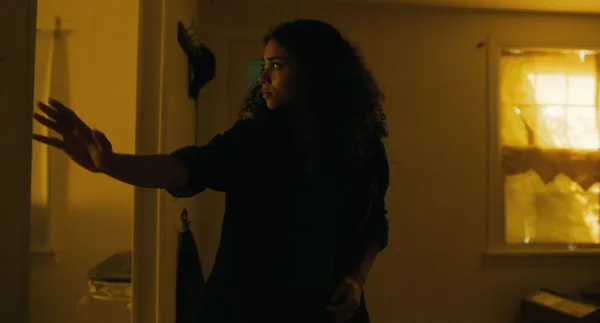
| Laëtitia Hollard as Cassandra in Trauma Or, Monsters All Photo: Fantasia International Film Festival |
Amongst genre fans, one of the most eagerly awaited titles at this year’s Fantasia International Film Festival has been Larry Fessenden’s Trauma Or, Monsters All. It follows a young writer called Cassandra (Laëtitia Hollard) who goes to stay in the town where his 2023 film Blackout was set and commences an affair with a library assistant called Agnes (Aitana Doyle). Before long she notices some strange things going on there. Adam, the lab-made man from Depraved, is living next door, and Fessenden’s own troubled character from Habit is about to pay the place a visit, looking for company. Still, the overall tone is not quite what all this might suggest.
Catching up with Larry – who is accompanied by Aitana – I put it to him that when we last spoke, around three years ago, and he told me he was planning to make a monster mash, he said that he was going to try and make it less melancholy.
He laughs. “Yes. I don't really have total control. When I make a film, I engage with the characters and I feel like, in a way, the girls brought a levity to it. But the reason it ultimately worked for me is that it's about how we all are living our own lives, and then there's a reality that's out there that may be very dark. In a way, all my movies are about this and they all acknowledge that life is filled with horror, so I don't mind.
“My favorite moment in the movie is there's a murder between the monster and – I mean, I don't have to spoil it. He throws the body on the ground and then I cut to the girls and she goes ‘Yeah. Ever since my parents divorced, things have been really hard.’ And it's just like we all have our own subjective reality. She's thinking about her little trauma, which is just, on the scale of things, just that her life was more disappointing because Christmas was no good. And yet, meanwhile, there's just been a murder in the other house with a guy who was made in a laboratory, you know?
“I'm trying to say that there's monsters among us and who's to say who is a monster and who isn't, and what is a trauma? It's just to bring to life the poignancy of existence, and within that is a invitation for all of us to be kinder to each other. So the sad reality is I make horror movies, but the horror is about the real existential horror. And yeah, like you say, it's melancholy. I had in mind that it would be about someone observing the monsters we've met in the other films, and therefore we see them as scary, but I don't think I achieved that because maybe it's not really what I want to say. I love the monsters.”
I explain that I used to work for a charity which supports trans people who are monstered by the press. People used that phrase, ‘monstered’, and there's certainly an element of that in this. Even though Cassandra doesn’t intend any harm, she's a monster to those pre-establish characters, turning them into monsters in the public imagination where maybe people overlooked them before.
“Yes, I mean, I can tell you the movie is ultimately about the conversation about identity. It's not as simple as the left says, which is that everybody is their own identity. And it's not, obviously, what the right says; that’s terrible. But it's a conversation we have to have. I have a direct thing where the trans kid says ‘I'm a monster too,’ and they have a werewolf on their arm. That's a real tattoo by a real tattoo artist who does tattoos for trans folks who are announcing their new names or whatever. But it's only one aspect. This identity thing I think has really caused great friction in society and I don't think it's resolved. So I'm more interested in thinking about that.
“Like you say, the article comes from a woman who's mixed race, so she has her issues and then she's having a dalliance with a girl but they both are like, ‘Well, that's not really me.’ The point is people want to avoid labels because they don't want to be categorised, and yet in the public sphere, everyone's given all these labels. So that's why it's called ‘Monsters All’. It's like, we're all monsters. Can't we get along? Which is a quote from Rodney King. That's where all this started. You know, he was beaten up in LA with clubs by a gang of cops. It was one of the first times something was caught on video and he was very gracious, even though he was penalised in public, and he said ‘Can't we all just get along?’ So I gave that line to Agnes because there's just an impulse to say ‘Can’t we get along?’ And the answer is no, at least in America right now.”
I ask Aitana if she felt that her character was somebody who was in the process of perhaps becoming a monster, or of being pushed into a space where people would treat her as a monster when they didn't before.
“I think that every character in this movie is dealing with some sort of identity crisis and they're all labeling each other,” she says. “Even someone like Cassandra who isn't ill-intentioned, you know, is still writing about something very black and white. But I think Agnes is uninterested in making sense of anything really, you know? They're talking about these monsters and Agnes is like, ‘Who cares?’ And I think that was a nice juxtaposition to Cassandra, who's trying to grasp and make sense of herself and also the world around her. So I think Agnes, from start to finish was there to aid that story.”
“I think Agnes has all the fun lines,” says Larry. “She says ‘Maybe they're just normal white guys, like incels or meth-heads.’ And then Cassandra is like, ‘You can't say that!’ because she’s trained herself in the woke mindset and so on. It's really a play on all of that and invites the audience to just see it for a brief moment in a movie. Like how we're policing our language, but we're crossing lines in different ways.
He turns to Aitana. “Another scene I love is the way you treat your boyfriend. It's sort of like this eye roll, and he's this sort of typical jock, you know, masculine guy, but he's so broken, and he just wants her affection, and he can see it drifting out of his control. And he's got these two goons as friends. And then there's a moment when he goes in the bathroom and cries. I remember my sound designer said ‘Why is he crying?’ And I was like, ‘You don't get it. Men also suffer, you know? And they’re so insecure.’ Of course, that's the crisis we're dealing with in America, is that the men are having a mental breakdown in public. Yeah. So anyway, I make a monster movie to enjoy these issues in sort of a metaphor.”
Aitana’s character is also younger than the other people we meet in the town, so is perhaps less affected by the trauma of what the town went through before. Does she feel that helped her to bring something else to telling us about the community through her character?
“Yeah, I think so,” she says. “Representing that sort of townie, because she is open to Cassandra, but she still is a little quite not getting it, you know what I mean? When Cassandra talks about her identity with her race, Agnes is very supportive but doesn't quite get it. I approached it from a way of, like, she doesn't think she's ever going to leave this town. I think the farthest she goes is in the library. I think reading those books and doing that job is enough. And she dyes her hair and hangs out and, you know, someone like Cassandra comes through and opens up the idea that the world is a lot bigger than that.”
“Agnes does represent the kindness,” says Larry, adding that this is the reason for her eventual fate. “But you have that other moment when you're so encouraging of the George Washington Carver book, and you're like, ‘Oh, this is so cool.’ And then Cassandra continues to seem dissatisfied, and then you go, ‘Well, maybe it's the Covid thing.’ And then you totally turn it on its head, because you're both somebody who's trying to find a solution, but you're also... I don't know. I just think that there's so much fun nuance, and you can see that I get carried away with those ideas. And then I have to remember it's supposed to be scary. But there are many types of scary in this world.”
There are, I agree. We go on to discuss how he built up the story of the town and what's happened since we were last there; likewise with the characters as well. What was it like stepping back into Sam’s shoes after 44 years?
“One of my favourite things is I still have the costumes.” He grins. “So the first kill is to see Sam in the city. He's got that same jacket. And you're like, ‘Whoa, dude, you've been wearing that jacket for 30 years? And where do you live? Do you live in a coffin or in the sewer?’ I mean, the whole thing is so absurd. But I enjoyed bringing him back and thinking about, obviously, the aging issue and the idea that he would have had to have fresh blood to really retain the youth. In other words, all the mythology about our monsters are worth digging in a little bit deeper and thinking ‘So how would that work? And then how would it not work?’ And I like that.
“It's always been a struggle in the movies. There's only a full moon one day of the month, but then it's on either side of the full moon that the werewolf, you know – that's from some books and magazines, but others, it's just the one night. But that makes movies very boring about werewolves. You can only have one. Anyway, all those things, I love that.” He turns to Aitana again. “At one point you say ‘Well actually, tomorrow's a full moon. Maybe he'll be a half werewolf tonight.’ Just always poking fun at these traditions while obviously loving them. I think it's so clear I love them.
“So the idea of Sam growing old, I sort of rationalised that, but more importantly, I did think about how for 30 years, he’s been just going on and having to find the blood and kill people and feeling regret because he still has a conscience. And then I think he slowly let go of that because it's too painful, so we find him more mischievous and nihilistic. Now he's just sort of like, ‘I want to meet these other monsters and know that I'm not alone. And then I want to do damage in this town.’
He does a bit of damage before that too, I point out, and Larry nods.
“Anyway, it was very fun. I love these characters, meaning the monsters and how they relate to their origins, which is to say Mary Shelley and all the movies and books and Guillermo del Toro and Nosferatu, and then how they fit into my world which is based in a certain social reality, and the little town we built for one movie and carried on here.”
It's interesting to see Guillermo del Toro's Frankenstein monster next to his, I venture, because everything's played down so much with Adam. But I think he's the soul of the movie, and he creates this idea that maybe there's room for some kind of redemption as well.
“One hundred percent. I mean, he's really the soul of the movie. I appreciate that. The other monsters have kind of given up. I think the werewolf says it. He says, ‘I'm done. I'm gonna go out and be myself. I don't care if I kill people.’ He's just so disappointed he can't ever get back to Sharon. And of course, now Sharon's been taken from him. I don't even know if he knows that, but there's that tragedy. And he also kills Barbara Crampton: well, what a mean thing to do. And unnecessary. So he's just given up, but Frankenstein remains steadfast, and he's the hero of the movie.
“Spoiler alert. There’s a crazy bit of music. That's the Depraved score. My composer, Will Bates, he said ‘Larry, I just had this thought.’ And he just does this saxophone like a rage cry. It makes me very happy. It's so cool.”
And poor Barbara Captain's character never even got her home improvements finished in all that time, I note.
He laughs. “Believe me, I live upstate, and that is the thing. The contractors never show up. But I love that secretly there's all these fun threads. Miguel was literally framed in Blackout as the guy who was doing the murders by the old white patriarch, and now he has taken over the business. So there are these little nuances about American life. You know, you can prosper. And of course, the immigrant story is very profound in both movies.
“I'll tell you something that's not funny at all: the Lopez was a real group of people who would come and do a garden or whatever, and they were in the movies and they were always so funny when they would see me. They’d go like, ‘Oh, the movie!’” He waves his hands. Then his expression sobers. “Well, they've all been run out of town in real life. Yeah.” He sighs. “So that's real life. I do feel that my movies are trying to capture a moment in history, hopefully so they're not bound forever to this time, but it's a reflection on how society changes, and the horror stories still are resonant through our modern fables.”
We’re running out of time, so I ask how it feels to be back at Fantasia.
Now his face lights up again. “Oh, Fantasia is fantastic. I love Mitch [Davis], of course. He makes it so personal. And last night were out at the bar and there was the director of I Saw The TV Glow and their new movie [Teenage Sex And Death At Camp Miasma]. It's such a community of people all enjoying each other, and no pretense, and this love of horror, which is such an expansive genre. We have my films, these sort of melancholy musings, and then there's just ribald madness in the next theatre and the fans taking it all in. And there's a sense of shared history because we know this genre. For the last 126 years of cinema, there's just been these amazing images. So I love coming here. I've been here since 1998, coming most years with films I produced, if not the ones I made.”
He grins. The Fantasia team is ready for us to finish so that they can prepare the next interview, but he won’t let me go without one last word of recommendation – for one of his favourite Montreal bars. “The frickles [fried pickles] are so yummy there. At McKibben's, I recommend the frickles!”