 |
| Saccharine |
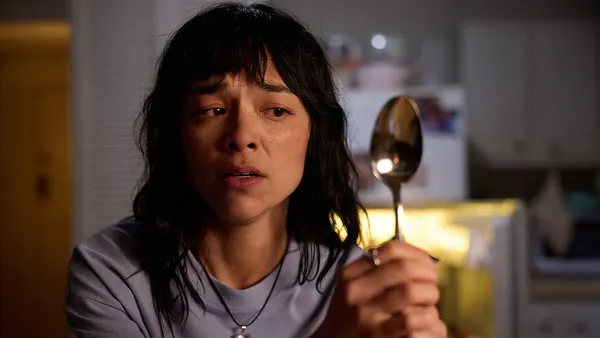
Australian-American director Natalie Erika James’ supernatural body-horror Saccharine, revolves around queer medical student Hana (Midori Francis), whose struggles with body image issues fuel her low self-esteem and self-loathing. She’s also too familiar with unrequited love. If that wasn’t enough, she falls into the cross-hairs of a sinister supernatural presence after participating in a new and obscure weight loss craze: eating human ashes.
Saccharine is James’ third feature and sees her return to indie filmmaking after her studio-produced sophomore feature Apartment 7A, a prequel to Roman Polanski’s 1968 classic Rosemary’s Baby. She began her feature filmmaking career with the family horror Relic, about an insidious presence exploiting an elderly woman with Alzheimer’s.
In conversation with Eye For Film, James discussed literary parallels between Oscar Wilde and Robert Louis Stevenson, and compared writing to an excavation and/or exorcism. She also spoke about creating juxtaposing the highs and the lows of her character’s experiences, using the visual language to take her audience along for a ride, and how Saccharine was borne out of the personal.
The following has been edited for clarity.
Paul Risker: How do you view your transformation across your three feature films?
Natalie Erika James: If I'm thinking about the shifts in what I want to do, then genre wise, my tastes are a bit broader than maybe when I originally started. I'm working on stuff that's not just in the horror genre. I’m branching out to more grounded sci-fi, and anything psychological is my kind of bag.
But in terms of a journey, it has been amazing to experience the studio world through Apartment 7A, and then just as amazing to come back to the indie world making Saccharine on home turf [Australia].
PR: A lot is made of the differences between studio and indie films. Having experienced both, what for you separates the two?
NEJ: It's the classic thing of more money and less creative control, or less money and more creative control. That’s certainly true, but just the virtue of doing the preview process with a studio film adds a whole other dimension. It’s not that you don't test screen indie films, but [on studio films] you're really having to troubleshoot things that are brought up quite early on in the post-production process. There can be some joys and discoveries in that, but it can be very restrictive as well. And it’s incredible to work on a studio scale and have all the toys to play with — it's just pros and cons, and it just depends on what the project is and what it requires.
PR: What was the genesis of the idea for Saccharine, and what compelled you to want to tell this story now?
NEJ: To some degree, I've always been writing the story in the back of my head because a lot of it was drawn from growing up with two parents who had very opposing ideas about their bodies, and how they related to food. So, growing up in that environment, it was always a discussion point for our family, and always knew I wanted to tell a story about it in some way.
The starting point had to do with how the experience of having an eating disorder can often feel like there's something outside of you that's coming in and taking control. I really wanted to use that idea of a dark presence or a dark passenger and equate that to a supernatural story or a ghost story.
In order to link those things to the character of Hana, I knew I needed something that would link to the logic of The Picture Of Dorian Gray, but instead of the painting getting older, the ghost gets larger the more that she eats. And I knew that the ash was something that had to link the two characters in this very physical way.
PR: It speaks about those private parts of ourselves, and how even if we were to open the door and let people in, those are aspects of our persona that we ourselves must ultimately reckon with.
NEJ: There is a sense that maybe she does allow herself to be fully seen by Josie, her best friend. And that is almost how she's able to potentially go on the path to healing at the end of the film. That connection and ability to let someone see the darkest parts of you, and still love you, opens the door. But certainly, at the start, it's a part of Hana that she keeps hidden, and it's that sense of enduring shame that grows in secrecy.
PR: Having spoken about the personal roots of the film, do you see filmmaking as being therapeutic?
NEJ: I also pay for therapy, so there's a separate element to that as well. But absolutely, there is a process of excavation and almost exorcism in writing a film that's very personal.
For me, like a lot of filmmakers and artists, there's nothing more exciting than starting a project and not really knowing the answer to a question. There’s the need to use the writing or the creation of something to explore that and to find the answers for yourself. So, yes, there's something compelling about that, and it can certainly be therapeutic, but I also think it's very important to have a therapist.
PR: When you say there’s a process of excavation, are you typically searching for the ending, and are your films a journey of discovery?
NEJ: The ending comes fairly early in the process. There are always discoveries that you make along the way, and of course, things can pivot a little. But generally, if I think back to something like Relic, the ending was always there from the start — it’s built into the premise. Certainly, there's always things that shift, but yes, it's pretty key for me.
PR: Given the sensitive subject of the film, how did you seek to use the visual language to communicate Hana’s ordeal?
NEJ: [...] We definitely wanted to have a sense of a shift in Hana’s perception of herself over the course of the film. So, as a general rule, we were shooting slightly longer to compress her against the space at the start of the film, just to have that sense of almost claustrophobia to begin with. Then, over the course of the film, we go slightly wider as things start to unravel.
We also wanted to convey the sense of the dopamine highs of her experience as well as the underbelly of a sickly rot — very similar to the title Saccharine. So, we definitely approached it with this idea of having these pops of colour, almost a neo-noir feeling where her inner state drives the logic behind the lighting. And then, that is paired with this sickly green sitting in the blacks, just to have a sense of grime underneath that as well. Hopefully, there are the thrills and the highs of binge-eating as well as the sense of being sluggish afterwards. That was our aim.
PR: So, the intent was always to plunge the audience into Hana’s emotional reality?
NEJ: Exactly, and even in the camera angles and extreme perceptions of her body, just to bring her subjective experience of herself into the camera’s language. It mirrors what's happening in Hana’s head and takes the audience along for the ride.
PR: Does the film lean into Jean-Paul Sartre’s idea about how “Hell is other people” and that we construct our own H ell?
NEJ: Hell is other people, but they are often mirrors of ourselves, and we experience them as such. Hana experiences that in a number of ways through projecting her desire and her aspirations onto Alanya, but also what she projects onto the cadaver, Bertha, who grows more monstrous over the course of the film through Hana’s perception of her.
PR: One of the challenges here is creating sympathy, empathy, and understanding for Hana, who doesn’t always encourage such warm feelings.
NEJ: That’s one of the reasons why the casting of the actress to play Hana was so key. Midori is such an authentically disarming presence, and because Hana’s a character that does very questionable things, we really needed someone who could carry her humanity and be able to have the audience on side. Hana is a character that tries so hard to keep things under her control, but obviously they don't go the way she intends at all.
PR: You mentioned Oscar Wilde earlier. Are there also parallels to Robert Louis Stevenson’s Doctor Jekyll And Mr Hyde through juxtaposing energies?
NEJ: Yes, and a human is very multifaceted. So, whenever we suppress parts of ourselves, it comes out in other ways, right? What you resist persists. You definitely get a sense from Hana at the start of the film that there's a lot that she's suppressing — the fact that she hasn't dated another woman and then there’s what she's not telling her parents.
PR: A strain on our mental and emotional wellbeing can feel disorientating, as though we were walking through a fog. Saccharine uses a dreamlike aesthetic to communicate this state of being.
NEJ: Your beliefs about yourself can colour your reality and can make things feel true that aren't necessarily so. Hana definitely lives in a warped reality in her own head, and then at the same time, she's someone who's very disconnected from her body. And with that comes a feeling of dissociation, which can have a dreamlike quality.
Saccharine opened in US theatres on Friday 22 May, and will premiere on Shudder in July.