





Eye For Film >> Movies >> Tin Castle (2026) Film Review


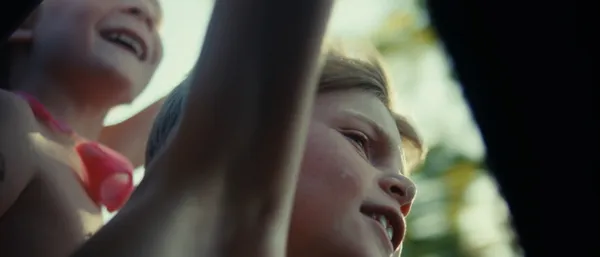

Alexander Murphy follows up last year's Goodbye Sisters with another lived in and sensitive documentary that offers a warm and humanistic insight into a family of Irish Travellers. The O’Reilly clan, described as an “Army of 12” in one of Tin Castle’s chapter intertitles, consists of mum Lisa, dad Pa and five girls and five boys, aged 16 and under. In the delightful, illustrative introduction to the film, Murphy’s camera is trained on the door of the seen-better-days static caravan where they live as members of the family come and go first thing .in the morning.
It may not be a big space – and imagining how they all find room to sleep is a head scratcher that Murphy never provides an answer to – but it’s not the interior of their home that is most important to this family. “I like living here because there’s so much space to play outside,” says one of the kids. This exterior freedom is something Murphy repeatedly captures – whether it’s the children playing hide and seek in a field, enjoying a picnic and a dip in a river or Pa or one of his older sons galloping along a road on a sulky hitched to one of their horses.
Murphy lets the family’s lives shine out without romanticising the situation and showing just how precarious the way they live is. The caravan is elderly, with repeated conversations about whether the roof will last another winter, the generator, meanwhile, is playing up (discussion of whether it might have a “Chinese yoke” provides a running joke). Pa’s mental and physical health clearly aren’t so good – he’s often captured sitting silently as the children play around him – and there’s also a possibility that he might have to do a jail stretch. For what is unclear but, in many ways, it is unimportant, it’s the fact that this would mean Lisa having to look after everything and everyone that is the biggest issue.
There’s talk of whether they might move to a house. The younger children marvel at the idea of being able to just flip electric on and off… but there’s no room for the dogs or horses. Pa notes, not unreasonably, how “stuck together” all the houses look. That freedom they value so much, constrained.
Murphy's film is also about choice, He shows how options for the family can be limited by the casual discrimination they’re up against. One boy says he couldn’t get a job if he wanted one because nobody will employ a Traveller and in one of the film’s most melancholy moments, there’s a reflection on how hard it is to keep a friend outside of the family unit. The kids are connected to everyday concerns and in formal education but they're also learning other skills. How to slip a dog off the leash to catch a rabbit at night, how to feed a younger sibling, how to throw a punch. As Clio Barnard noted after a screening of I See Buildings Fall Like Lightning, which also screens in Cannes Directors’ Fortnight and would make a great double bill with this film, “Joy is an act of resistance”. In Tin Castle, joy is also home.
Reviewed on: 20 May 2026


