 |
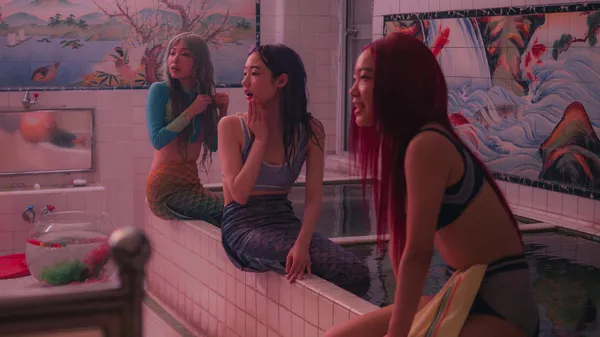
| Titanic Ocean Photo: Festival de Cannes |
Greek director Konstantina Kotzamani dives into the world of teenage hormones inside a Japanese boarding school which aims to train its young recruits to be professional mermaids, donning tails and training in aquatic acrobatics in order to get jobs entertaining the crowds at aquariums. Among the hopefuls is Akame (Arisa Sasaki) – aka Deep Sea. Like all the girls at the school, the mermaid persona is an opportunity to shape and choose a fantasy identity, including a song, something that Kotzamani emphasises through the film as the everyday brushes up against magic realism, drawing on mermaid myth as well as the school’s concrete reality. We caught up with Kotzmani in Cannes, where the film had its premiere in Un Certain Regard, to talk about the themes and shooting style.
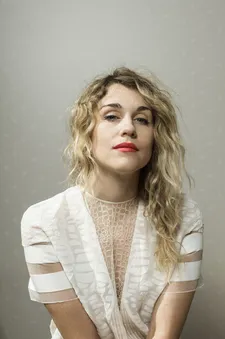 |
| Konstantina Kotzamani Photo: Semaine de la Critique |
How did you come across this mermaid subculture?
Konstantina Kotzamani:I started writing the film 10 years ago and it started really from an article. I was in Argentina then shooting another film and I saw a photo with five Japanese girls in mermaid suits and I thought, what is that? And then digging on the internet and finding interviews, I came across this really fancy but at the same time, surreal world of the mermaids. What really struck me was the fantasy part. These girls had dual identities – themselves and their mermaid identity, with the nickname, the coloured hair and a different life that they felt was safe. It may be manufactured but for them, it felt safe. So, I felt that it's a nice way to talk about the girls today and how there is this double world in our minds. There is an artificial world of image and what is created for us and the world that we really feel. So it was a symbol and a vessel.
Then, of course, it was enriched with the Greek myth of the sirens from mythology. Sirens are supposed to be mythical creatures that have this amazing voice which can be also destructive and it can bring people to their knees. So I thought it was nice to speak about how you find your voice as a girl.
Speaking about the girls’ mermaid identities, was it fun to craft all of them – to choose the names and the hair colour? – how did you go about that?
KK: This was a very fun part. It's a very seductive world. I know that is the dark part, but also there's a seductive part. That was what I was most enjoying, adding parts of myself to, let’s say, five different characters. It was a very nice process. When I was a young girl, I had an anime which I really loved. It was called Candy Candy. It was a Japanese one and it showed a girl in an orphanage school and she has her friends, her enemies and also there’s the director of the school. I kept this environment somehow, of this very girly and very emotional and intimate anime in another context of the mermaid school.
The main character, Deep Sea, has purple hair, was there a reason you picked that?
KK: I really love crystals and colours and, for me, purple is, in the hierarchy of the frequencies of the colours, a higher one and it’s related to the higher chakra of our head, which is kind of the most spiritual colour. It's the most dangerous but also it's the one that leads you to spiritual freedom. It’s related to the higher part of ourselves so it can be destructive but also it can be the one that leads you to the transcendental.
How did you go about casting because your stars need a very athletic skill set?
KK: I cast girls who were professional mermaids but all the professional mermaids were a bit older and I wanted to to have most of the girls from 15 to 18. I started casting dancers, I cast girls who were doing a lot of sports – one of the girl was working as a stunt stand-in in action movies. I cast girls who are very close to their bodies and were not afraid of the water – Eternal Sunset is a surfer.
When we finalised the casting, of course, we had a test with them in the pool in order to be sure that they're not afraid of the water. Then we started five months of very intense training and I was there with them. I really love water. I'm a diver and I was there. The girls were five months in the water before we started the film.
In the case of Deep Sea, she also has a prop, a jellyfish that she swims with. That can’t have been easy to learn to work with?
No, it was very hard. I think after the film I think she had to sleep for a month. It was really exhausting for her.The girls worked really hard, especially Arisa, she gave herself to the film and it was her first big film. She was acting and she had done another film. But in a minor part. When I saw her, I immediately felt she was the girl. She has something unique. She has these witchy eyes and she can be a witch and so innocent at the same time.
Arisa had this thing that she could get lost [in the character]. Japanese actors are very precise, they work a lot, they are amazing actors, but they are really afraid of getting lost. I mean, they hate improvising. They want to know everything – every detail and in what second they do it. Every take is exactly the same as each other in the editing room. Arisa, from the beginning, was very open to getting lost and I think this is the core of her characters. She transforms and she’s not afraid of losing control.
Can you talk about the wonderful production design, you use a lot of blues and pinks so that they almost seem as though they’re underwater even when they’re not?
KK: With DP Raphaël Vandenbussche and production designer Sebastian Vogler we worked a triangle collaboration because we used a lot of props in order to give light. Raphaël did not like to use big lights so we used props in order for it to feel sensual with the characters. One of my favourite visual references was vaporwave, which I also followed in music and in visuals that use a lot of cyan and purple and pink, but in a way that it feels like very nostalgic and very postmodern. These colours are very soft and very, let's say, naive in a way, but vaporwave uses them in a way that is very dark and very nostalgic, and it feels more like the end of the world. You have neon things and beautiful stuff but it feels so alone and so dangerous and unsettling in a way and we had that in mind.
Did you feel that coming from outside the Japanese culture made making this film easier as you were looking at it with a curiosity you might not have had if you were within it?
KK: I think that if he was born in that culture, I wouldn't make it as I know I don't do things in Greece because sometimes it's easier to connect to something that is further away than to see a mirror of ourselves. This film was really like a journey for me in so many ways. In terms of the difficulty for me, in terms of the healing process and how long it took – 10 years. I’m happy that it’s done and it’s here. It’s as if something really long and difficult found a bright end point.
Can you tell us a bit about the choosing the music for the film, because every girl has their song so that much have involved a lot of rights management?
KK: There were many things that were cut because the first edit of the film was six hours. Every girl had her song. It was a long process to find the songs for every girl and take them and the rights. We didn’t use it all in the end. I worked with a French music supervisor, Thibault DeboaisneThibault Deboaisne, and he was really good and really helpful, also suggesting songs that could be more easily acquired. For Akame, the song was very connected to her hair and her Deep Sea name and all these ocean feelings. I also chose The End of The World from the beginning. It's really one of my favourite songs and it speaks about the end of the world, which is a theme that recurs in the film. Yokohama Blue’s I found in the process. When I was in Japan, I was in a karaoke bar with some Japanese collaborators and and they put on Blue Light Yokohama by Saori Yuki and I completely fell in love with her and I started listening to her songs and I have two other songs in the film that somehow connect with Saori Yuki, a Japanese singer from the Sixties with an amazing voice.
What will your next project be?
KK: I want to make a series in Greece. It’s kind of Twin Peaks on a Greek island. We might do a collage of different Islands, it depends. I really want to shoot on an island called Nisyros because it has a volcano. I want to make it like a desert volcano there but have strange things happen. And I have two feature films that I was developing while I was waiting for Titanic Ocean to be shot. Then I want a holiday, I finished two weeks ago and I want to watch films and read books.