





Eye For Film >> Movies >> Cecile Is Dead (1944) Film Review


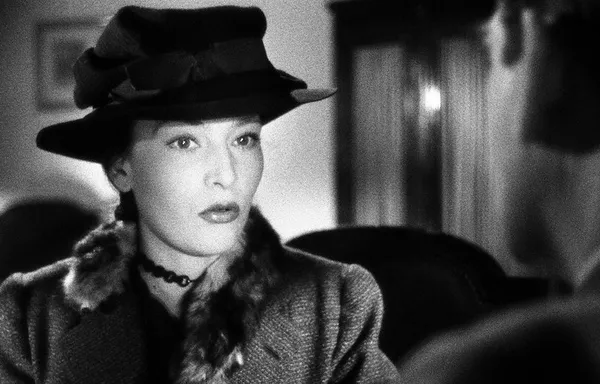

Cecile Is Dead (Cécile Est Morte) is something of a bitty film. It was shot in early 1944 and screened on the eighth of March, three months before the D-Day landings, making it one of the last films released by the Nazi-operated Continental Films. It adapts one of Georges Simenon's many Maigret detective novels, Cécile Est Morte, into something between a who done it and a comedy.
The dialogue is fast paced and focused on comedy and plot exposition rather than character development. Contrasting this are a number of long slow curving pans. These intricately constructed shots, along with Maurice Tourneur's use of depth of field and photographic arrangements of characters, are more than the script deserves. The plot is, to say the least, contrived, in a couple of places it makes little sense but there are incidental characters that insert little nodules of realism into the film.

Kicking off Cecile Is Dead, the soon to be deceased Cecile (Santa Relli) arrives at detective Maigret's police station. There is much banter amongst the police in the building about how she must be in love with Maigret (Albert Préjean); she visits him often to complain about strange goings on in her aunt's house. After taking her statement about furniture mysteriously moving in the night, Maigret heads off to arrest some counterfeiters.
Cecile returns home to her disabled aunt Madame Boynet (Germaine Kerjean). She is in fact not disabled and is just exploiting Cecile, demanding care that isn't needed. Her brother Gérard's (André Reybaz) wife is about to give birth. He needs her to persuade Boynet to give him some money. Though never explicitly stated in the film, the economic state of France in 1944 is dire. Boynet refuses him, making him a prime suspect in what is to come.
As Maigret and his colleagues travel on a raised section of the Paris Metro they spy, through an open window, a half naked woman lying on a bed. There is some more banter. They arrive at an apartment building and start enquiring about a woman rather than the counterfeiters. For no discernible reason, other than to push the plot along, they have alighted the train and are now investigating the woman that they saw. This is a pretty big clunk in the plot. It's like your bookmark fell out and has been put back in the wrong place. Have you just missed an entire chapter? On gaining access to her apartment they find her dead, beheaded. Maigret turns on the hot tap. In the mirror above the washbasin a name magically appears: Cecile. It turns out that the apartment block also houses Cecile, her aunt, and a creepy man who Maigret met earlier at the police station Charles Dandurand (Jean Brochard). He is dressed up in the black cliché of villainy: Van Dyke beard, beady glasses and cigarette pipe.
There is much toing and froing to come. Madame Boynet is murdered in her bed, Dandurand is shot and Cecile is found dead inside a closet in the police station. When all is eventually revealed it will not pay to think too much about the timeline or the plausibility of the explanation.
The narrative structure is entirely linear. This is a problem in that it places the hook, Cecile being killed in the police station under the noses of the cops, at a third or more into the film. That's the mystery, the bait, that the audience has to bite in order that they then swallow the ridiculous plot.
If you can suspend disbelief then the film does have things to offer. The comedy is quick, funny and often well observed. The actors are all quite capable of delivering it at pace. Their performances can seem rushed and there may well be technical reasons for that. Many things in wartime France were in short supply, that included film stock. As a matter of economy, some of Cecile Is Dead would have been shot on short ends (leftover stock of limited length). The actors may actually have been on a timer.
Maurice Tourneur and Pierre Montazel's cinematography is the standout in the film. The deep depth of field used in the interiors combined with superbly realistic set dressing and the and the often visited claustrophobic stairwell of the apartment building give it a distinctive look. And then there are the long slow pans. They are not just suspenseful. Tourneur uses them to shift time and move actors around the set.
Reviewed on: 21 May 2026