 |
| Palfi: 'It’s harder to make a movie outside of my country but we proved we can do it' |
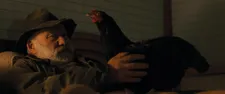
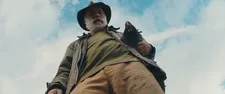
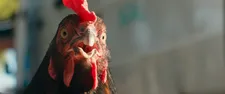
With Hen, György Pálfi and his co-writer and Zsófia Ruttkay take a fable-like approach to the story of their plucky chicken protagonist, whose own quest to lay eggs and raise a family becomes mixed up with a story of people smuggling. This bird’s eye view story – released by Conic in the UK this week – is frequently observed from near ground level as one little black hen escapes a factory and finds herself rescued, quite literally, from the jaws of death by elderly restaurateur Giorgos (Yannis Kokiasmenos), whose eatery business is shut up. Instead, the unpleasant partner (Argyris Pandazaras) of his daughter (Maria Diakopanayotou) is running a smuggling operation, which is about to scale up from white goods and cigarettes to humans.
As the grim human drama unfolds, and between make-out sessions to an a capella version of Ravel’s Bolero, the hen has a ringside seat for man’s inhumanity to man. Pálfi and Ruttkay, who are also life partners, are in an upbeat mood when I speak to them over Zoom as it’s the day after Victor Orban was voted out of power in Hungary. Given that the reason Hen was set in Greece is because the pair were unable to make anything in his home country due to the political situation, it’s no wonder they’re celebrating.
 |
| Palfi: 'We had a lot of technical assistance and we used a periscope lens' |
“We are very happy,” says Pálfi, beaming. “Until yesterday, I couldn't imagine that it could happen. All of the power was in one man’s hands and I never imagined he will say one day, ‘I lost this election’. Oh, that was a great moment yesterday. I’m very suspicious and I’m looking for the trap.”
Ruttkay agrees: “It’s hard to believe but I hope it will be promising.”
If the regime change has come too late for hen to be set in Hungary, the story, about smuggling people into Europe, has found a perfect setting in Greece, which has become known as a destination for desperate refugees trying to escape conflict, despotic regimes and poverty.
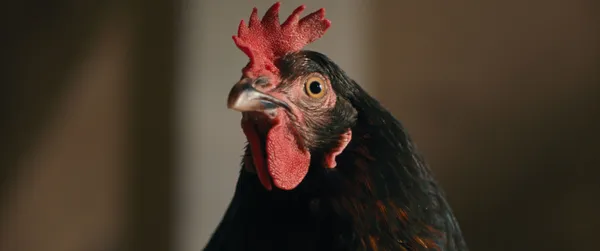
The hen is such a character, perhaps because she’s played by a whole roster of birds. It’s one thing to cast humans, but how do you work out a pecking order for chickens?
“First we needed to find out the type of chicken,” says Pálfi, “Because, in the script, we knew this is an industrial type of chicken and when we knew we were shooting movie in Greece, we just went into the factory and we saw they use white chickens, a type of leghorn. We also knew, scriptwise, she is a black one, an australorp type, so I went to the trainer and I told him I needed australorp chickens and he found them. He found more than 15 chickens and he started to educate them – and educating means a safe environment, checking the abilities of the chickens and that time they started to choose with this kind of casting, They chose eight chickens from the 15. And these eight chickens became the actors or actresses of the movie, and the eight chickens are playing one character.”
That made things a little easier when it came to the shoot since, inevitably, some chickens are better at jumping or sitting still than others. It was also their goal to keep themselves down at eye level with the hen when she is observing events.
“We had a lot of technical assistance and we used a periscope lens. We tried a lot of solutions but that was the best. so it's uh we will just stay so Lance with the Periscope lens. Yeah, and we tried a lot of different kinds of solutions, but that was the best solution because it can be very near the ground. We had thought about digging holes for the camera but that was the decision.” Technical solutions were also needed when it came to shooting a key scenes with a fox and with a dog, both of which are quite partial to takeaway chicken.
“We couldn’t use the same frame with the dog and the chicken, so we needed to shoot for the dog and after we needed to shoot, with a locked camera, the chicken and then split the frame so it looks like they are together in the same frame.”
In the case of the fox, even more care was required.
 |
| Palfi: 'I think it came from our gut' |
“We worked differently,” says Pálfi, because the fox is a wild animal and he was in an open space, which is dangerous for him. So the fox was on a leash and the animal trainer was always next to him, and then afterwards with CGI we deleted the leash and the animal trainer from the frame. We could shoot the chicken and the fox together because the fox was on a leash so he could never be dangerously close.”
That certainly adds a level of verisimilitude when it comes to the animals’ reactions.
Ruttkay adds: “It was very important to have the real reactions towards each other.”
The film blends quite a lot of humour in with the tragedy of the people smuggling in the human world, but the balance, the pair say wasn’t too hard to strike.
“If you are Eastern European, you’re born like that, I think,” says Ruttkay. “You need this ability to have that humour and have the darkness at the same time because otherwise, you cannot survive here.”
Pálfi agrees: “Yeah, the dark is pain, but you are laughing because you cannot do anything else, if you would like to survive it, so I think it came from our gut”
For scenes as the hen escaped the factory, they needed to go into a real-life spot, which required “knowing someone who knows someone who knows someone who has relatives who have a chicken farm”.
Shooting in Greece was not without its challenges, though.
“The Greek culture is very close to ours but also different,” says Pálfi. “It's sometimes very hard to understand why they are doing something or not because our culture is different.”
He adds: “There were a lot of surprises because of the different culture. We lived there for one year before the shoot, and we tried to learn this kind of culture but if you didn’t grow up in this culture, it’s just a rapid study not a deep one. So sometimes we met surprises but we enjoyed it. It’s harder to make a movie outside of my country but we proved we can do it.”
But did being outsiders themselves lend itself to having the outsider perspective?
Ruttkay says: “That was good for us because the chicken’s perspective is very different from the human one, so our perspective was closer to the chicken. Maybe that helped a lot as well.”
In terms of the smuggling element of the film, they had an advisor. “She gave us a lot of advice and a lot of things to read and see.”
Beyond the famous music in the film, which also includes some Khachaturian, they also weave in Greek romantic songs, but the scoring from Szabolcs Szõke is also full of character, giving the animals a similar among of personality to the likes of Prokofiev’s Peter And The Wolf.
 |
| Hen |
Speaking about the composer, Pálfi says, “It’s a very funny story because we tried a lot of kinds of music for the movie and no one worked well. I was in despair. And I found a solution – I’m not going to look for good music, I need to look for a good person, a character who can join us and write his own music for it. So I made a casting – not a music casting – I made a casting of the music composer, and I found this very wise old man who comes from theatre, but he is a very talented and brilliant musician who, at the same time, has a dramatic sensibility. I started to believe him but until he recorded the music, I couldn’t get any music from him. He just promised me and said he would go to the studio with the musicians. It’s a lot of money so the producers are asking, ‘What kind of music?’ I told the producer, ‘I don’t know but I trust this guy. He will do good music’ and I think he did.
Now it’s “their dream” to be able to make films back in Hungary again, and they’re not planning to stop with their brave little hen, as they have a trilogy of animal films planned.
“I already wrote the second part, which is The Monkey,” says Ruttkay. “It will be harder to train and then with that, we will need to use CGI, so it will be a bit wider and harder than Hen.
“It’s the next level,” says Pálfi.
And that’s not the only project they have planned. Ruttkay adds: “Because of the political changes, we have some hope to make something in Hungary maybe. We already have a script. It's a very funny and dark tragicomedy Western, but Eastern, and a Faust kind of story.”
That film will involve a dog but as for that third part of the trilogy, we’ll all have to wait to find out what animal that will involve. “It’s a secret,” says Pálfi.
Hen is released by Conic in the UK on May 22.