 |
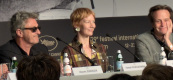
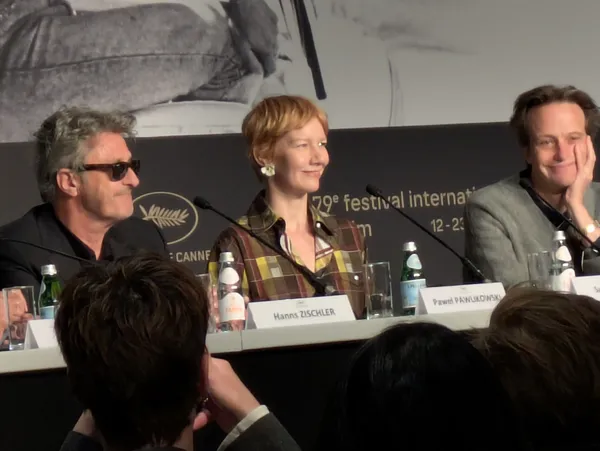
| Pawel Pawlikowski, Sandra Hüller and August Diehl discuss Fatherland in Cannes Photo: Amber Wilkinson |
Pawel Pawlikowski has returned to Cannes Film Festival this week, with another magnificent monochrome film, after Ida and Cold War, which won the Best Director’s gong at the festival in 2018. This time out the focus is on German Death In Venice author Thomas Mann (Hanns Zischler) and his relationship with his homeland and his family. It focuses on a period in 1949 in which Mann and his daughter Erika (Sandra Hüller, on great form as usual) return from America to what is now a divided homeland, first travelling to Frankfurt in the West to receive the Goethe Prize, before going on the Weimar in the East of the country, where Goethe lived for some years. The journey is rocked by tragedy, reacted to very differently by dad and daughter, although Mann slowly builds a crescendo of shared emotion.
Speaking at a press conference at the festival, which he attended alongside the chief members of his cast, including August Diehl, who plays Erika’s brother Klaus, the director was asked why it had taken eight years to make a follow-up to Cold War.
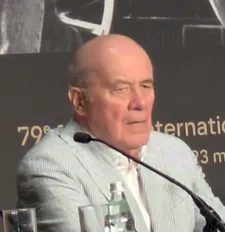 |
| Hanns Zischler in Cannes Photo: Amber Wilkinson |
Pawlikowski said: “It's always hard to find the subjects that you really want to spend three years of your life with, but there was also the problem of the pandemic where everything stopped. Then I had a project I was developing for three years, which collapsed two weeks before the filming started – it was called The Island – because of the actor's strike in the States.”
He said he takes a long time to “get going” with a project and added: “This Thomas Mann thing came because I was sent a biography of Thomas Mann written by Colm Toibin. The company Nine Hours asked me if I could do a film of it and I said, ‘God forbid, it’s a biography and I don’t want to do biopics or anything like that’.
“But then, having thought about it, I thought there was one interesting moment in this story – Thomas Mann's return to Germany in 1949 which seemed like a good context for a film especially given the things that happened in the Mann family. The love triangle with Klaus, Erika and Thomas kind of coincided with this amazing moment in history. So I thought maybe that, could be an interesting film – not a historical reconstruction, but if we can abstract everything away and focus on the three characters and the moment and reduce what was a complicated, long journey to the simplicity of a road movie, a little bit, like Ida, five days on the road. That would give us a chance to make something condensed, cinematic, not retelling stuff that really happened, but something that has its inner power, and it's a family story in an incredible historical context as well, which is always something that I like doing. I'm telling history through people, through relationships.”
Some latitude has been taken with the story, in that when Mann took the trip he was actually accompanied by his wife Katia but Pawlikowski she wasn’t “dramatically so interesting” as Mann’s daughter Erika. He was able to add in additional characters, including Erika’s ex-husband actor Gustaf Gründgens (Joachim Meyerhoff), the inspiration for Klaus’s book Mephisto (which went on to become a film hit adaptation by István Szabó) and the grandsons of Richard Wagner.
The director added: “Once you throw things in and start adding, eliminating, condensing, you end up with something. That's very rich for a human level or historical level.”
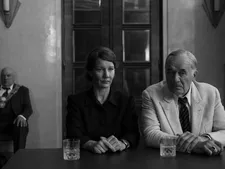 |
| Sandra Hüller and Hanns Zischler in Fatherland Photo: Festival de Cannes |
He says it is probably the quickest project he ever developed taking a year to a year and a half. Among the themes of the film are grief and the German concept of “heimat”, which is more complex than simply a home and refers to the place you’re from as well as a feeling of belonging.
Hüller is continuing to cast a spell on the awards circuit, most recently winning the acting award in Berlin for period drama Rose earlier this year.
She said that although she didn’t know anyone in the Mann family, that her co-star Zischler was “a very generous source of information”. She added: “Whenever there was a relationship question between the two, I could generally ask him.”
She also admitted that she didn’t know much about Erika Mann but found her character intriguing because she was a writer and actor and spoke many languages.
She added: “She really was a citizen of the world.”
The star said that all of this gave her plenty to work on but that the cast and crew also found elements of the character together. “This is a true collaboration,” she said. “That we have negotiated a lot of other things on set. Pawel helped us to be in this very focused way of acting because this frame requires a certain space that you have to be in. And in that space you find a little bit of freedom. I had a wonderful week and beautiful costumes.”
Diehl said: “You have a responsibility when you play characters that actually really existed in the real world.” He said he read his books in the beginning but that it was then “a very fast process to go away from this because we're not doing a documentary or even a biopic.”
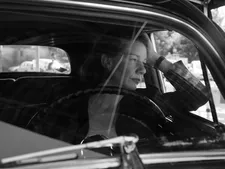 |
| Sandra Hüller as Erika Mann in Fatherland Photo: Festival de Cannes |
He added: “I’m not really interested in imitations of a real thing but more acting and acting’s something different. I appreciated very much that I was invited into a search, rather than, ‘We have to have this and that’. It was a dialogue.”
As for Zischler, he says: “It was a very strange experience to follow a person whom I knew by reading and by listening to him for a long, long time. And what could be taken from it is the general attitude he developed through his life. He was a conservative in the very beginning. He changed his mind and he had to change his mind during immigration and then he was confronted with something and even catastrophic when he returned. So this means that this man had to develop or invent an attitude of his own and without being biographically exact it was the lesson this person gives throughout his life. It was astonishing for me to follow and be directed in that way, how he managed to be polite, sober, not always very helpful and to accomplish a mission which might look cruel, but he has no choice.”