





Eye For Film >> Movies >> Raging (2025) Film Review


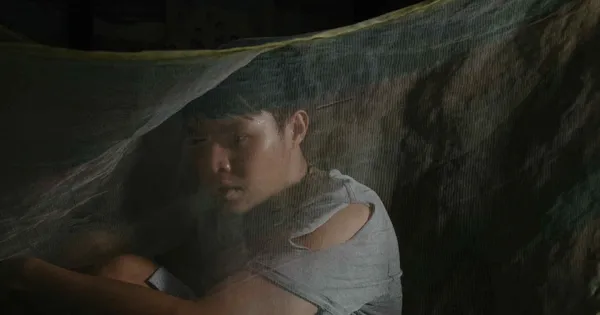

In Ryan Machado’s third feature, most of the raging takes place beneath the subdued exterior of Eli, played with aching inwardness by Elijah Canlas. Set on Sibuyan Island in the Philippines in the 1990s, Raging follows this young man who has been recording audio journals on his Walkman, using the tapes to process what he cannot say aloud. When the device goes missing, so does the fragile record of his attempt to recover. From the outset, it is clear that Eli is trying to survive a recent traumatic experience, one that Machado reveals only in brief, economical flashes. These fragments create a sense of dread, as though the film is moving toward a confirmation the viewer already fears.
The island around Eli is lush, humid and seemingly idyllic, but this beauty is never allowed to settle into postcard imagery. Early on, Eli witnesses what appears to be a small plane crash and tries to report it to the local authorities, only to be dismissed or disbelieved. That sense of not being heard becomes one of the drama’s central tensions. Eli’s reality, whether shaped by trauma, memory or simple fact, keeps meeting a world unwilling to receive it.

His closest companion is Jepoy (Reynald Raissel Santos), a fiercely expressive presence who fills the emotional space Eli cannot. Their search for Eli’s lost Walkman, containing tapes about his trauma and his attempt to recover from it, gives the narrative its loosest thread. Jepoy is also one of the work’s most quietly significant figures: an effeminate young man who appears comfortable in his body, even as others mark that body as a target. When a group of boys taunt him with the line, “Shut up or I’ll get you pregnant,” the cruelty lands casually, which makes it sting more. Without turning Jepoy into a symbol, Machado gestures toward the social position of the bakla in the Philippines, a term often used for effeminate gay men or gender-nonconforming people, though its meanings are broader and culturally specific.
Around these intimate struggles, Raging also sketches a wider world of extraction. People work in the mines, not because the island’s natural abundance has spared them hardship, but because it has been made profitable by forces larger than them. The damage is environmental, but also psychic and social. Machado does not underline this point heavily. Instead, the mines sit in the background like another wound, another form of violence absorbed into ordinary life.
Theo Lozada’s cinematography is crucial to the drama’s effect. The camera often keeps Eli at a distance, framing him within forests, rooms, beds, mosquito nets and empty spaces that seem to press against him. The images mirror his reticence and inhibition, allowing the atmosphere to thicken around what remains unspoken. The humidity feels almost emotional.
Raging will not satisfy viewers looking for conventional momentum or overt dramatic release. Its power lies elsewhere. This is a work of restraint, withheld expression and accumulated ache. Machado avoids both signposting and fetishizing trauma, trusting silence, texture and mood to do the work. The result is quietly heart-wrenching, lingering less as a sequence of events than as a residue of feeling.
Reviewed on: 10 May 2026