 |
| Body Blow Photo: Fantastic Fest |
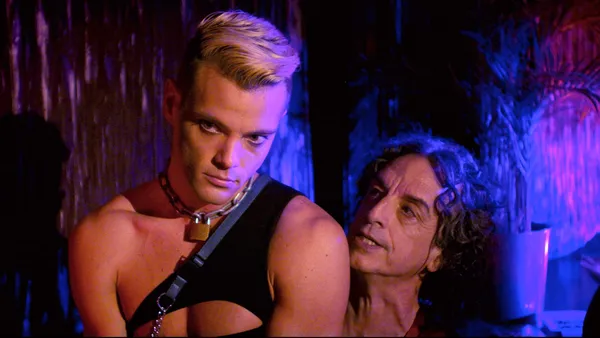
Although it tends to concentrate on more obvious genre fare, Fantastic Fest has always had room for films that are, well, fantastic on their own terms This year that includes Body Blow, a thriller charting the affair between Aiden, a gay police officer who is trying to get a grip on his sexual desires, and Cody, a young sex worker with some dangerous connections – not to mention big ambitions. One the eve of it première I met its director, Dean Francis, who summed it up himself.
“Body Blow is a kind of dark, neon noir. It's set in the underworld of Sydney's gay and nightclub culture, and it comes from a collection of local experiences in Sydney, partly based on a true story, believe it or not. And for me, it really comes out of my passion for the erotic thrillers of the Eighties and Nineties, which I grew up watching, and the idea that these were films that explored sexuality in an often fairly intense way, but of course, they were always heterosexual narratives. I wanted to take that same treatment of erotic thrillers and put it into more of a queer perspective and set it locally in Sydney.”
I tell him that I’ve recently spoken with a few directors interested in bringing back the erotic thriller, going back to Joe Lynch on 2023’s Suitable Flesh and most recent including Neil Marshall’s female-focused Compulsion, both of which deal with queer passion. When taboos first started to be able to break down and serious funding started to be available for queer films, a lot of things were in many ways more similar to heterosexual stories. But there are so many queer stories that remain to be told, and this one has a lot about it that's specific to queer culture. We're now looking at that wealth of stories that can be told. Does that excite him as a filmmaker?
“Oh, absolutely. I mean, I said to my producers when we finished the shoot, ‘This is so much fun. I want to do every genre as a queer show’ – because, like you say, all of those narrative tropes of more mainstream cinema are rooted in really fixed ideas of masculinity and femininity. I think when you break that apart, you open up a whole lot of other really interesting possibilities for what characters can do. And I mean, queer cinema is evolving really quickly, and it's really interesting to see a little bit of a return to older tropes being reinvigorated through a queer lens.”
The film opens with the cop, Aiden, listening to a motivational speaker talk about the mystical power of semen as he works out. It gives us quite a different impression from the one we get when we learn more about him and discover that he’s desperately trying to change his behaviour.
“We really wanted to explore two ideas, really. Addiction. Addiction to online gurus, addiction to sex. But also the idea of repression and the idea that there is this struggle in the character between who his essential self is and what the expectations are that are placed on him by his job and his surroundings. And a really interesting volcanic tension that's building inside him is, of course, what propels into his downfall. That's something that, as a gay man, I very much relate to.
“It came from actually meeting gay cops in the context of Sydney Mardi Gras, which is an annual big Pride event. Unfortunately, there was a lot of violence against the gay community by cops, so when I was speaking to the, especially plainclothes officers, it was that question of what is that kind of like to be on both sides simultaneously, and how do you cope with that? Ultimately the question arose: who's the ultimate antagonist for a sex addicted gay cop? And of course, it's the most dangerous homme fatal in the world, which is our twink in the movie.”
Their first sexual encounter gives the impression that the only way that Aiden can engage sexually is to approach it as a cop rather than just being himself.
“Yeah, absolutely. That was a really interesting scene to do because a lot of the erotic tension comes from the power imbalance between them and the fact that he is a cop and that he's got a gun. But that is the erotic driver for both of the characters. And of course, getting that balance right, and making it really clear that it's not” – he hesitates – “well, I mean, it is an abusive situation, but there is mutual consent and passion there. And, of course, it unlocks this relationship that takes on a whole lot of depth as Aiden comes to terms with everything.”
People are probably going to hear about the film and think of it as very sexual, but the sex in it is not very explicit. It's more emotional in focus.
“I think it was really important that the sex in the film was driving the story forward and driving the connection of the characters,” he says. “We didn't want it to be explicit for explicit’s sake. I think. I think there's another thing too, that, of course, since those erotic Nineties movies, censorship of the film industry and DVD releases has become even more conservative.
“Always this struggle is a pendulum that swings both ways. We did a film a couple years ago which did have much more explicit sex scenes in it, and we found that a real obstacle in terms of getting audiences to it, which is disappointing. But when it came to doing this one, I felt like seeing the really explicit nitty gritty of what the bodies are doing is not really the most important thing. We wanted to focus in on the emotional exchange of those sexual encounters, and hopefully bring this to a wider audience than just a queer audience. Obviously, Fantastic Fest has a very diverse audience, so that was a choice right from the start, I think.”
Talking about Cody as an homme fatal is interesting because usually femme fatales are older and more experienced. He is naïve and frankly scatterbrained some of the time, but he still has that power to drive the plot.
“Yeah. I mean, Cody is someone who's grown up in that nightclub culture, kind of on the streets. And while he's younger and in many respects a little bit more naïve, he's also got this depth of experience within that world of sex work. And he obviously has more knowledge of what's going on behind the scenes than Aiden. Aiden himself is actually quite a sheltered and naïve character. Again, it came from that idea that, like, what is going to be the most destructive force for a cop who is in that crisis of masculinity and in that dilemma about who he is? It's that struggle between what you desire and what you should do.
“Cody is designed as the real antithesis of Aiden in all sorts of respects. And of course, Tom Rodgers, who plays Cody, who I think is just a stunning young actor, really brought a lot of ideas to that. The really distinctive styling of the character evolved with a lot of Tom's creativity. I think the thing about him is that he's sexy, he's funny, you never know what's going on under the surface of him. It creates a real fun tension that hopefully amuses us as we see the characters contribute to one another's downfall.”
We talk about the visual side of the film, which makes a powerful impression.
“We were really inspired by a lot of those Nineties films,” he says. “Ken Russell's Crimes Of Passion was a huge reference with those really strong, stark colours. And also, I think, the tone of that film just being ever so slightly heightened while still hopefully holding onto some emotional depth. So we wanted to create a measured visual style. Our intent was to really keep the camera moving in that Brian De Palma kind of fluid way. And of course, really treat these streets like stages and create a sort of heightened world within the world. There's a really strong delineation. The whole film is, of course, about opposites and juxtapositions.
“Aiden is this boy from the suburbs who is thrown into this dark and dingy inner city world. His suburban life, in contrast, is very monochromatic and very bland. He lives on the very outer fringes of suburbia, and then when we go into the city, there's this vibrant, pulsing, over the top neon world where we've got a little bit more camera movement and excitement and energy.”
There’s a strong contrast between the scenes in the shadows and the glamorous, brightly lit world of the club ruled over by Cody’s pimp, Fat Frankie.
“Oh, absolutely. I mean, I think something that we often see in queer films is this kind of reluctance to have evil queer characters, which would be good. And, of course, all of our characters are gay, and all of them are somewhat morally compromised. And so that club is this kind of beautiful stage for all of these different things happening simultaneously.
“The location we shot at is the very famous Stonewall Hotel in Sydney, and we hardly changed a thing. That is the vibe of the place. It's got this kind of richness and it's got history on the walls. There's always flamboyance. There's always something going on in terms of performative expression of identity. So just to come into that world and make that the headquarters for the evil Fat Frankie was so much fun to do.
“I know it's a very heightened film narrative, but it's based on stuff that has happened. Aiden would by no means be the first guy to have sex in that particular alley. Like I say, the club is very much the club. Of course, one thing we also wanted to explore was – going back to this tension between LGBT identity and the police – that Sydney has got a really dark history of police violence and brutality. Steele, in the film, hints at this. And of course, Samson Steele is very loosely based on a real cop in Sydney who was charged with murder ultimately. So there's a lot going on.
“When we portray Sydney as filmmakers, it tends to be this quite glamourised sort of place, and I really wanted us to see a different view and really see it through that film noir, Gotham kind of lens. And, you know, Sydney's got so much going on visually that you literally just need to point the camera at it and you get this incredible atmosphere out of it.”
The future is already looking bright for the film.
“We're very excited to be releasing it in quite a few different countries in theatres. A lot of that is underway, and we are taking it to some other film festivals in America and in Europe, coming up in the next few months. We're doing the Munich Queer Film Festival and Outshine in Miami, and a couple of others.”
He’s happy to be at Fantastic Fest as a viewer, too.
“Oh my God, there's so much great stuff. I'm very excited to see The Restoration At Grayson Manor because that premise sounds absolutely off its face and totally up my alley. It's great to see some other queer films in the festival - and, of course, Deathstalker, which looks super hot and a lot of fun.”
It’s difficult to imagine him being disappointed in either case, but Body Blow is definitely one worth looking out for.