





Eye For Film >> Movies >> The Tasters (2025) Film Review



It’s fairly common knowledge that in the final years of his life, as armies closed in on Germany from east and west, Adolf Hitler grew increasingly paranoid and became convinced that people in his inner circles were plotting to kill him. Less well known is what he did about it. The full story emerged only a few years ago, when then 95-year old Margot Wölk shared her story. Silvio Soldini’s fictional film is closely based on her account.
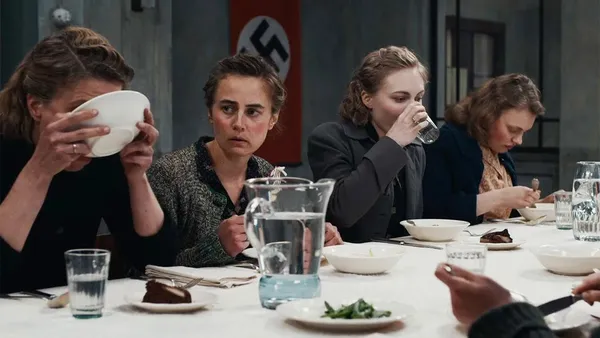
We follow Rosa (Elisa Schlott), who has fled the city to stay in a village with her husband’s parents at his suggestion. He’s away fighting at the front, but has heard about the cities running out of food and thinks she will be better off up in the hills. What he doesn’t know is that Hitler has built his secret headquarters in the nearby woods. Being a healthy young woman (aside from the damage done by going hungry), Rosa is recruited and forced to join a group of women whose task is to sample everything that the führer will be eating.

On the one hand, it’s thrilling to be presented with three meals a day – and cooked by a highly acclaimed chef, at that. On the other, they know that, at any one of these meals, one of them – or several – could die. When her in-laws find out what’s happening, they beg Rosa to get out, but she doesn’t see any realistic means of escape. She’s not a rebel; she has no allies. She’s just an ordinary woman who, until this happened, had no idea how ruthless the Nazis really were.
Soldini spends much of the film observing the women as they get to know one another. Although it has its share of dramatic events, he is at his best when observing details like the way the women look at each other when they’ve first been rounded up and are assuming that a different fate awaits them. The soldiers’ commander is very careful to protect them from abuse – he needs them to be healthy and the whole business is much easier if they cooperate – but this should not be mistaken for kindness.
Sympathy is in short supply all round. It takes a desperate situation to persuade some of the women to trust each other, and the soldiers clearly don’t feel safe, even if they have learned to live with that. When Rosa begins an affair with one of them, he’s as keen to talk as anything else, having had nobody with whom to discuss his many distressing wartime experiences; but as his confessions take a darker turn, the relationship begins to sour. Max Riemelt is excellent in this challenging role, which deals with aspects of wartime psychology not often addressed in film.
A twist close to the end is also handled well, addressing the complexities of identity which become apparent when fascist politics try to force everyone into narrow categories. Although other aspects of the film are more familiar, it highlights the fact that we really don’t have much work about this fascinating period, when Nazi ideology was being exposed as a failure but German society at large had nothing to replace it with. Chaos is everywhere, along with the fear of straight-out societal collapse. Each tense dinner sequence reminds us of the need, in such circumstances, to take what good things one can get, risk be damned.
Reviewed on: 08 Oct 2025



Director: Silvio Soldini
Writer: Rosella Postorino, Doriana Leondeff, Silvio Soldini
Starring: Elisa Schlott, Max Riemelt, Alma Hasun, Emma Falck, Olga Van Luckwald, Boris Aljinovic
Year: 2025
Runtime: 123 minutes
Country: Italy, Belgium, Switzerland
Search database: