




 |
| A Pale View Of Hills |
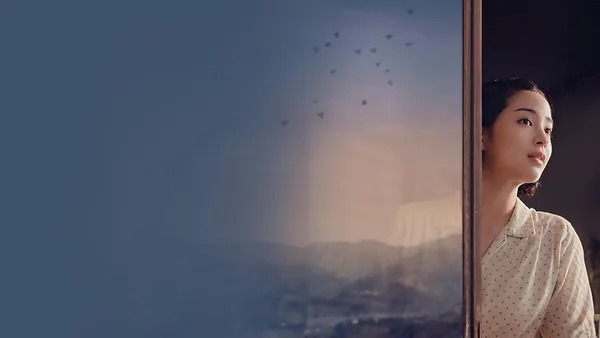
Japanese director Kei Ishikawa's adaptation of novelist Kazuo Ishiguro's first novel, A Pale View Of Hills is structured around a series of conversations between a middle-aged Japanese woman, Etsuko (Suzu Hirose), and her adult daughter Niki (Camilla Aiko).
Working on a writing project about her family, Niki, who grew up in England, asks questions about her mother's time in Nagasaki, Japan in the 1950s. A Pale View Of Hills, co-written by Ishiguro, is an exploration of memory and two generations confronting the past, that takes the form of a series of fragmented dreams.
Ishikawa's previous films include Âku, an adaptation of Ken Liu's futuristic short story, about immortality in an uncertain world, the sci-fi drama Previously Saved Version (Futsugô Na Kioku) revolving around a married couple in the year 2200, and Listen To The Universe (Mitsubachi To Enrai), which reveals the stories of four pianists competing in an international piano competition.
Speaking with Eye For Film, Ishikawa discussed the cinematic quality of Ishiguro's prose, how the films of two notable Japanese directors contribute to their memories of Japan, and seeing the story through the personal.
The following has been edited for clarity.
Paul Risker: Why filmmaking as a means of creative expression? Was there an inspirational or defining moment for you personally?
Kei Ishikawa: I always loved watching films, and so, I always wanted to work in the industry, but you know, filmmaking is kind of an addiction. With directing being the thing that interests me the most, I couldn't escape this. So, that was one reason. The other is that making a film is the easiest way to confess myself. I can't sing, and I can't play any instruments, and filmmaking became the easiest way for me to communicate with people.
It's my language, but at the same time, it is so technical. You have to learn the vocabulary, and then you have to understand the idioms and how to use them. But the most important thing is what you want to talk about. That's the main core, and through filmmaking I'm trying to find answers.
PR: I'd suggest the uncertainty or mystery that drives our curiosity can be more important than the answer to any question.
KI: I agree, and being a filmmaker, I'm always thinking when I'm making a film. Of course, we have questions and doubts, but I'm always thinking about how we have to have answers at the end of the film, and if we don't answer those questions, then we must somehow have something to show the audience.
Personally, I want to watch films that can change my way of thinking or way of seeing the world. I don't require the answer, but I want to glean a new perspective from the film, and this guides me in my own filmmaking, because the answers aren't enough.
PR: Given your desire to shift your perspective, what compelled you to adapt Kazuo Ishiguro's novel?
KI: Well, I've always been a big fan of Kazuo-san's novels, and I think it's kind of the same for every Japanese filmmaker. His first two novels are set in Japan, and the second one has already been made into a TV drama. For me, this first book was more fascinating. It's actually connected to our conversation, because it has an ambiguous beauty where he neither answers nor shows us everything. What's not said in the book is more important than what's written, and to my mind, it's also very cinematic.
I felt this element more in his first novel, A Pale View Of Hills, and I thought we could use those elements to create mystery and suspense structures that would entertain people. But despite this potential, it was expensive to produce, and so, that's why nobody could really make the film. But to me, it has been obvious that everybody wants to adapt the novel.
PR: What makes Ishiguro's prose so cinematic?
KI: Well, cinema is very good at revealing memories, and to my mind, it's more efficient at doing so than novels, because the sequence of scenes and how we edit is similar to how we dream.
A Pale View Of Hills was written far away from Japan and Kazuo-san recalled that he was remembering. And also in the book, when Etsuko tries to remember what happened in Nagasaki, it was told by a narrator. It's very thrilling but at the same time, it's connected to the nature of memories. And also, what fascinated me was that history has been told by unreliable narrators, right? The book was about history, and how Kazuo-san talks about that history is totally new and somehow personal. In this sense, it's very cinematic.
But I didn't want to make a period film, and I was not really interested in a history centred film. What interested me was to talk about Etsuko's memory, and how she remembers. The story of Japan in the Fifties is told by her, but it was never our goal to recreate the Nagasaki of the Fifties. Instead, we tried to create the Nagasaki through her eyes, which means we were always in the UK in the Eighties looking back. In this sense, it was quite a unique process, but it's one we enjoyed.
And also, for us, the memory of the Fifties actually comes from the films of [Yasujirō] Ozu and [Kenji] Mizoguchi — those films which we watched so often are our memories.
PR: In what ways is the film shaped by your own story and did it provoke personal memories?
KI: When I was making this film, I was always thinking about my grandmother. My grandfather died during the war. At the time, my grandmother was in China, and afterwards, escaping back to Japan, she had to evade the Soviet Union army. And on the way, my mother was born. I always tried to ask her about what happened, and she would tell me. But every time, the stories were fragmented, and she would always end up crying, and she couldn't really finish.
So, the memory of my mother and my grandmother, and all of those fragments somehow came to mind. I regret that I didn't really ask them about the whole story, and I didn't write down everything. Then, when I found this book, and then when I made this film, I started to feel maybe those fragments are more important than what really happened.
For me, that's my grandmother and that's what happened to her. I understand how hard it was for her, right? So, just by making this film I started to figure out what that history is and what I should remember about those people, from that time.
A Pale View Of Hills was released in UK cinemas on Friday 13 March.