





Eye For Film >> Movies >> Come See Me In The Good Light (2025) Film Review


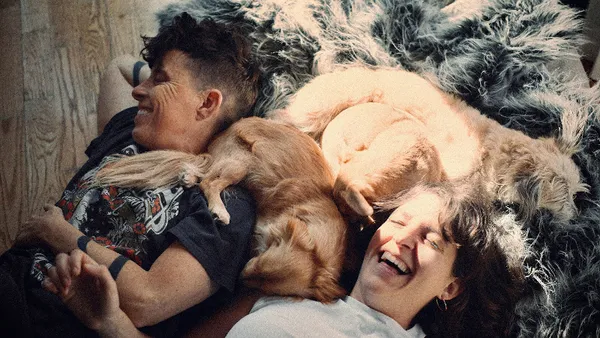

The idea, and the saying, that the good die young is an infuriating one. All the more so when the person in question is made to live with the knowledge of their own premature death, forced into an awareness of time that most of us are spared. Ryan White’s Come See Me in the Good Light, which follows Colorado poet laureate Andrea Gibson through the final year of their life alongside their partner Megan Falley, is a heartbreaking testament to the preciousness of time and to the unbearable fact of our ephemerality on this planet.
I found myself thinking of Paul Kalanithi’s memoir When Breath Becomes Air, not because the two works are especially similar in form, but because both are animated by the same impossible task: how does one live when death is no longer an abstraction, but an approaching reality with ever clearer contours? White’s 2025 Sundance-premiering documentary, released before Gibson passed away in July of that same year, does not offer tidy answers. What it does instead is remain close to Gibson’s language, their humour, their humility, and the grace with which they try to make meaning out of dwindling time.

Gibson’s modesty about language is among the film’s most moving qualities. At one point they remark that they know so few words, that when they published their first book their publisher joked that all their poems were just the same words rearranged in different orders. It is a disarming sentiment from a poet of such enormous emotional intelligence, but it also clarifies the ethic of their work: why write a poem that goes over someone’s head and, even more importantly, why write one that goes over someone’s heart? Their poetry, like their presence here, cuts through ornament and goes straight for the vital nerve.
The documentary gradually builds toward the final live spoken poetry show Gibson is able to perform, even as medical treatments, test results, and rising cancer markers loom in the background. Most of us know, in the abstract, that we are going to die, but far fewer are made to live with that fact as an immediate and structuring presence. In Come See Me In The Good Light, Gibson offers one possible response through poems and through an outlook on life that insists even a second is a great deal of time. When they recite “Acceptance Speech After Setting the World Record in Goosebumps” the effect is quietly shattering.
For a film that explicitly invites us to see in the good light, light itself becomes its currency, with cinematographer Brandon Somerhalder rendering the Colorado mountains, the couple’s janky mailbox, and their home in Longmont in a soft luminosity. Just as crucially, White leaves room for Megan’s quiet grief, allowing the camera to linger on sadness that is almost imperceptible until it suddenly is not. The strongest passages understand that dying is never experienced alone, that the anticipatory grief of the one left behind carries its own mute devastation.
Still, there are moments when White’s approach feels a touch too reverent, too polished in its pursuit of uplift. Faced with a subject as beloved and as wise as Gibson, the danger is less exploitation than canonisation. Yet the documentary is most powerful when it allows exhaustion, fear, mess, and the banalities of illness to remain in view beside the poetry. When the Irish poet WB Yeats died in 1939, WH Auden wrote that “the death of the poet was kept from his poems”. White’s documentary comes to resemble such a poem for Gibson, with their death kept not only from the poems, but from the audience as well, the work having been completed before they passed. That tension, between Gibson’s living presence on screen and the audience’s knowledge of what has already been lost, is what gives the documentary its sharpest emotional force.
Reviewed on: 15 Mar 2026


