




 |
| Kill Me |
A man wakes up in a bathtub full of blood. Fortunately he is able to summon an ambulance before he bleeds out. The thing is, he has no memory of doing that to himself. Yes, he has a history of mental illness, but he’s certain, in his heart of hearts, that somebody must be trying to kill him.
This is the opening of Peter Warren’s Kill Me, which recently screened at SXSW 2026. It follows the man, Jimmy (Charlie Day), as he proceeds to try and solve the crime himself, enlisting the aid of initially reluctant 911 operator Margot (Allison Williams). I met Peter shortly before the screening and he told me how the story developed.
“I think the initial idea came from a twofold place,” he says. “The first being a desire to try and reinvent the whodunnit. You know, it's easily one of my favorite genres, and I was looking at deconstructing it into its core parts. You have the body, the detective, the clues, the killer. I asked myself, how can I put this together into something I haven't seen before? And I said ‘What if the body was the detective? What does that look like?’ It started to feel like this movie about someone who is trying to solve their own murder mystery.
“Secondarily, I was really passionate about making a movie that explored issues of mental health and depression and suicidality through the lens of genre. I firmly believe that a movie can be really fun and also be holding space for a really important conversation, that those things actually marry really well together. And that became Kill Me.
“I have a pretty varied and diverse relationship to issues of mental health. I have my own depression. My mother's a psychiatrist. I have people in my family who struggle with mental illness. I volunteered as a suicide and crisis counselor on the front line. So it's something I've always been exposed to and care a lot about. And it's one of those movies where even as we were getting into pre-production, it felt like every single day someone would come into my office and close the door behind them and tell me about their personal relationship to these kinds of things. And the movie is really built, I think, to be a thorough conversation around these different perspectives as it relates to issues of mental health.
“We hear the voice of the family, the voice of the doctors, the voice of the new partner, the voice of the ex partner, and the voice, obviously, of the person who's struggling as well. Everyone gets their turn on the microphone, everyone gets a chance for us to really hear what their experience of this is like. That, to me, was important, because it created a portrait that felt fairly complete, or at least as much as you can do in one movie.”
I tell him that I'm not surprised to hear that he has his own experience. When outsiders approach this subject, often they're terribly delicate about it. In my experience, whatever kind of illness it is that people are dealing with, the people themselves tend to be irreverent and playful and have dark humour about it.
“You have to,” he nods. “You have to laugh, because how else do you survive? Depression and suicidality is incredibly serious and incredibly painful and incredibly insidious, and it's also dumb and annoying and frustrating because it's your own brain trying to kill you. It feels like stepping on a rake inside your own head a hundred times a day. I think it's dishonest to portray these kinds of things in one tone or mood. The movie, I think, has quite a broad range of tones, and to me, I think that's very rich and harmonious. We laugh and we cry and it's scary and it's stupid and all those things. That, to me, is just trying to accurately render what it's like to be a human.”
Did his experience on the crisis hotline help with creating the charater of Margot, the 911 operator?
“Yeah, absolutely. In Margot, we get a sense of her long term fatigue. She's obviously carrying her own demons with her sister, but I think she's also starting to carry the weight of doing this work, and her own somewhat obsessive relationship to it. Her experience is obviously different than my own, but I felt like I saw myself in every character in the ensemble to some degree.”
We discuss locations and how to structure a murder mystery.
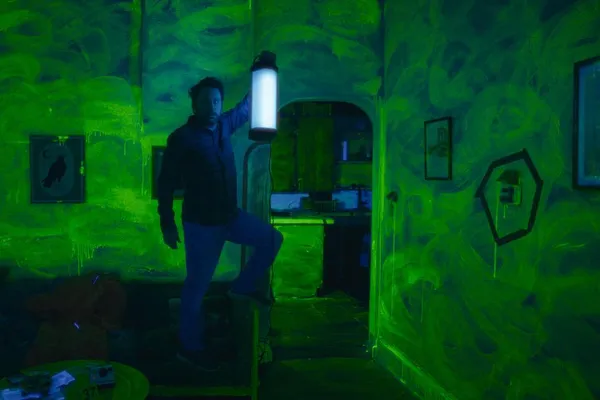
“I think on of the hallmarks of the murder mystery is that it puts on that it puts details and spaces under a magnifying glass,” he says. “It's different than other genres, because a room or an apartment or a brief moment becomes something that you go through with a fine toothed comb. Everything from how many steps are there between here and the door? Where exactly was this rice put down? What exactly is this hair or fibre or piece of dust? It all becomes critically important. We spend a lot of time in Jimmy's apartment because, like any crime scene, it tells a story, and he's trying to figure out what story it's telling. We see him imagining and theorising what that could be.
“The opening scene is probably my favourite scene in the movie. I wanted us to go through this journey aligned quite closely with Jimmy. He wakes up in the tub, and so do we, and we are as perplexed to find ourselves here, and scared, and confused as he is. I think it creates a real sense of intimacy between us and the hero of the movie because we're there every step of the way, and we are as desperate to solve the case as he is.”
Is there a different kind of intimacy that he feels as a writer/director as well? Some of what he’s doing, I point out, is very similar to what people are doing as detectives in that situation, the way that he has to work out all the different steps very precisely.
“Absolutely. On the one hand, you need to step back and build a journey for Jimmy to go on. But also, you really need to stay closely aligned with Jimmy because he's not a professional detective. He's about as much of a detective as I am. We even see him watching cop shows on TV. We understand that his reference point for how to do this comes from where mine would, which is I've seen movies, and maybe some frantic googling about what to do. And so it was especially important.
“It's different when I'm writing something about, say, a really seasoned detective who's been on the police force for 50 years, when I need to do a lot of deep research and try and render that accurately. In this movie, in so many ways, what I'm rendering accurately is what an amateur Jimmy is. Confronting the problems that he confronts the way that I would do it was actually really additive to the movie, which is like, what do you do when you need supplies to investigate the crime scene? And it's like, Amazon – and hope it gets there in time.
“I hope the experience of watching the movie really puts you in Jimmy's shoes, not just in terms of the journey he's going on, but also the sense of suspicion or uncertainty. There's probably moments where you start to go ‘I think I know who did it,’ or maybe he starts to get evidence and you go ‘See, I knew it. I totally knew it.’ And then it makes you go ‘Sure about that?’
“That feeling of ‘I'm seeing the matrix, it's all adding up. I get it. No one else gets it, but I do’ – that's what it's like to be Jimmy, and that's what it's like to have an issue with mental health. What you often don't lack is conviction or certainty. You're like ‘Trust me, I got it. I know what's going on.’ It's very destabilising to have that then called into question. ‘I'm not asking you if you're sure who did it. I'm asking you, how sure you can be about what you think?’”
I like the way that he preserve the ambiguity throughout, I tell him. It seems to me that some of it's about how Jimmy has to learn to live with that ambiguity, and also the tension between him and Margot as to whether or not she's willing to take on that level of ambiguity in being close to him.
“I'm so glad that the ambiguity came across,” he says. “It's funny because people often describe it that way, like it's an ambiguous ending, but to me, I think that's an incredibly determinative ending. I think it's being incredibly declarative about the dilemma of mental illness, which is of course, you want to be able to solve it and go ‘We fixed it, we cured it. We know what's right, we know what's wrong. We know what thoughts we can believe, and we know what thoughts we have to question.’ And the reality is, you can’t.
“I think a primary thesis of the movie, something that I was really passionate about, was having the hero of the movie, the person who is objectively deserving of our attention and our listening ears and our faith, be someone who is not doing so hot. A big statement of the movie is the idea that you don't need to be well, to have your voice matter. That you don't need to be unimpeachably accurate and stable – because none of us are – in order to be listened to. That is vitally important, but it's also a very difficult thing in practice.
“Margot is passionate about making sure that people listen to Jimmy, but listening and trusting are different things. He is deserving of trust, but he's not deserving of unconditional trust. And that's where it gets really difficult, because she never wants to leave his corner. But it's also very dangerous to let him, or let anyone, be shielded from perspective and from the thoughts of others.”
I complement him on the amazing cast that he has found, who make it possible to communicate all this.
“My gosh, the cast is so incredible,” he says. “It feels like cheating as a first time filmmaker to have such an incredible cast. People are like, ‘What's your advice for making your first movie?’ And it's like, ‘I set myself up with such an incredible cast that I was like, “If I can just remember to press record every day, we'll be fine”’, you know? And I remembered to do it almost every day.” He grins.
“Casting started with Charlie Day. Charlie came on this project before it was a project, which is the bravest thing that you can do in Hollywood. The absolute most valuable thing you can do as a movie star is put your name behind someone who is doing something for the first time. Charlie read this script and he called me and said I would do this for free. And it's an indie movie. So I ended up basically being like, ‘I'm going to take you up on that.’
“Once Charlie was aboard and so passionate, we were able to start to grow the ensemble, because who doesn't want to work with Charlie? And so were thrilled to bring on Allison Williams as Margot. So incredible, soulful and funny and just deeply skilled. And then Giancarlo Esposito came after that, and that was an absolute dream come true, to work with him and to learn from him. And Aya Cash, Jessica Harper. I mean, it's a rogue’s gallery of actors. And I think that the movie – this is a real hot take, but I think that movies are great when we let actors act in them. I know, it’s wild, but it's true. Some movies give actors a chance to really dig in. There's monologues in this movie. There's big emotional moments. And there's performances in the movie I'm so proud of.”
He must be excited that it’s getting so much attention now, I suggest.
“Yeah. It's very exciting. I mean, when I make anything, but particularly a movie about this subject matter, the hope is that people see it and enjoy it and that it makes people feel less alone. That, to me, is always the greatest aim for any piece of art you put out in the world: that people feel somehow reflected by it and comforted by it, particularly around these themes. So I'm excited for it to get out there and for the movie to make some new friends.”