





Eye For Film >> Movies >> Turner & Constable (2026) Film Review


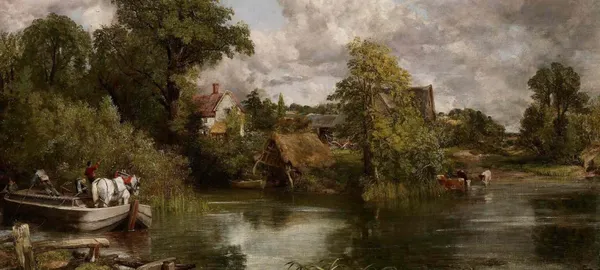

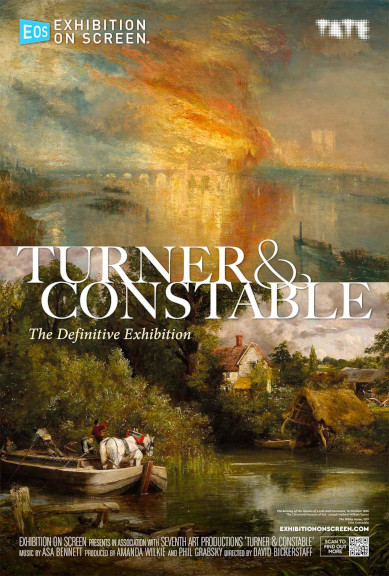
Although it’s based in the UK, the Exhibition on Screen series has not dedicated a lot of time to UK artists. That changes here, with a film based around Tate Britain’s joint exhibition of their works, running from November 2025 to April 2026. It’s an attempt to pin down a transitional moment in art history amidst rapid social shifts, with Turner’s dramatic experimentation set in contrast to Constable’s more traditional style, yet with the insight to highlight their shared challenges and the ways that Turner still drew on the past whilst Constable looked to the future.
The two artists look out from the wall as the camera enters the first room in the gallery. This pair of self portraits immediately picks out the contrasts in the men themselves: Joseph Turner fresh-faced yet slightly rakish in his dress, John Constable a little prim with those delicately blushing cheeks depicted on ladies of the previous century. Born within a year of each other (the exhibition was convened to celebrate their 250th anniversary), they had more in common than is commonly assumed, and some of what has been depicted as rivalry or spite was more a case of friendly banter. Though they had very different ideas about how to explore their subjects, they shared inspirations, such as Claude Lorrain and the poet James Thomson, and neither seems to have felt that his way was the only way.
This is the first time that the two have featured in a joint exhibition of their work, and it’s used here, as in previous films by the the Exhibition on Screen team, as a jumping-off point for telling their life stories and observing the evolution of their techniques. The film’s various interviewees are in agreement that the biggest factor shaping their early work was the isolation of the UK caused by the Napoleonic wars, which triggered the development at long last of its own distinctive art style, as well as leading Turner to imagine famous vistas long before he could visit them (we see his Lake Avernis alongside his Bay of Baiae, the latter informed by his 1819 trip to Italy and featuring very different light, introducing his love of yellow. Constable, meanwhile – the wealthier and yet in many ways the less advantaged of the two – kept his focus on home, mostly his native Suffolk, and in the process set the benchmark for an English landscape painting tradition which endures to this day. It’s amusing to hear that his most famous piece, The Hay Wain, only garnered attention here after travelling and being exhibited in the Louvre.
Watching an exhibition on screen is not the same as being there, but there’s a positive side to that. Here we have the chance to look through Turner’s sketchbook rather than seeing it open at a single page, learning a lot about his process as we do so. We also get more context, so we’re able to more thoroughly appreciate how unusual it was that Constable never split his work into sketch and studio modes but preferred to be outside as much as possible. There’s an interesting look at changing paint technology and how it facilitated this. We also learn just how novel chrome yellow and cobalt blue were when Turner began to explore their possibilities.
Films in this series always devote a little time to the words of contemporary critics. Here they are directly compared to internet trolls, with their persistent racist comments about Turner’s yellows. Their sniping at Constable seems to have focused on the misapprehension that he was trying to make paintings which deluded viewers into thinking they were seeing an unfiltered scene. This highlights his interesting position as an artist unashamed to remind people that they were looking at a painting, and able to use that to comment on reality rather than just imitate it.
In a similar manner, this film brings us closer to the exhibition itself than some of its predecessors have done. At one point there’s a a clever shot where the camera eases back and moves between rooms, bringing out the three-dimensionality of the paintings in the process. Elsewhere we see Salisbury Cathedral on one wall juxtaposed with Caligula’s Palace on the adjoining one; you can guess whose is whose. It’s an entertaining choice which sums up their temperaments and output nicely.
The format allows us to get up close to some paintings which really deserve it, exploring, for instance, the powerful currents and subdued terror of early Turner painting Fisherman At Sea. We get to appreciate the detailed chiaroscuro of Constable’s printmaking, which would seem to establish the style that half the book illustrators of the following century would strive to imitate. In the last room in the gallery, two unfinished paintings hang, both begun with a focus on light before their creators departed. Even if you know both these artists well, seeing their work together like this will leave you feeling enlightened. If you paint at all, you will be brimming over with ideas to take away and explore on your own.
Reviewed on: 09 Mar 2026



Festivals:
Search database:
