 |
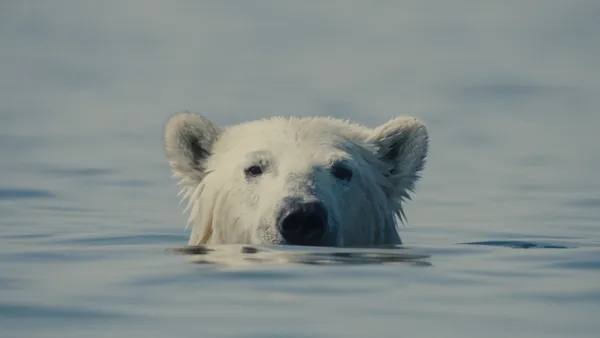
| Nuisance Bear. 'You’re going to get better, more authentic realities if you just listen to people' Photo: Courtesy of Sundance Institute |
Gabriela Osio Vanden and Jack Weisman expand on their short of the same name with their debut feature Nuisance Bear. Premiering at Sundance, they continued their festival journey with screenings at Thessaloniki Documentary Film Festival this month. We caught up with them to talk about it in Greece but, please be aware, this interview contains what some people might consider to be spoilers.
The feature opens up from the largely observational short to explore the tensions surrounding the bears between Churchill, which relies on them for tourism, and the Inuit town of Arviat not much further north. The issue concerns “nuisance bears” which scavenge and cause problems in Churchill, leading the townsfolk to airlift them north… which essentially just moves the problem out of their neighbourhood and into Arviat’s. Narration and insight is provided by Inuit elder Mike Tunalaaq Gibbons, who has since passed away, and whose son Aaron was killed in a bear attack as he protected his children.
Unlike some people who start with a short and expand it up, the pair’s intention was always to make the feature with the short being a contraction of the big idea rather than something they later expanded on.
Osio Vanden: “To some people it looks like we expanded the short, but we always had this idea of the two communities for the future film, but it just wasn't the right time for a bunch of reasons and so we just made an assembly from what we had shot in Churchill that year and sent it to a trusted filmmaker friend. And they were like, ‘This is already a film’ and we were like, ‘Oh okay’. At that point, we were nobodies in terms of directing so it made sense to just do something to show what we could do.”
Weisman: “From 2015 we had this idea. Just the juxtaposition of these two communities. We were really shocked by Churchill's infrastructure and economy around the bears in itself is it’s own film but then to find out there’s this other town that’s getting the worst bears passed off to it and has a whole different history with the land and the Canadian government and the animals. So it was a complete discovery for us.
“As an American originally – I'm dual citizen now – but I didn't even know that there were polar bears in Canada and I had no idea about the Inuit. So for me, it was very educational, eye-opening.”
The short went on to make the Oscar shortlist but not the final nominations, which seems to have been something of a blessing, given how much time working on the publicity around an awards run can take up.
Osio Vanden explains: “I was relieved that we weren't nominated, to be honest. In some ways, obviously, as a filmmaker, it’s a really great thing to have that recognition, but at the same time, it did worry me – like, will this thing kind of balloon out more.”
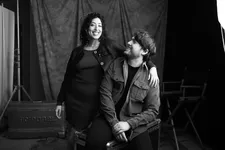 |
| Gabriela Osio Vanden and Jack Weisman Photo: Courtesy of Thessaloniki Documentary Film Festival |
Weisman adds: “At the time, I made this sort of agreement with myself that if we got nominated, we wouldn't make the feature. But to be honest, I don't think it would have made that much of a difference now.”
In fact, the short turned out to be a great idea in terms of gaining the trust of the community in Arviat, as they were able to see the approach that the pair intended to take.
“We went up and screened the short right before we started the feature,” recalls Weisman. “We said, ‘This is what we're trying to do’, and we knew about Mike and his family and we knew about the death of his son. And so, we were hoping that members from the family would come to the screening and, potentially, tell us that this wasn't something that we should be doing, and we would have respected that.
“There were about 200 people who came to the screening, it was unanimously supportive. There were lots of questions about what we were doing and why we were doing it, but there was a lot of concern for our physical safety as we were doing it but nothing like, ‘Don't do this’.
Osio Vanden adds: “I think people were content that we were interested in hearing their side of things because Churchill gets to have its narrative a lot of the time, just because of the tourism and because they have a narrative. I think Arviat’s community was just pleased that we cared.”
“Also that we were taking this really neutral stance,” says Weisman. “I know that some critics are like, ‘Oh, they don't have a point of view’ or, ‘They don't want to point the finger at the bad guy’. But that wasn't what the communities were interested in doing because they have a lot of conflict between the communities around the bears. So, both parties were hesitant to participate in an exposé or any kind of reality TV show because that had been done and it kind of had negative consequences.”
Osio Vanden emphasises the fact that the two communities have to coexist and that it was important for them to respect all the subjects of the documentary.
It’s a film that also doesn’t forget to take account of the polar bear’s perspective, so how hard was it to balance the various points of view as they were editing the features?
Weisman says: “It was very difficult because we had sort of already developed this bear perspective point of view, technologically that was what we were going for with the equipment and then we had to expand that. That was a Covid project too, so we were bubbled in our car, we didn’t interact with people. We couldn't do any interviews, so it was kind of a limitation that was forced upon us because of the times. So then when we returned to do the feature, those restrictions were lifted and so we really had to develop a new approach or we just had to film it in a more traditional way, following characters and we were following so many different characters.
“Every character that you see in the movie, at one point was the main character, until we realised that there were too many and we really needed to distill it down to a single voice that could kind of speak on behalf of everything, which is a lot of responsibility. There was no one we felt could really do that besides Mike, because of what had happened to him and his empathy for the bears and even Churchill, the people that had abused him. He was a patriarch of his family and he was also a minister so he had this ability to speak publicly and poetically. He was kind of this amazing fit and in the back of our minds, we were always hoping that he might narrate the film. We were going at the speed of trust, which is years, so we were hoping slowly this relationship might evolve and it did.”
Trust proved to be crucial, because in the wake of Aaron’s death the community clamped down in terms of talking about the bears, so as not to upset the family in their grief. That moment of trauma was the point when the filmmakers decided to pivot to the short and take a big step back, focusing on Churchill.
Once the short was finished, however, it reignited the conversations they had originally had with the community in Arviat.
Weisman recalls: “They were like, ‘Oh, the short was cool, but what happened to our view? What happened to that movie? You want to come up and do it?’ And we were like, ‘Well, maybe’.”
One of the most striking images in the film, is the sight of a bear being airlifted out of Churchill by a helicopter. “They’ve done even crazier things in the past,” says Osio Vanden.
Weisman agrees: “This is the latest in a long line of trial and error. This is the best that they came up with, for now. You don’t even want to know what they were doing 20 or 30 years ago.”
“It was Russia, funnily enough, that made all the countries with polar bears band together to protect them, which is a funny little fact.” adds Osio Vanden, “But they’re off that now.”
Having first visited Churchill in 2015 and Arviat two years later, the death of Aaron in 2018 made them realise it was not the right time to be shooting there. But then after returning to Churchill in 2020 and making and touring the short, they finally returned to the feature they had originally planned. While Osio Vanden acknowledges “It’s such a relief” to get it over the line, Weisman says: “It wanted to be made, though”.
He adds: “I think I became more of a spiritual person from all this just because the probability of the events that we witnessed were so rare and we needed them all to kind of happen. We were out there a lot, of course, we spent 200 days filming so I don’t know if it's just the time spent doing it.”
“That’s days filming,” Osio Vanden notes, “We also spent a lot of time hanging out, which is really important. To show up without cameras and listen to people, be a person.”
“Sometimes you feel like you can’t be a person and a filmmaker at the same time, I’ve heard that before,” adds Weisman.
Part of that, says Osio Vanden is down to the fact that a lot of filmmakers haven’t taken the time to get to know the people in the community. “They have expectations of what they want to shoot and usually they have overhead and oversight so they have a certain amount of days they want this, that and that. And so Inuit people, in particular, find that really irritating. Whereas I feel like our take on just listening is really what shaped the film and so that allowed them to feel truly like participants like not just subjects.
“How are we supposed to know what it’s like to coexist with bears when we’re coming from Toronto? You’re going to get better, more authentic realities if you just listen to people.”
Weisman adds: “Before you go, you have an idea of the structure, what you are trying to accomplish, I think. But if you come in with this really rigid mindset – we watched a lot of crews make mistakes and so we were able to learn from watching them and hearing about how they interacted. It’s pathetic how low the bar has been set by foreigners, unfortunately.”
The trust the pair established and the care they showed towards the community paid off in that they were the only team during the years that they were shooting who got the permits to shoot in Arviat. That’s partially because footage of traditional seal and bear hunting has been used to vilify the community previously.
They had to go through a formal process with a committee. “I think it’s an important process to go through,” says Osio Vanden. “Do you stand behind this project and are you able to have the difficult conversations to reach it? And to be malleable enough that if you do have blind spots, you're willing to hear them out.”
- Read the second part of our conversation with Osio Vanden and Weisman, in which they chat more about the bears, the division between work and home life and their plans for the future.