





Eye For Film >> Movies >> Never After Dark (2025) Film Review



“I thought there were supposed to be two of you,” the owners of the house say to Airi (Moeka Hoshi) when she arrives. She shrugs and shifts the focus to business. Of course there are two – she and her sister Miku (Kurumi Inagaki) have been working together for a long time – but for some time now, Miku has been dead.
We’re a long way from The Sixth Sense here, and no-one is obliged to pretend that this isn’t obvious from the start. Airi is a professional psychic, so having a ghost as an assistant suits her nicely. This isn’t quite Randall And Hopkirk (Deceased) either, however, and though the two may solve mysteries together, they treat is as something mundane. Airi has no fear of ghosts. They mostly just need a bit of help so they can move on. Unfortunately for her, her latest task involves dealing not simply with the dead but with a threat from the living.
Mother and son Teiko (Tae Kimura) and Gunji (Kento Kaku) are in the property business. They bought the house, which used to be a hotel, intending to fix it up and sell it, but Teiko, who is living there in the meantime, has started seeing a ghost. Our first sight of this being is in a painting she has made, and looking at it, it’s easy to understand why she’s unsettled. Gunji doesn’t take the psychic business seriously and stresses that, as he sees it, she’s being paid to stop his mother worrying; but by the second day of her stay, each of them has separately approached her to try to build a more positive connection.
The house has lots of little quirks. An elaborately gilded grandfather clock catches Airi’s attention; Teiko tells her that its approach to timekeeping is erratic. There’s a door to one of the guest rooms which keeps opening and closing by itself. Other little signals to viewers include on of those long, lonely forest roads just beyond the gates, and a title font in that that particular shade of yellow beloved of Seventies horror directors. It’s when Airi locates what the ghost has been looking for, however, that the genre subtly shifts and becomes much more disconcerting.
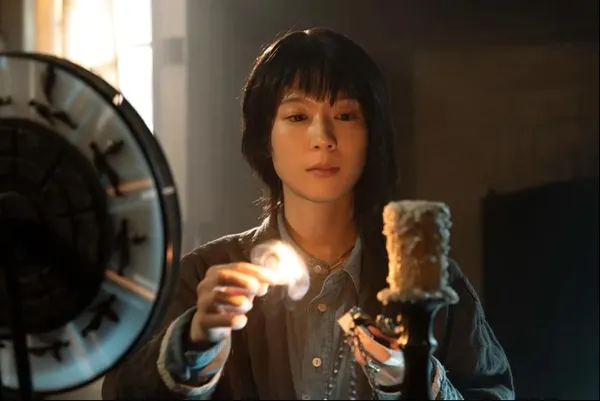
Writer/director Dave Boyle has said that from the outset he wanted to find his own way of doing things. The film follows its own path, as does Airi – not a traditional onmyoji nor part of any obvious Western tradition, though she does speak of a veil between worlds (and this is not the first time it has been realised with a blue filter. To get into the hypnotic state which enables her to cross over, she lights a candle, burns some of her hair and then turns her attention to a mirror with a motorised zöetrope surround. It’s a device which not only looks fantastic but can easily make viewers feel disorientated themselves, and it helps to give the film a very distinctive visual presence.
With a cleverly signposted plot twist which ratchets up the tension towards the end, the film makes room for one or two j-horror tropes which should please the home audience, but doesn’t rely on them. Like all the best supernatural tales, it keeps the rules simple but still manages to wrongfoot viewers. Meanwhile, there’s the complex relationship between the sisters, in which Airi, who used to be the dependent one because she was the youngest, is nor older than Miku ever got to be. It gives the film an emotional depth that means it will stay with you – haunting you, perhaps, but not in a bad way.
Never After Dark screened as part of SXSW 2026.
Reviewed on: 14 Mar 2026


