 |
| Drift |
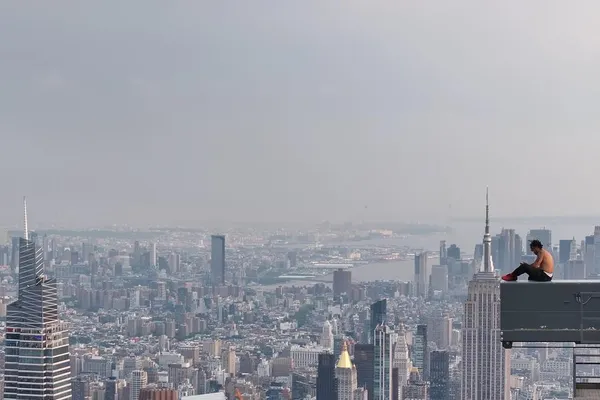
Director Deon Taylor's documentary Drift enters the world of multidisciplinary artist and United States Army veteran Isaac 'Drift' Wright. Struggling with trauma, Drift illegally climbs some of the world's tallest buildings, where he puts his self-taught photography skills to use, taking captivating images high above these urban scapes. However, his illegal and clandestine climbs are not motivated by the pursuit of the ultimate adrenaline rush, nor is the motivation solely artistic. Instead, it is a personal and inward journey to connect with his true self. Taking huge risks that bring him into conflict with law enforcement, in 2020, one climb resulted in a four-month incarceration. Drift follows not only these daring climbs but explores the human being behind the art and the headlines.
Taylor, who is the founder of the Hidden Empire Film Group, previously directed the 2018 human trafficking drama Traffik, followed by The Intruder, a psychological thriller about a young couple whose purchase of a beautiful dream house descends into a nightmare when the former owner refuses to relinquish the property. Taylor also directed the noir thriller Fatale, and the comedy horror Meet The Blacks and its sequel.
Speaking with Eye For Film ahead of Drift's world première at SXSW 2026, Wright and Taylor discussed self-actualisation, creating a series of spiritual journeys for the audience, and telling a story about good versus evil.
The following has been edited for clarity.
Paul Risker: What were the roots of the project and how did the two of you first connect?
Isaac 'Drift' Wright: When a number of documentary companies reached out to me in 2021, I was originally planning to do the documentary with another company, and they were trying to make a deal with A24. That ended up falling through back in 2023, and I remember feeling a little discouraged, because I didn't know if the story was good enough.
There were a lot of different things happening, and we went into a free fall period, where I didn't renew the contract with the company. Then, through a series of connections, a friend was working with someone who knew Deon and they introduced us. I've had the privilege of working with Deon and Hidden Empire on the project for the past two years, and it's been an amazing experience.
Deon Taylor: A mutual friend-connected us, and I was actually, at the time, given a couple of clips of Drift's stories. The previous company he was working with, had not shot the doc, but they had put together a small sizzle, if you will. I remembered reading the story about him and seeing some things, but like so many other people, I didn't know who Isaac was. I just knew about him from an article. But when I saw the teaser, I went crazy, and then, I met him for the first time on FaceTime.
He was on a beach with his feet in the sand, and that was the first time I asked, "What is happening with this story?" From there it just kept unfolding, and the more I learned, the more fascinated I was. You'd think it's just about these climbs, but it just kept becoming something more. It was a fascinating first meeting, and from that moment on, I was blown away by him as a person. I told him, "I would love to be the person that helps tell your story."
PR: Your climbs are the entry point to a larger story, and this should encourage us to be open minded and look beyond the surface. Perhaps this documentary tells us we should embrace the curiosity to know more, and to self-reflect on our own identity and personal journey.
IW: Anytime somebody lives authentically as themselves when the world is in direct opposition, is going to challenge the mental concepts that we have about ourselves. That happens because it is so rare to see a strict adherence to what one person feels is their true nature, and because they're taught to fear that from such a young age. And for me, the creative work was always what felt natural, and there's a lot of simplicity in that.
The work and the story are largely about self-actualisation. I think art in general is truly about the development of a self, and not even an idea of what we think we are, but what we truly are beyond all the concepts that are pushed on us. And that's what I found; that's where my journey has landed me at here, as we arrive at the premiere of the documentary.
I went through stages of thinking that it was about so many different things: cultural success or money, fame or fighting things. But what I found is that if you do the work, then art and everything else in life is a conduit for this. And if you're doing the work that comes with actualising the self, it will at times feel like you are just adhering to your nature in a true way, and also that you are fighting against various systems in the world, when in reality, you're not trying to fight anything. You're trying to just be, and that's what I found. I remember thinking that I was fighting against so much, but then I came to realise, 'No, I was just trying to be myself.' And this work has been an unfolding journey of learning to just be, and that's really beautiful.
So, it's really the story of everybody, because it's the journey that everyone has to take in actualising the self. Everyone does it through different means, but everyone is facing the same challenge of what it looks like to move beyond our various fears in life that come in so many different forms. I could stand on top of a skyscraper, but having to heal from not just trauma in the military, but sexual trauma and other things, to move beyond that and learn who I was beyond those other fears was the greater work. This was just a way to point me to that.
PR: The challenge in making this documentary is to create an immersive experience for the audience, which not only requires Isaac to be vulnerable and to trust the filmmaking process, but the use of the cinematic language to take the audience inside his world. It speaks about how world building is not only concrete but emotional.
DT: This is a very complicated film — it's not easy. It's funny because Isaac and I were talking a few months ago, and I was explaining that just as a filmmaker, the material is so exceptional and breathtaking. The story is chaotic, complex, beautiful and ugly. It has everything, and as a filmmaker, it probably took me a year to figure out how to actually formulate what the film would be, because you could have easily just took seven climbs and had him talk. It could have easily been that, and you would have been excited. But this was a puzzle. You had to figure out how to tell a linear story inside such a complex story. How do we want to build this? How do you allow people to meet the real Isaac? And then on the journey of meeting Isaac, they're introduced to Drift. All these things had to be combined, and the climbs become a sanctuary in the film. The climbs become the moments where you have escapism from this world where he's dealing with things. And so, the climbs become freedom.
It's interesting because you would normally see a climbing film, and it's like, okay, well, this person is doing this for adrenaline, they're doing this to defeat something, or in their mind, they're processing that they just love doing it. I had this amazing feeling that the higher he went he was getting closer to his truth and was becoming more grounded. And I just thought it was phenomenal.
So, the climbs represent him climbing through life and getting to these peaks and then standing back. It's like being on the freeway and looking in the rearview mirror. When he gets to the top of a building, that's the rearview mirror. He did it, and so, what's the next chapter?
I wanted to make sure the film had that approach, where each climb actually offers you more of a spiritual journey, and then, ultimately, you get to the end, and you're like, 'Oh, my God. This was what it was for.' It wasn't that the Empire State Building is the tallest building in the world. Instead, it meant the most because it's so sacred.
Drift is just an anomaly; he really is. I don't really know what people will take from the film, but I know one thing they will get is a spiritual journey, and they will see one of the most complex and prolific artists we've seen in this generation. That's what I wanted to get out of it as a filmmaker, and I just wanted you to feel it. And I think we did a good job of that as partners.
IW: Deon did such a terrific job, and what he said about moving, you're in and out of this story. To fit it into a feature film was an amazing feat by Deon and the team, and there's so much complexity that it's sometimes hard to quantify.
I have noticed that different climbs represented different states of consciousness. As I grew closer to myself, I'd be able to do bigger and better things. I'd be able to make better art, and I understood that art comes out of a person. Something that we don't think about is art is a completely spiritual journey. When you see something that someone produces, it is a reflection of their spirit.
As I've gone along on this journey, I take better photos every year. But the whole point of that was to show me the photos are a means to an end. It's about understanding what life is really about, and that there are infinite depths to which we can understand ourselves. And by moving through these different things, we move closer to ourselves.
When people look at some of the things I've moved through in the film and beyond, there's this understanding that there's no separation between light and dark. One feeds the other, and you have to accept all of it in order to fully become yourself. You have to accept all the ugliness, the difficulty and the struggle. And this work has led me to ask; can I accept it all within myself and transmute it and continue to make beautiful things from it? I enjoy climbing, but I'm not a climbing fanatic. I love art, and I'm an artist and the climbs are very metaphorical. So, having that language, I began to understand that the climbs and the photos taken were a reflection of what I was doing on the inside, and that would never change. I understand that from here on, anything I produce artistically is just going to be a reflection of the work I continue to do on myself, and that's the greater work of life.
PR: We should never forget, that as much as cinema is a medium driven by technology, it comes from our desire to express ourselves creatively and intellectually. Also, while the world is a divided place, we can be inspired by one another through cinema. Meanwhile, if a film starts off being about the characters onscreen, it ends up being about you, the individual spectator. It occurs to me that this documentary brings together all of these ideas.
IW: If a subject; if an artist fails to bring the work, the story, the life, and the reflection back to the collective, then I don't want to say it's a wasted effort, but I would say that to me, it is. It bears out this truth that lies beyond the idea that we're all connected.
If I see you, I see me. If I allow you to see me, I allow you to see you. So, it's the work of the artist to consistently see and hold themselves in observation and allow others to see and then give them the grace to hold themselves in observation.
The means by which an artist does that is the plethora of music and writing. It's all beautiful, and it's all different manifestations of the same thing. There was a younger version of me who thought this was so much more about myself, and losing my brother opened my eyes to that. I realised that because I was traumatised, I came out of a situation where I didn't have anybody. I needed help, and I had to rely on myself a lot.
Art that doesn't come back to the collective is self-serving. It is destructive, it's not life-giving, and it's the job or duty of any artist, but especially if you're fortunate enough to have a spotlight like this, to turn that spotlight back on the audience and to remind people of what they are so often stripped of every single day. And that is the idea that what exists in me exists in you. There's no such thing as my strength and your strength. It's our strength. There's no such thing as my journey and your journey. We have unique paths, but it's one thing, and we need to get beyond the idea that we're these separate entities.
[…] I went through that phase of seeing myself separately and being alienated by my struggles, but when I had to heal from that, part of that healing was understanding that, in the best way possible, you can simultaneously be a unique and special expression, but also understand that it's not special at all. And what I mean by that is, at the very end of it, if I was looking at the work as anything other than being my part to play in the world, I don't think I would have learned anything, because the work is humbling.
It's quiet and most of the time nobody ever knows. There's so much risk. I know what it feels like to have my stomach touching my ribs in a jail cell and cold air coming through the wall and wondering if I'm ever going to see the light of day at the end of the year. The objective of that work is to bring you to the point where you understand that you're just a conduit for it, and that's so important. I want the audience to see themselves in me, and I want them to feel that this is a story about all of us. It's the job of all of us to work on liberating ourselves by whatever means possible.
DT: As you're listening to Isaac speak about how he sees things, and how he understands the world now and how he envisions things and lives as an artist, what the documentary is exploring and trying to show you is the world is a very divisive place. It does have light, and it does have darkness trying to take over light, and there are bad people. What the doc is saying is that here's someone who's trying to simply exist in the world and be for everyone and be colourless and do his thing and show his art. And the world has people saying, "No, I'm not going to allow that to be."
It also shows you that there's a definite divide between black and white in various ways in this country. But it also shows you that allies are what makes the world so goddamn amazing. People could be like-minded no matter what colour they are and say, "I don't believe what this guy believes in. I'm going to help you fight. That's not right what this guy is doing." It is the age-old drama of good versus evil and someone just trying to be. And that's what makes the doc so exciting.
I know that's what I wanted to pull on — look at this guy doing this thing that is so primitive that we keep fighting against it over and over again. But oh, by the way, it's not a black story where all the black people came in, and they helped him. No, everyone that has the right mind came in to help, no questions asked. They fought so that his art could be free and that a documentary like this could be made, and we could be here talking about it. Everyone worked for a greater cause. And what's so phenomenal about the doc is that it is good versus evil for the sake of art.
[…] This is a story about survival, passion, and integrity. It's a story about overcoming and never settling, and it's a story about faith. And it's wrapped in this amazing thriller where you come out on the other side and light prevails.
Drift world premièred in the 2026 SXSW Documentary Feature Competition.