 |
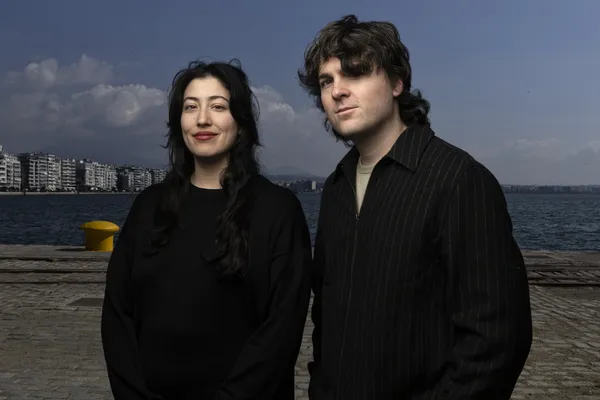
| Gabriela Osio Vanden and Jack Weisman in Thessaloniki. Weisman: 'Since we were 23 we’ve been in a relationship and working on this thing together' Photo: Courtesy of Thessaloniki Film Festival/Studio Aris Rammos |
Osio Vanden says: “I think the thing I found most shocking when we first went up – and I think this can be said about just about any subject matter these days – is just how prevalent filming is of everything. I was just imagining bears out in the wilderness and it was like every time I saw a bear, there's a crowd around it. That to me was honestly the most shocking. I think the job the conservation officers have is so hard because they're trying to protect people and the bears so they're between these two things. People want to get close to them, the bears want to get close to town because there's food and then there’s this business aspect to it. People get mad when they buzz the bears away but it’s kind of an impossible situation.”
“I think the camera creates this feeling of separation or something,” adds Weisman. “The whole thing was shocking for sure but then actual events that we witnessed, which made our jaws drop included the bear tricking a trap, where it steals, the the bait – I don't think anyone's ever seen that before.
“So to be witness to that was really quite startling and amazing. Then a scene where they're in that pen and they're getting paintballed at the end.”
Osio Vanden adds: “That was the last thing I was expecting. I was in Churchill and Jack was directing Arviat, so me and my cinematographer friend were shooting right before we were going to break down the vehicle rig. We were shooting something else and then just saw that and we were like, ‘What is going on over here?’ There's a moment every season where it just gets to this fever pitch, where there's just bears everywhere and everyone’s exhausted. They’ve not been sleeping for all of bear season.”
The pair say they are now working on new ideas. “I’ll say it has nothing to do with polar bears,” says Osio Vanden, with a laugh. They say they view wildlife films as a genre just like any other they might turn their hands to.
“I think we see ourselves as filmmakers more than wildlife filmmakers,” says Weisman. “So this was our wildlife film. I'm not sure what the next genre will be. It’s kind of hard to do docs now, no one’s buying them. Even now, we’re struggling to find distribution.”
The film was made by A24’s standalone documentary arm – which had a slate including The Deepest Breath and Steve McQueen’s Occupied City – and the pair were relieved to get the film over the line before they shut the division down last year.
“We made it to the end of the process by the skin of our teeth… some films didn't,” adds Osio Vanden. “I was more sad for a documentary at large when they closed the division than for ourselves because they were great to work with, we had such wonderful executive producers who were intelligent, they weren't overbearing and we had creative control.”
Both filmmakers are also cinematographers, a career that they love, so that is also likely to factor into their work going forward, although they also have their eye on more directing.
Osio Vanden says: “I think I’m interested in scripted for the future but if the right doc project comes up, I wouldn’t be opposed.”
The pair are life partners as well as working on films together but Weisman notes that “don’t want to be seen as co-dependent”. Osio Vanden adds: “Since we were 23 we’ve been in a relationship and working on this thing together.”
“Gabby is much better at drawing the line,” says Weisman, “and not engaging with stuff when she doesn't want to.”
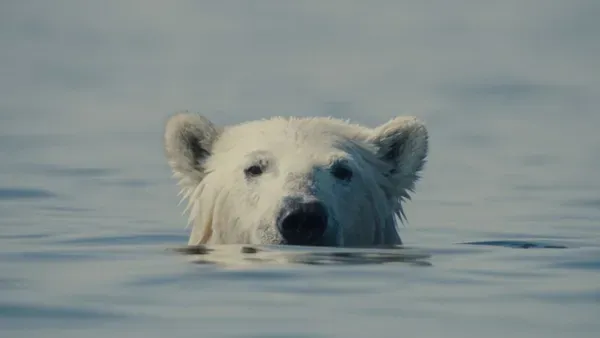 |
| Weisman: 'As young, impressionable students I think we just couldn't believe this was a place – this economy of bears' |
Among the things which first attracted their attention to Churchill – beyond it being fairly famous for its polar bears in Canada – was a film by Peter Mettler, Picture Of Light (1994).
“It’s his attempt at capturing the Northern Lights on film for the first time,” says Weisman, “and they just went mad trying to do it up there. It's quite a time capsule and I really recommend it.”
Inspired to try their hand at it, they went up for five days while they were students and, as Weisman puts it: “It was basically a disaster.”
Osio Vanden adds: “It was great because we met people that we ended up working with for 10 years up until now, so it was very formative. And I'm really glad we went then because there was an old world feel to the place that's less so now. There were just a few wild characters.”
“There was a Bear King character,” says Weisman. “He had a roadside zoo of wild bears, so you could pay to come and see these wild bears.”
“It wasn’t a zoo exactly,” adds Osio Vanden. “They were wild, but he was feeding these dogs that he was breeding so he was feeding the dogs, but he was also feeding the bears.”
“He had trained them to sit like a dog,” recalls Weisman. “It was illegal but he was a pirate. He’d been there since he was 14. So as young, impressionable students I think we just couldn't believe this was a place – this economy of bears.”
“Also as a young person who cares about wildlife and has seen a lot of films about the environment and activism, you realise that these things aren't so simple,” adds Osio Vanden. “I think that really opened my eyes to that. Also, this question about this sub-population of polar bears which is not going extinct as of now. Of course, the melting ice is going to threaten their way of life over time but, until this point, their numbers have actually increased.”
Osio Vanden says that while they may have been, to a degree, naive about the scope of the project when they started shooting, in some ways that worked to their advantage.
She explains: “I think that is the beautiful thing about first films. You maybe take on more than you can chew and you just have to rise to the occasion.”
Weisman adds: “You don’t have all the answers. We had only just enough experience to pull this off, so the solutions we came up with were all unique and creative – there wasn’t a formula that we’d already developed because we’d solved that problem on a previous project. So that freshness of almost being like a film student – you don’t know what you’re doing but you know enough so that it’s not irresponsible.”
Osio Vanden also notes: “It attracted a lot of professionals in the wildlife space to work with us because it was fresh and it was different to what they are used to doing and get frustrated by.
Finally our conversation turns to the score, which was written by Emmy award-winning Chilean Canadian Cristobal Tapia de Veer, who has worked on series as varied as Dirk Gently’s Holistic Detective agency and The White Lotus.
“We will definitely work with a composer like Cristo again,” says Weisman “That calibre of musician elevated the project in a way that I don't think very many people could have. As a musician initially before I became a filmmaker, music's really important to me, rhythm’s really important to me and so I think getting the opportunity to work with someone like that was such a gift. He came in before we even had a rough cut, so we were editing to his music, so that was an incredible experience.”
- Read the first part of our conversation with Osio Vanden and Weisman, about balance and perspectives in Nuisance Bear