





Eye For Film >> Movies >> Children No More: Were And Are Gone (None) Film Review


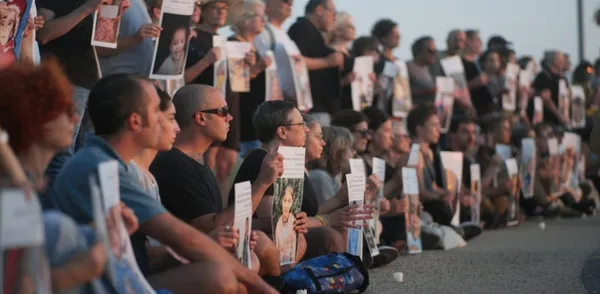

Hilla Medalia’s Children No More: Were and Are Gone enters a morally fraught space with admirable clarity, observing a group of conscientious Israelis who began holding weekly silent vigils in Tel Aviv, after Israeli attacks killed 193 children in Gaza in a single day on March 18, 2025. Holding up photographs of the children taken in life, and painted flowers where no such images exist, they insist on a basic principle of recognition, that these children be seen first as children, not as abstractions, statistics, or collateral. Yet a blind spot appears from the outset. The film’s opening caption calls them “Gazan children,” not Palestinian children, as though geography were easier to mourn than a people.
Medalia does not overconstruct the gesture or overexplain its participants. Instead, she trains her camera on the vigil itself and, crucially, on the hostility it provokes from passersby. One man tells the demonstrators, “In an ideal world you’re right, in the real world you’re wrong,” a line that exposes the moral vacancy of realism when it becomes an excuse for accepting atrocity. If the protesters’ actions can seem timid, even meek, the reactions they draw reveal just how far the threshold of acceptable cruelty has shifted in Israeli society.
Still, the documentary short invites a harder question than it perhaps intends. Symbolic solidarity, when it asks little of those performing it, risks becoming self-referential. The vigil may be moving, but it remains a gesture whose political efficacy is uncertain. In that sense, Children No More: Were And Are Gone documents not only grief and conscience, but also the limits of dissent when it is stripped of material stakes. It is a sobering portrait of moral discomfort, though not always of meaningful resistance.
Reviewed on: 18 Mar 2026


