 |
| Compulsion |
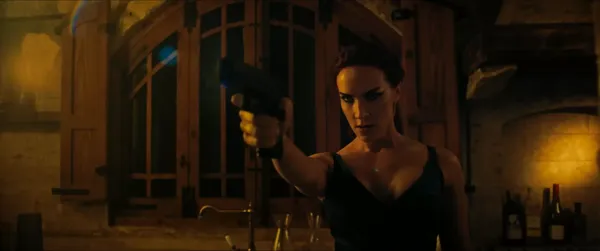
Few British film directors are as prolific and popular as Neil Marshall, who has built up a loyal fan following over 20 years and is in the fortunate position of being able to do what he loves whilst bringing the fans what they love. This time around, that means a return to working with frequent collaborator Charlotte Kirk, who plays a petty thief caught between an aggressive boyfriend and the woman she’s trying to seduce as her next mark. That woman is played by up-and-coming Polish star Anna-Maria Sieklucka, and she might have a few secrets of her own. There’s also a female serial killer at work in Malta, where the action is set, but is it one of them – and if so, which? The film is Compulsion, and when I caught up with Neil to talk about it, we began by discussing the erotic thriller genre, somewhat neglected in recent years.
“It's funny that you make stuff now on digital and do everything you can to make it look like an old movie, adding grain and trying to give it a vibe that’s somehow trying to capture the feel of those movies,” he muses. “Because it's kind of split between those kind of late Eighties, Nineties, like erotic thrillers, but it's also got a touch of giallo about it as well. I was going for that kind of gritty Sixties, Seventies kind of vibe with it as well, mixing all that in.”
The killer's look is very much a giallo type thing, I observe.
“One hundred percent,” he says, “I wanted to tick those boxes. It's the black mask and the razor blade and the leather gloves and things like that. I was wanting to try and make a giallo film in Malta. I always like to twist things around by having the women killing the men, having a female killer. It's also like a little twist on the Psycho vibe, isn't it? With the shot we see at the start. So yeah, I’m just playing with genre conventions as much as I can.”
 |
| Compulsion |
Without wanting to give anything away, there is a scene later on where someone is stabbed, which I loved because real life stabbings, as I understand it from the police and so on, actually take quite a long time, which we just don't see in films. What was the thinking behind that one?
“It was kind of a challenge to myself and to everybody else involved,” he says. “Initially in the script, I think it was just written that they attack him in the kitchen and it becomes a fight and then he gets killed. And we were having an early production meeting about it and the stunt guys said ‘So what do you want for that? Do you want a 20 second sequence?’ And I thought about it for a while and said ‘I'd like a five minute, five to six minute sequence and I want to shoot it in one take and I want to do it as practically as possible on the basis that, yeah, when somebody's adrenaline's up and you know they're fighting hard, something like that would take a while.’
“I thought ‘There's got to be some grisly way of depicting that, of how horrific it really is.’ And you put the audience through the wringer a bit with it as well. So that's why I came up with that scene. It was kind of a one take wonder because all the blood was practical. The only thing we added in was the blades of the knives. Everything else is one hundred percent practical. I knew that once our blood started flowing, the kitchen floor would become like an ice rink. So I designed the whole thing to be like on the ground that they were going to be on their knees and everybody was like slipping around in the blood as it came out.”
So that way no one falls and has a horrible injury.
He nods. “It was going to be so dangerous. But I thought practically in real life, if that was happening, you'd be doing the same thing. So we rehearsed the fight sequence again and again and again and again. And then on the day we set up the camera and we rehearsed the camera moves with the fight sequence. It's tricky because it's a six minute shot that has to be in sequence all the time when the actors are getting exhausted. But that added to the whole effect, I think, and eventually we were like, ‘Okay, this is kind of a one take deal because once that blood flows, it's going to take forever to mop up and reset.’ So luckily we got it in one take.”
That scene – and details elsewhere in the film – also serve to remind us that these are not superhuman characters. They’re all vulnerable in their different ways.
“Oh, very much so. You want to set up that any one of these characters could be the suspect and could be the killer. So they all have their mental fragility that's going on, their emotional fragility that's happening. There's something up with all the characters somewhere along the way that makes you think ‘That could be a killer.’ Ultimately, well, I don't want to give anything away, but there's more to it than simply one killer.
“It's playing around with that idea of, like, you're seeing inside a character's thoughts, but just because they're thinking it doesn't necessarily mean it's correct. So again, it puts questions in the audience's mind as to what they're seeing. The clues are all in the film for them to figure out who's doing what, when. But yeah, we're playing around with perception quite a bit.”
We talk about Malta, which looks like a gorgeous place to go and shoot.
“It absolutely was. It was such a great experience filming there. It's a beautiful place. The crew and everything was incredible. I had an absolute blast filming. It's my first time filming there, first time going there, and, yeah, that was wonderful. The film was written to be kind of non-specifically, somewhere nice, around the Mediterranean. And when we went out there and kind of got the flavor of the place, I was like, ‘Okay, let's just set it on Malta.’
 |
| Compulsion |
“So many films are shot there and not set there. I thought, let's actually set it on Malta – why not? I like the flavour of the architecture and the houses and things like that. So we found great houses and stuff for all the characters, and it had that very specific Malta architecture. The city itself and all the locations were really beautiful, and the weather was nice. It wasn't a bad place to go and film at all.
“We did it pretty fast. It was like a 25 day shoot. I think we were there for about four weeks beforehand. I think it was like two, three months total or something that I was out there.”
Sex scenes added to the pressure, because they’re never easy to get right.
“Yeah, I mean, obviously it's tricky. I've had to do things like that before on Black Sails. It wasn't my first experience doing it, but doing any kind of sex scene in films, it doesn't really matter what the context is – it's not sexy at all. It's like doing any action scene or any violence scene or whatever. It requires practice and rehearsal and careful planning. And, you know, it's these poor actors trying to do this stuff and recreate some kind of intimacy when there's a whole bunch of crew standing around, so it's awkward for everybody involved.
“The objective always is to try and create a safe environment for everyone concerned. In this case, you know, we spoke with all the actors beforehand and everybody was fine. I think all of them have done these kind of scenes before, so they're used to it, to a degree. And then it's just care and attention all the time, just making sure everybody's fine and clearing out the sets and all that kind of stuff. Then just making sure that you also get the performances, you also get the characters coming through.
“Generally speaking, I was just like trying to keep it to a suggestive minimum. I was not trying to go graphic with anything, but like, how can we get the vibe that we're after for it? And that's it. It’s about what we can do with that dramatically. I think of a sex scene exactly like a fight scene in that it's a dramatic scene in its own right. It has a beginning, a middle and end and it's telling a story. It's telling character stories and character beats.
“I think also, you remember in the Eighties movies where they used to have the sex scene and it was always some song playing over it and pretty shots of this, that and the other. And I think audiences have just got very, very tired of that kind of thing. No one wants to see that anymore. So it's just kind of like, we know what's going on. Tell the story, move on.”
There’s a really good rapport between the two leads, which gives the film a lot of energy. How did that develop?
“We did as much rehearsal as we could, just getting them to work together in prep. I was doing other stuff, so I left them to it. But yeah, they worked together quite a lot just to hang out together and get to know each other's characters a lot better, and it pays off.”
He’s always skipping around between genres and doing different things, so what’s next?
“Well, no more sex scenes!” He laughs. “I’m done with that. Now I want to get back to doing action and carnage and stuff like that. Car chases and explosions. That's more my style. I have a number of projects. I’ve got a World War Two alien invasion story that I'm hoping to do next, which is all written, it's ready to go. So we're going to start casting that soon and hopefully shoot that next year.”
 |
| Compulsion |
How does he keep going through so much? I tell him that it looks like when he goes to film in places like Malta, that's his holiday, because there’s no time to rest between films.
“You kind of have to enjoy those moments when you you're doing them, yes, absolutely. I haven't had a holiday this year. I'm just constantly trying to keep plates spinning, get irons in the fire, come up with new projects all the time. My imagination never switches off. I could do it on a holiday, for sure, but you kind of feel guilty if you're not doing something. I'm trying to get things made.”
Is it partly because he’s working with the same kind of team of people some of the time, so he’s keeping all of them employed as well?
“Sometimes, although it's not often you get to work with the same team because more often than not they're busy with the next one. I'm really, really keen to work back with a lot of the team that I did my early films with, like Dog Soldiers and The Descent, and get some of that team back together, because they've all been so successful and busy, it's hard to pin them down. But that's the dream. Working with that team again would be great.”
Descent has been getting a lot of attention recently because of its anniversary. How does he feel about it after all this time?
“I'm blown away,” he says, beaming. “I mean, who knew 20 years ago that we'd even be talking about it. It's coming back in cinemas in October. It's incredible. The fact that people still love it, are still scared by it, is quite a feeling. I'm very proud of it.”
Is he still enjoying everything as much as he did back then?
“One hundred percent. I mean, getting to do what you love is a rare thing. I love movies, I love making movies and this is probably why I can't take a break, because it's my passion, my hobby. I live and breathe these things, so it's not like it's work as such. So that's a blessing.”
Compulsion will be in cinemas across the UK from 19 September.