 |
| Ovary-Acting |
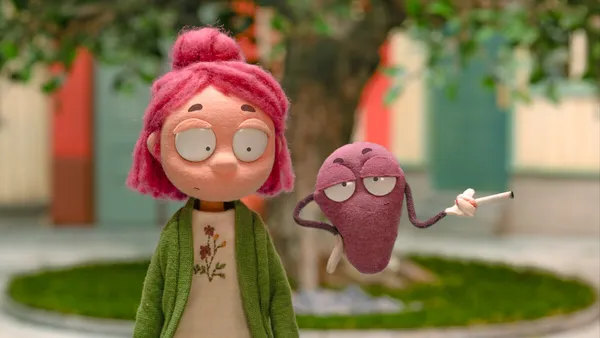
A piece of stop-motion animation which has a lot to say but still manages to be charming, and certainly quirky, Ovary-Acting tells the story of Eva, a woman whose friends and relatives keep pressuring her to get pregnant, until, in a bathroom during a baby shower, she unexpectedly gives birth to her own uterus. This is Ovy, who follows her around, cajoling her in a similar fashion, until she eventually feels ready to defend herself. By then, however, they have formed a strange sort of friendship.
Ovary-Acting has been nominated for an Annie animation award and, more recently, longlisted for a BAFTA. I met director Ida Melum to discuss it, and noted that, although she didn’t write it – working from a script by Laura Jayne Tunbridge – it feels like a very personal project.
“It's lovely working with Laura as a writer again,” she says. “This is our second film that we're working on together, and the collaboration on both projects has been very similar. I usually have the bare cornerstones of the film and the idea, and I bring that to Laura. At this point, we've established this really great relationship, and we are able to feed off each other's ideas, which is super lovely. But I think my mind lives very visually, and I’m sure hers does, too, but she's able to take all of that and translate it into words, and then everybody else can understand what I have visualised in my head.
“It was definitely a very personal story. I was definitely getting bombarded with all these questions about whether I was going to have my own. And all the women who naturally came to this project, we all had experiences with this, but we came from different backgrounds. Some had kids young, some didn't want kids. Some were trying for kids. I think that was super lovely, to have such a vast group of amazing women behind this story. It just added so much nuance between the lines, which I think people pick up on.”
Did it help to broaden the set of issues that the film takes on?
“I think so, because it's such a broad topic, and then there's so many. As we said, there is so much nuance to it. It's just one big gray area, isn't it? I think having such a diverse team really emphasises that, because the film was never about telling people what was right or wrong. It was just about showing them everybody should be allowed to do whatever they want, despite what society expects of them. And it felt very safe exploring that topic with such a great group of women.”
We talk about the way the film is animated.
“I discovered that style with my previous short, Night Of The Living Dread,” she says. “And on that one, I really experimented because I hadn't found anything that felt like mine just yet. And then I stumbled upon that mix of fabric for the skin and felted hair, but also keeping it snappy and cartooning by adding 2D facial features. I really fell in love with it. It's quite technical and requires a lot of work, but I really like the outcome. I really like the look. You get this perfect mix of digital but tactile. And so when I wanted to do Ovary-Acting, I just wanted to continue that style and see if I could push even further. The eyes got even bigger, more cartoony. We were a lot braver with the 2D, a lot more obvious. I was just pushing it. I wanted to see where I could go.”
What about the design of Ovy? I've seen animated uteruses before, I explain, and they generally tend to be slimy or at least shiny. This is something quite different, a very cute looking organ floating around.
“This is a good point,” she says. “You should never say never. But we just wanted her to be charming and sweet and not gory. We didn't want her to distract from the story. What was exciting about Ovy was her personality, because she's so over the top and very in your face and very unapologetic about who she is. But she also has a flaw, right? She doesn't listen to anybody. She just blazes on and talks over people, so her big lesson was that she needed to learn to actually listen.
“The design came very naturally. We had a massive debate about it, because by designing what Ovy looks like, you're designing what their internal organs look like or what they’re made of. So we had some discussion. Should she be made out of clay or just felt, or was she fuzzy? In the end, I just wanted Eva and Ovy to feel two halves of a whole. That made it clear to me that she needed to be made out of the same fabric, but in a different shade.
“We also really tried to match Ovy's skin tone with Eva's hair, but they became a slightly more different than I anticipated. I still think it worked out. We wanted them to be like, from a distance, you could link the two together by both texture and colour, or your brain would subconsciously pick up that they were a team or belonged together. So, yeah, all those things dictated our design. But the big eyes was a non-negotiable.”
So why make it a musical?
She laughs. “It was actually a good friend of mine when I was saying ‘Oh, I think this would be a great musical,’ but I can't write seven songs for a ten minute film. There's not enough time and not enough resource. And then she said ‘It doesn't have to be a whole musical. You could just have one number.’ And I was like, ‘Oh yeah.’
“I love musicals. I think they're great, but they're also really silly and fun. There’s something so over the top about people breaking into song. But it either it really works or it really doesn't work, right? There's no wriggle room. So I just wanted it, and as soon as I had the idea, I couldn't let it go. It became this perfect way of getting all this information across. They were able to say all these things that they had on their minds in an interesting, entertaining way, also visually.
“I think that made it really fun and I just love it. I usually struggle to watch my films when I finish them because I've seen them 10,000 times, but I'm still not sick of the song. I really am not. I find it so catchy. I'm really happy with it. And it was just a good challenge, wasn't it?”
I tell her that I was particularly struck by the scene at the start of the film in which Eva attends the baby shower, just because there’s no much happening in it, with lots of characters to keep track of in each frame of animation. It is, I say, the second most complicated film I’ve seen like that this awards season, and of course she’s curious about the first, which I explain is the Italian stop motion short Playing God, with its cast of 82. She’s heard of it, she says, and is looking forward to seeing it. She also thanks me for noticing the supporting characters in her work.
“There's always a pull, I think, in stop motion and in most indie projects anyway – you know, you have this vision as a director, like, ‘Oh, we have 20 guests, but the budget and the schedule only allows for five, because they need to be filled, they need to be animated, all of this stuff.’ So there's always a tug and pull between that and what time you have available to animate. Initially, I probably would have preferred a little bit more. I think we could have done a little bit more with kids and chaos. There was actually a whole sequence in the beginning of kids being nasty and picking their noses, and drool and everything, that was going to help Eva freak out even more, but because of time and because of schedule, we actually had to cut it.
“When it comes to actually animating the characters, , I think that comes down to me and my good friend and collaborator, Rich Farris. He came to Norway to shoot the film with me and he animated that big wide shot that you see with all the guests. He’s great at adding those details and giving the women characters and personalities. We discuss all the things and we have ideas.
“It's a tricky one, to make someone come alive but not steal the whole show. That's like a constant balance, I think. But yeah, it's fun. It's tricky because with puppets – if they don't move for a while, they look a bit dead, but I don't want him to be moving all the time. You're just feeling your way through it. But that wide shot with all the guests, that was rich. I think he did a really good job with that.”
What happens to her puppets after the filming is finished? Is she somebody who keeps them?
“On this one, we actually have duplicates of Ovy and Eva,” she says. “We did that in order to run two units simultaneously. And so the studio in Norway where we shot everything, they kept one version of them. And then I got to bring one Eva and Ovy home as well. And so I take them on tour, I bring them to the festivals, and then I bring them to the viewings. People seem to love seeing them up close. In this case, the big star is always Testy, which is really fun. He always makes people laugh. When they've done their little festival run, I put them on display and keep them, and they're really great references for new projects. I used my previous puppets and Night Of The Living Dread as a great reference for Ovary-Acting, so it's really good to keep them.
Will she take them with her to the BAFTAs if she is successful getting to the nomination stage?
“Oh, my God. I haven't even considered,” she says, pausing for a moment to think. “Maybe I should. Definitely Testy on the red carpet. Yeah, I should definitely consider this. That would be amazing. I think that would be so much fun. Also, Ovy the puppet, she's so tiny. She's like four and a half centimeters super small.” She holds up her hands to indicate this. “Yeah, I should definitely consider that.
“It's the first week of January we got the Annie nomination, which I was over the moon about, and then that Friday we also got on the BAFTA longlist, which I just did not expect. And it's been insane. It's been wonderful. I think as a team and as a filmmaker, you know, all we wanted and hoped for was that people would enjoy our film, and with the reception we've been getting so far, I think the team managed to do just that, so it's really nice. And then obviously, these big accolades are really fancy and fun and really cool, and hopefully it will lead to more projects down the line.”
She has a couple more films that are about to enter development, she says.
“One is about sort of like a werewolf themed idea where instead of turning into a werewolf on a full moon, she turns into her mom. It's very silly idea, but again, I keep wanting to make films about women in crisis and also about subjects that are quite universal and things that we can recognise ourselves in, like becoming your parents or catching yourself doing things that are very similar to what your parents do that annoys you. And then also ageing and all that stuff. Especially women aging, you know? All that pressure we have on us to look a certain way. But yeah, that is definitely a subject I'm super interested in, so that's what I'm developing at the moment, and then we'll see.”