





Eye For Film >> Movies >> Closure (2026) Film Review


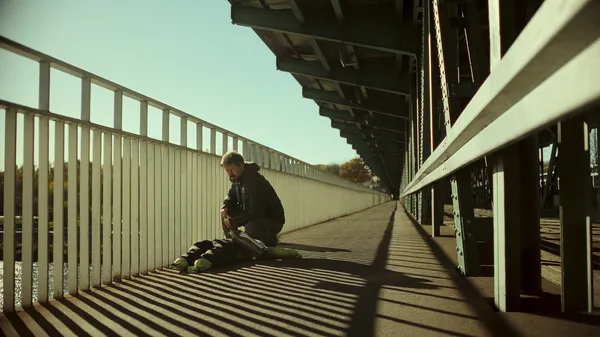

Closure, Michał Marczak’s return to Sundance, after 2016’s All These Sleepless Nights, begins with a search that refuses the solace of a conclusion. Daniel’s teenage son, Chris, is last seen on CCTV near a bridge over the Vistula, and what follows is not a mystery with clues so much as a vigil with equipment. Weeks turn to months, then years, and the river, Poland’s longest, becomes less a location than a repeating question that cannot be answered at human scale.
Trying to negotiate closure as a discrete event is futile; here, it’s a continuous and arbitrary process, revised daily by endurance, exhaustion, and whatever the world allows you to know. A determined father searches with the stubborn precision of someone trying to make grief measurable, but the attempt itself starts to warp the life around it. His search becomes a strain on the family, and Marczak frames it as a battle between an insurmountable river and a surmountable man. The water is indifferent, the human body finite. In his garage, Daniel keeps a map of the Vistula and traces its winding turns with his finger like a vein of pain, as if the river were not geography but anatomy.
The Polish director understands that the work of searching is also the work of deciding what not to show. When the search yields bodies that are not Chris’s, the images refuse the easy charge of proximity. The distance is not coldness. It is dignity, and it also sharpens the film’s quiet critique of institutions. Daniel and his team locate what authorities glide past, and Closure very subtly calls out the failures and limits of official searching for missing people, not through accusation but through juxtaposition, asking who keeps looking, how, and at what cost.
Marczak shows Daniel using modern tools to simulate certainty – boats, drones, GPS trackers, improvised experiments that model currents and probability. At one point he drops a dummy body from the bridge to test what the river might do. Later, as if to test whether technology has made him forget older ways of knowing, he throws loaves of bread into the water and tracks their drift, a folk method that feels both tender and cruel, because it admits what the machinery keeps trying to deny.
As the physical search stalls, the narrative shifts into the digital realm. Daniel begins tracing Chris’s online footprint, trying to understand the mind he cannot reach and the isolation he did not see in time. The move is conceptually sharp. A river is a flow you can point to. An online life is a flow that pretends to connect while enabling private descent. The documentary’s most unsettling insight is that both environments can swallow someone without leaving a trace that feels commensurate with the loss.
The story widens further when Daniel starts helping others search for missing relatives. This expansion can feel like a structural gamble, risking a dilution of the film’s most intimate stake. Yet it also reveals what time does to a person trapped in limbo. He becomes a reluctant specialist in not knowing, someone who cannot finish his own sentence, so he starts standing beside other people mid-sentence. In that reframing, the widening is not a detour but a transformation: grief turning outward because it has nowhere else to go.
Closure isn’t waiting in a river in Poland. The Vistula keeps flowing, indifferent to narrative, while Chris’s father keeps tracing its bends like a vein of pain, trying to turn the unanswerable into something that can be carried.
Reviewed on: 23 Jan 2026