





Eye For Film >> Movies >> The Two Towers: Extended Edition (2002) Film Review



The second part of Peter Jackson’s Lord Of The Rings trilogy, The Two Towers is probably the part that suffered most from being cut back to the acceptable running time of 179 minutes. In retaining the essential parts of the story, it ended up quite unbalanced – the book is too, but at least with that it’s easier to skim certain bits. Here, curiously, adding material even to the problematic sections makes them more engaging rather than more tedious.
As in The Fellowship Of The Ring: Extended Edition, there are several tweaks to minor scenes which help to flesh them out, and there’s quite a bit more focus on strategic planning, making the heroic characters seem more like real military figures rather than just good soldiers or battlefield commanders. They exhibit understanding appropriate to their stations, and the older characters demonstrate the benefits of experience. A line from Legolas which always jarred, when he’s out on the balcony at night in Rohan, works much better in context.
One of the ways that Jackson diverged from the text when originally adapting Tolkien's books was in making much more of the female characters, since there are so few. Here we see more of both Arwen and Éowyn, which makes more sense of the complicated relationship each of them has with Aragorn, and makes it easier to understand that he’s grieving the anticipated loss of Arwen through much of the story. We get a better understanding of the pressure that Éowyn is under before she meets him, trying to keep things on an even keel at Rohan as Wormtongue pours poison in her uncle’s ear, and see why that uncle invests so much in grooming her to be his successor – how she is discouraged from combat not just because she’s female, but because of her capabilities elsewhere.
With Arwen seemingly fading from the picture, Aragorn and Éowyn’s attraction to one another seems like a natural thing for both of them, even if he’s old enough to know better – he reveals his actual age at one point, which may give some viewers a shock. There’s a sense that with Éowyn he can be the ranger that he wants to be, whereas with Arwen he must accept the destiny that everybody else has planned for him, as a king. At any rate, in this version he seems conflicted and tempted to break his own moral codes; Éowyn no longer comes across like a child with an unlucky crush.
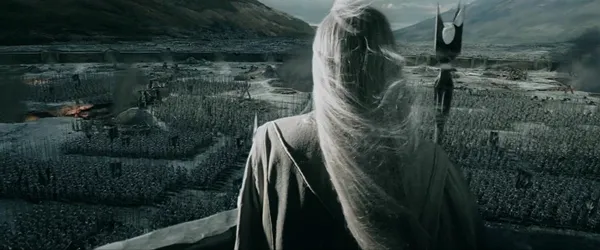
If anyone is unlucky in relationships, it’s the ents, and here we get the tale of the ent-wives, one of the stranger bits of Tolkein’s mythos. The ent parts of the story are more spread out and feel weightier, less like an annoying diversion. Partly in consequence, we also get to know Merry and Pippin better. The battle in which they are involved has a bit more action, and a more satisfying conclusion. Saruman’s ineffectiveness makes more sense.
The extension of other scenes means that the battle at Helm’s Deep no longer dominates the film the way it once did, and this makes the work as a whole feel less grim and pessimistic, perhaps for the simple reason that we spend proportionately more time in daylight. Not a great deal is added to it. We do get a little more in Osgiliath, however, and this helps to round out Faramir as a character, better expressing the loss he feels at his brother’s death.
There is more world building here than in any other part of the trilogy, and the additional material means it’s better balanced with character development. Theoden and Arwen, in particular, get more time for reflection. Overall, the different strands of the story flow more smoothly around one another, and the overall story moves at a more consistent pace.
Reviewed on: 14 Jan 2026


Director: Peter Jackson
Writer: Fran Walsh and Philippa Boyens, based on the books by JRR Tolkien
Starring: Elijah Wood, Ian McKellen, Viggo Mortensen, Andy Serkis, Miranda Otto, Liv Tyler, Christopher Lee, Orlando Bloom, Sean Astin, Billy Boyd, Bernard Hill, Paris Howe Strewe, Dominic Monaghan, John Rhys-Davies
Year: 2002
Runtime: 235 minutes
Country: New Zealand/Aotearoa, US
Festivals:
Search database:
