 |
| Solstice |
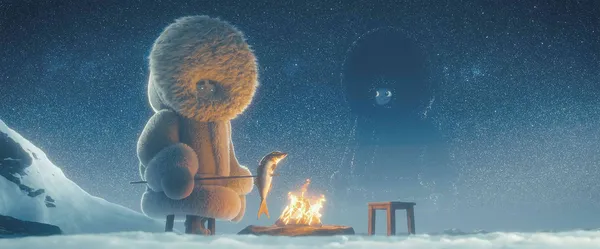
In the middle of winter in the Northern hemisphere, most people are longing for long summer days, but midsummer is a lonely time for the animated star of Luke Angus’ BAFTA contender. A beautifully constructed short film with a lot of heart, Solstice follows an Inuk man alone in the icy realms close to the pole. Having lost the woman he loves, he has no time for sunlight; he longs for the stars, when he can see her spirit again. We watch his story unfold across the seasons until he comes up with an ingenious solution to his problems. This interview contains spoilers but should not spoil the experience of the film.
“Everything worked backwards from this idea I had for an ending,” Luke explains when we meet. “Poking holes in an igloo to make it replicate the night sky felt like such a great idea for an ending. Because igloos are typically found in parts of the world where they don't get the stars for months at a time. So during the summer when they don't see the stars, I thought, that's a really nice rounded story conclusion.
“It was just a really fun process of working backwards from there. Why would they want to recreate the night sky inside their igloo? And then all these natural themes started to come in, to do with the loss of a loved one who they would look up and see in the stars. In the summer when there are no stars, they're on their own again. So that was it, really. I don't know where that idea came from. It's one of those ones just appears in your brain one day.”
It’s dark outside the window of his small study, and between that and his accent, I surmise that he’s also in Scotland. Most people here, I note, look forward to summer, so it was nice to see this flipped around.
“Yeah, I do find that I like the flipping it on its head like that. I always had a love for the night sky. I grew up in rural Scotland so we had proper stars and could see the Milky Way. I loved that when it would come back to winter and you got these long nights and you could go stargazing – for me, when I went to bed early as a kid, I could do some stargazing before I went to bed. I managed to do it with my dad as we had a telescope out in the back garden. So I like this idea. I like flipping it and saying ‘Oh, the stars are out!’ The night sky is this beautiful thing that you get in the winter, especially the further north you go.”
I suggest that winter might also be preferred by the film’s protagonist because it’s a time when he can go about his day to day activities more safely. in summer – especially now, with climate change – the ice becomes dangerous.
“Yeah, that's true. It was a difficult sort of montage to write, to come up with all these little scenarios that are being mirrored in the summer montage and the winter montage, and what he gets up to, and trying to show that he enjoyed his winter more and things were easier for him during the winter. Obviously the loss of his partner in the film happens during the summer when the wet ice is melting and it's thinner and he has to cross to collect wood.
“It was quite difficult to write that when you are naturally thinking what they do to pass their time, and they’re really completely isolated, with nothing around in a completely desolate environment, essentially. But I think trying to keep a positive spin on keeping the winter being his preference and what he loves, and showing the tragedy happening during the summer to further emphasise his love for the winter.
“I am a full time animator, until recently head of a studio in Glasgow, and I do a lot of freelancing. I’ve been animating for almost 15 years now, professionally, but I've always just made short films in my spare time. You've technically got this entire film studio in a piece of software, and so with enough time and patience, you can make your own short films. Over the years, just in my professional work, I built up a lot of skills that stretch across the entire pipeline of animation. My short films are just a way to test out new techniques and even new software and new styles of animation. Just because there's no risk, there's no client at the end of it that I worry about pleasing. I'm just doing it for my own interest and my own fun, really.
“Solstice was just another example of that. The big furry hood he's got is almost a character in itself in the film, and it's so central to the charm of his character, and that was a very big technical challenge. That's something I couldn't do prior to making this film. I had to learn how to do that, all that process. The most technical scene is when his furry hood gets covered in snow and he sleeps out in the snow by mistake and kind of freezes over. Just technically speaking, that was very challenging. But yeah, that's an extra layer of joy.
“Why I make these films is just to push myself, technically speaking, and try to learn a bit more. I have an idea first and then figure out how to make it. So I made the whole film by myself over about four years, roughly speaking – but you know, it was just in spare time whenever. So saying four years sounds like a lot, but if you were to work on it full time, it might be something more like a year or maybe a year and a half. It was just a very long process, trusting the process that I know well from my professional work, and just going through a step at a time.
“There probably were some things I would have liked, technically speaking. I could have imagined some of the night sky treatment being all 2D hand drawn animation, perhaps. I don't do any 2D hand drawn animation. It's not something I could just quickly learn mid-career. Someone else could have done it, but I really enjoy the passiveness of it being a solo project. If I bring other people on, I can feel like I can have a bit more pressure behind me to get it finished in time.
“I really enjoy the piece of the headspace it gives me to just know I can take as long as I need. I've never really done 2D animation. I didn't really want to do it badly, and have that scene, so I found ways of doing it which I'm also really happy with. The sort of style I found for his partner in the stars, and how she moves, and the endless vast sea of stars, I was actually quite...” He hesitates. “For some reason I didn't want to do the classic constellation look with lines connecting stars and that being the person, the shape there. It just was a bit too, you know – we've seen it before.
“I had this idea where there's just so many stars in the sky in that part of the world, there's almost no part of the sky that's not covered in stars. Therefore you've almost got the entire form of her. Not just a few dots to make her up. Every detail of her is there.”
We talk about the film’s score.
“I've had so many compliments on the music,” he says. “It has been nice because I would have liked to have had a completely original score written that was more to the budget. I didn't have thousands to spend on a really good score. I didn't want to do it cheaply because I was very precious of the film. And it's amazing the damage bad sound can do. And it's also incredible that with good sound, how much you can elevate it. So I met somewhere in the middle.
“I had confidence in the sound, but essentially the process was sourcing some artists on some libraries I found online. You know, publicly available, but licenses that you're acquiring. You're still paying for it. I found a few artists who were just incredible online. I chose three different artists for this. The artists themselves aren't connected to each other, but they shared something tonally, and the soundscapes they were making were somewhat connected.
“I downloaded up some different stems and tracks from them and I mixed all their different music together basically. So I’m partly responsible for the sound, but obviously cannot take credit because it was their incredible talents actually writing the music and composing those pieces and I was splicing them together. So I was sort of in between, budget-wise. I was obviously spending on licenses and getting the license for those tracks, but I didn't have the budget to do my first choice, which would be to hire a very talented composer.”
If he wins a BAFTA, it might be easier to get funding for his next project, I suggest. Is he excited about the possibility?
“The fact that I'm in this final six – I cannot overstate how crazy that is. I've just been in my living room on a laptop computer working on this film. Then to be alongside other – I mean, I've seen the films in the category. They're all unbelievable. And to just be on a list that is as public as this...I've done film festivals before, but never to the level, so I just couldn't believe that was I've made it that far. So I genuinely say this: I'm so happy to just be on this list and to have got this far with this little film.”
He’s making a science fiction film now, he says.
“It is tonally very different. Much more realistic. It's not about this sort of charm and whimsy of silliness of the characters. It’s much more ambiguous – I wanted to try something that wasn't quite so tied together. There’s maybe more of a conversation at the end of it, as to what happened and as to what people interpret with the ending. I enjoy that sort of discussion element. It'll be, I think, a six minute film, and it's called Redivider.”
The new film has some more topical themes, he says, so he’s keen to complete it more quickly, and he may put it on YouTube straight away rather than taking it to festivals. Solstice felt more like a festival film, and worth taking on that lengthy journey.
If he wins a BAFTA, he’ll know he was right about that.