




 |
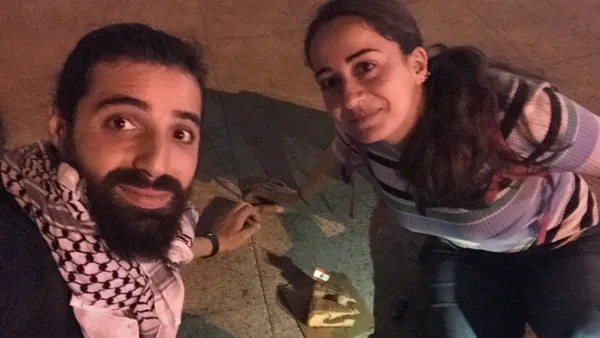
| Abd Alkader Habak and Janay Boulos. Boulos: 'Through developing the idea and having a strong team, we decided that the best way to tell the story is through our personal love story' Photo: Abd Alkadhu Habak |
Given how central it is to the film, let’s talk about the point at which you decided to make a film about your relationship?
Janay Boulos: We are both journalists and filmmakers and storytelling is part of our life. And I think that we wanted to tell the bigger political story of what's happening in Lebanon and Syria and the region. Through developing the idea and having a strong team, we decided that the best way to tell the story is through our personal love story.
With 13 years of your own personal archive what to include and exclude must have been difficult to decide. In the press notes, you also talk about how psychologically challenging it is to go over a lot of traumatising footage, especially for your team. Tell me a bit about how you colour coded it to help navigate that challenge.
Abd Alkader Habak: It was hard because since I left Syria, I’d never opened my hard drive. I just left it closed here in the closet here in London. But in my head, I always have a memory of what I have footage of. When we started working on the film, first we had to create a very like protected system to protect the team. We were working with footage that was traumatic but at the same time we were working with a team who had never experienced war or working with journalists on the ground. So we created our system to protect our team.
I noticed as well that you were working with psychotherapeutic support. It is interesting that you built that in, was it useful?
AAH: It really helped our team. I was talking to our therapist about how to protect our team and it was hard because our editor needed to access some footage but at the same time we didn’t want him to access the whole thing. So we created a traffic light system. I sat for two or three weeks trying to identify the folders. We have green, which is something he can access, yellow, which is a little traumatic and red, which is traumatic footage. That really helped him not to see a lot of red footage except if we needed that.
Once you were both in the same place, and continuing to film, that must have presented its own challenge of when to get the camera out, especially when you're with your families.
JB: Because we are filmmakers and camera people, I personally always had a camera in my hand since I was eight. I was filming with my mum and dad for a very long time, through everything happening in Lebanon for no particular reason, just to document it. I's kind of a way for me to experience the world and sometimes it makes conversations with them easier when you're holding a camera, especially if something is challenging or difficult to express. So from my perspective, my mum and dad were always used to me having a camera around and filming. Most of the time when I’m filming in Lebanon, something politically is happening like elections or a revolution, so I'm taking their reflection.
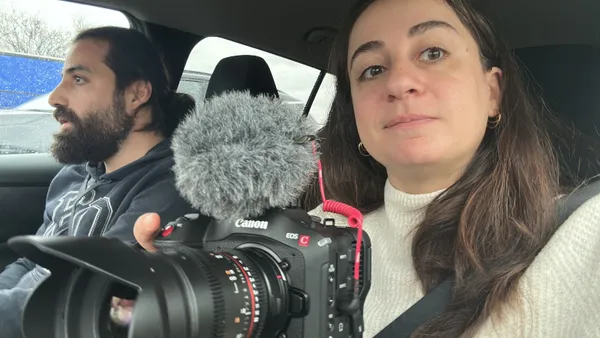 |
| Janay Boulos Abd Alkader Habak. Boulos: 'Because we are filmmakers and camera people, I personally always had a camera in my hand since I was eight' |
AAH: For me, I have my brother, who after I left Syria, took up and continued my journey filming with my parents, since I wasn’t able to go back there. But when the Assad regime fell it was good because my brother, who was with me all the time, was filming me so when I went to my parents house for the first time and met them, he was documenting almost everything.
Beyond your relationship, you also touch on the impersonal nature of news gathering in the world, the way that editors, perhaps necessarily they might argue, have to keep a distance from people who are shooting footage in warzones. Was that something you wanted to highlight?
JB: It was, because that’s part of my experience and part of my journey. It's important because it's how we met and it's important because that's also what drove us to make this film in the end and this is the journey we are on. So because of being in a newsroom and experiencing that and understanding what makes a story and what stories I want to tell and wanting to be free of this editorial restriction, we've started a production company and I'm working now fully in that. So that transition from the newsroom to making this film and other films we have is part of my story and part of our relationship.
The other thing your film highlights is the way that becoming a ‘known hero’ or ‘face of a conflict’ can come at a price. After that happened to you did you feel differently about the way you shot others?
AAH: The character I’m shooting is always a hero from my point of view, from the point of my camera. Shooting in Syria as a civil journalist, I never got journalism training. I taught myself how to film and how to cover news and it was a huge journey to get the right thing out. Many times we shot stories and they decided not to take them at the last minute and that’s what makes us feel less important. If the country was calm it was like, “Yeah, we don’t need any footage,” but when the bombing was restarting, it was like, “Okay, we want the footage now”. There’s a big barrier between the people who are working on the ground and the newsroom and it’s really hard to understand that.
As a result of this film, you’re likely to become known heroes of a sort as a result. Do you have any concerns about that given that you’re normally behind the cameras or doing the editorial?
JB: For me, it’s been quite emotional Since we were working on the film, every cut we see, every scene, my first reaction has always been that I have to cry. I think at some point you have to separate the personal from the message and the reason why we did the film. We are using our story as a tool to tell a bigger story and that's what we want to keep in mind. Later with our impact campaigns we want to try to use this film as a tool to impact how journalism works and how filmmaking works back in Lebanon and Syria. It’s a tool for a bigger means, in a way. It’s our personal story but it is also a means to something else.
Tell me more about that campaign.
JB: We want to develop a sort of immediate system that trains local journalists and reporters to tell their own stories and then connect that to a social media platform, maybe YouTube, where we can help them develop documentaries of short or medium lengths and put them out there. Then also develop connections with outlets, so maybe we can work with them to pitch to Al Jazeera, to The Guardian to other sorts of outlets. So creating this sort of local pool of journalists who can tell their own stories and giving them the tools they need and then an outlet. It's a service to get their voices out to the world and is also training. That’s what I would like to do moving forward, because it's needed at this time.
Just to finally return to the personal, you’re both still based in the UK but I was wondering how you feel about that as you both have roots in different places and you could say that the UK has become an increasingly hostile environment towards people who have migrated here.
AAH: We like living in the UK and we always say we are living in the UK. The UK is the place where we get together and relax.
JB: We need a base in Europe with access to the international world and the stories we want to tell ultimately are from Lebanon and Syria. Being this bridge between there and here [the UK] is quite important, so I guess it’s going to be home for the foreseeable future.
Birds Of War will premiere at Sundance Film Festival on January 24