





Eye For Film >> Movies >> Don't Trip (2025) Film Review



“Don’t give up!”, they say. “Follow your dream!”, they repeat. So, a nerdy youngster from, for instance, Pittsburgh, fills his bags with dreams, ambitions, some talent and ideas, and goes west to Hollywood willing to do everything to succeed as a screenwriter. There, however, the kid faces the complex and convoluted gatekeeping system and the caste of nepo babies who have a head start over him. Then the guy remembers the words he has been fed by Hollywood all his life and doubles down his efforts.
Hollywood can be a cannibalistic place that feeds on its own and their broken dreams. We know it from Sunset Boulevard via The Day Of The Locust, Trumbo and Mank. And now, Alex Kugelman tries to walk that well-trodden path with his feature-length debut Don’t Trip, but with some additional flavours of horror and satire and an indie, extremely modestly budgeted approach to filmmaking. Judging by his background in production assistant jobs on a few projects – features, shorts and TV series, Kugelman knows what he is talking about, but the question is whether it is enough to make Don’t Trip click with audiences and critics and to make a splash that will dent the robust, well-oiled machinery that Hollywood certainly is.

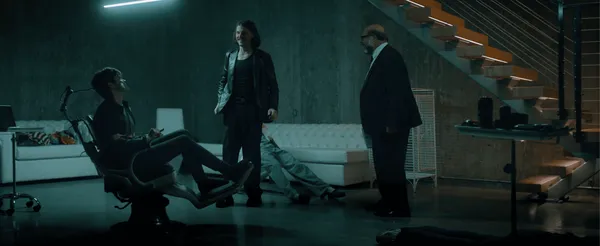
Dev (Matthew Sato) is determined to make it in a movie business as a screenwriter of an ambitious future superhero action comedy blockbuster, but he cannot get it produced that easily. He tries hard to get to the decision makers, but his boss, the agent named Jane (Pell James) fires him from his assistant job for going behind her back. Dev’s girlfriend Monica (Olivia Rouyre) advises him, somewhat naively, to drop the whole Hollywood dream and to try to make his movie on his own with no budget, but he is set on getting famous hit-making producer Scott Lefkowitz (Fred Melamed in a late cameo) to read and greenlight his script. The path to him, however, goes via his party-loving son Trip.
As we can assume, Trip (Will Sennett) is quite a character. Not only that he is a party animal in and out of rehab facilities, but he also sees himself as a rebel-hipster-poet, minus the talent and the idea. He also acts like an entitled spoiled child, but he has the money and the power to dictate the terms of friendship between him and Dev who thinks that Trip is his ticket into the world of movies. As their camping trips and Jackass-like videos threaten to dissolve the relationship between Dev and Monica, Dev also realises that Trip is a sociopath who can react in an unpredictable way when he realises that he is being played…
Probably the best two sequences of the film are the opening and the closing ones. The opening is a textbook horror set piece where a beautiful young woman (Chloe Cherry) browses a Hollywood mansion only to get stalked and murdered, while the closing one features the biggest name and the best actor in the cast, Fred Melamed, as a Mephistophelian producer who tries to strike a deal that would push every inconvenience under a rug. Between those two, the whole thing seems quite predictable on its track from a Hollywood satire to a schlocky horror piece. There are some clear insider’s insights here, like Jane’s double speak, so typical for professionals who have to pretend to promote independent voices while doubling down their efforts in gatekeeping, but Kugelman overplays his hand in that scene, signalling that he will do so in every other.
Some decent production values aside, and they are quite okay for such a tight-budgeted flick, Kugelman makes a cardinal mistake in the character development department and with casting choices. Simply put, the characters, whether too complicated or simplified, are always present in the same way, more or less, rather than showing new traits as the plot progresses. That puts the actors in an awkward position, since some do not have much room to add depth to their characters and others have to wrestle with task of expressing multiple traits at once, which does not seem genuine. Even Fred Melamed as the trump card ends up working against the rest of them because he shows his command of the scene and his improvisation skills where the rest of the ensemble fails.
There was a simple solution for the whole ordeal: a short film instead of a feature, with the repetitive middle section of the push-pull dynamics between Dev, Trip and Monica packed into a montage sequence. In that case, the question of reach seems reasonable, but only on the surface, because Don’t Trip does have that much of it in its current format either.
Reviewed on: 16 Jan 2026


Director: Alex Kugelman
Writer: Alex Kugelman
Starring: Matthew Sato, Will Sennett, Olivia Rouyre, Fred Melamed, Pell James, Chloe Cherry
Year: 2025
Runtime: 97 minutes
Country: US
Festivals:
Search database: