





Eye For Film >> Movies >> The Return Of The King: Extended Edition (2003) Film Review

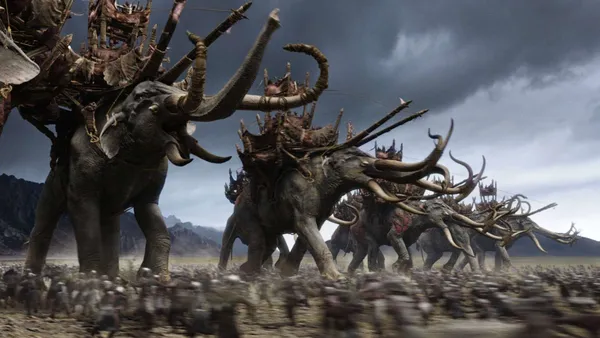

With almost an hour of additional footage, this third instalment is the most significantly altered of the Lord Of The Rings extended editions, and if you are to see only one of them on the big screen, this is the one to choose. Almost every part of the story benefits from being more thoroughly fleshed out, and the fact that only minimal alterations have been made to the scenes set in Mordor means that they balance much better with the whole, no longer sapping its energy. They are now welcome opportunities to catch one’s breath during the battle scenes, rather than an irritating distraction at inopportune moments.
Early on in this expansion of The Return Of The King, we spend more time with Merry and Pippin, who are enjoying their discoveries in Saruman’s larder. There is also a scene tying up the story of Saruman himself, and Wormtongue likewise, which resolves the awkwardness of the original cut – we are no longer left wondering about the possible risk from a capable enemy who seems to have been forgotten about. The time spent with the young hobbits also adds emotional weight to their subsequent parting, and helps to explain Merry’s desire to go into battle.
Later, when Pippin is in Minas Tirith, there’s a brief scene in which he speaks with Faramir which resolves a practical question and gives us more of an insight into who Faramir is when he’s not busy being heartbroken over his father’s rejection or fighting hopeless causes. We see more of Pippin’s activity as a guard of the citadel, get a proper sense of how out of his depth he is and in the process, gain a better understanding of how overwhelming the war – or any war – is for all involved.
As in the earlier extended versions, but here most of all, there is a lot more focus on battle planning and on what’s going on at a tactical level during the great battle itself. In particular, we learn more about the ghost army, getting to see their initial encounter with the corsairs who had been a key part of Sauron’s plan, so that the arrival of that ship near the end no longer feels so much like a deus ex machina.
Numerous small changes work together to change the character of the battle. it is no longer a splendid spectacle, full of elegant moves and tinged with comedy. Those elements remain, but overall it is far grittier and more visceral, an immersive experience. This is party because of the introduction to it that we get as we follow Pippin, but largely because we spend most of our time with Éowyn, who has never been in a battle before. Her heroism extends far beyond the act of taking on a nazgul, and that incident has horrific consequences for her. With her story centred in this way, she becomes much more than just a secondary love interest for Aragorn, but for those who find her appealing as a romantic character there is, towards the end, a hint of what will happen between her and Faramir, more substantial than their exchange of glances in the coronation scene.
Where The Two Towers lost some of its grimness in the extended version, this film feels darker, with more focus on the sacrifices necessary to defeat evil on that scale. it is also deeper and more resonant, as we get to see more of what’s at stake for individual characters. Aragorn’s transformation from ranger to king feels more organic, less forced, and we get a clearer understanding of the courage it takes for him and his troops to march on Mordor in their final effort to help Frodo complete his mission.
Almost four hours in length, this is a lot to sit through, but it’s ultimately a far more satisfying experience – a fitting final chapter for a tremendous cinematic experience.
Reviewed on: 15 Jan 2026


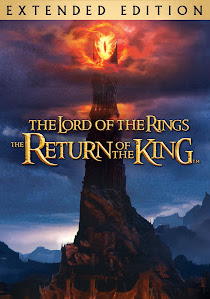
Director: Peter Jackson
Writer: Fran Walsh and Philippa Boyens, based on the books by JRR Tolkien
Starring: Elijah Wood, Viggo Mortensen, Ian McKellen, Miranda Otto, Andy Serkis, Sean Astin, Orlando Bloom, John Rhys-Davies, Bernard Hill, Billy Boyd, Dominic Monaghan, David Wenham, Liv Tyler, Christopher Lee, Hugo Weaving
Year: 2003
Runtime: 263 minutes
Country: New Zealand/Aotearoa, US
Festivals:
Search database:
