





Eye For Film >> Movies >> The Bog (2026) Film Review



Crime has become a contemporary goldmine, and streaming platforms tirelessly dig in search of the next corpse. In 2024, productions of this kind accounted for 32% of scripted titles commissioned by major services, reflecting our collective appetite for genre cinema. Scandinavians have their dark landscapes, the British local oddities, and Americans serial killers for export. On the map of genre curiosities, Baltic noir likewise demands a seat at the table. The Bog (Klajumā aiz meža), a Latvian-German-Estonian co-production directed by Reinis Kalviņš, nevertheless proves that merely plunging into muddy waters does not guarantee that viewers will follow.
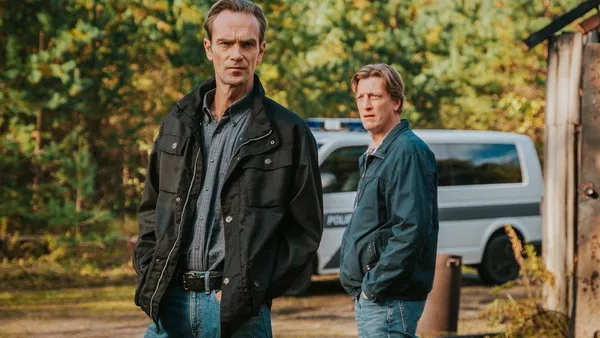
In a small Latvian town, the earth conceals what we remember and what we would rather forget. Drunk Ādamsons (Edgars Ozoliņš) discovers a boy’s body in a peat bog. Police officers Brože (Kaspars Zvīgulis) and Keziks (Armands Berģis) try to establish whether the remains belong to Mickey, a teenager who disappeared 30 years earlier. As the suspect’s testimony falls apart, the investigation becomes a game of memory. Kalviņš’s story touches on something important: the raw legacy of the Soviet Union, generational nihilism, and the awareness that the past cannot be buried so easily.

The 1990s are, moreover, the most convincing element of this world. Repression smouldering in post-Soviet society and provincial hopelessness form a credible backdrop for a story about guilt that no one wants to take upon themselves. Yet Kalviņš, who studied filmmaking under Béla Tarr at Sarajevo’s film.factory, appears to be continuing his mentor’s slow, auteur cinema, forgetting the grammar of the genre when it comes to dramaturgy. Brože’s passivity is difficult to read as an in-depth psychological portrait, while the laconic dialogue and successive omissions hardly build tension. The latter remains as lukewarm as the investigation. A suspended limbo means the case practically expires before the viewers’ eyes. People talk,memory fails, and the solution remains as murky as the terrain on which the police move. Even the presence of a sauna does little to raise the film’s temperature.
Whatever strength the film possesses lies in its technical qualities. Evocative cinematography turns shimmering brown water, reddish peat, and a wrinkled, raisin-like body with ginger hair into images whose weight can sometimes be felt, even if it is difficult to find a deeper thought within them. The bog itself becomes a keeper of memory: its damp, decaying terrain, muted voices and ambient sound give physical form to the unresolved past.
At the height of true crime’s popularity, Baltic noir emerges. But The Bog looks enticing, though at times it is hard to tell whether this is the cinematographer’s achievement or simply Latvia’s landscape. Unfortunately, only the bog seems to have any depth here. Although Kalviņš immerses his latest film in thick, red-brown peat, a sea of unextinguished sadness, and post-Soviet nihilism, what emerges from this promising mixture is a tedious, badly balanced crime story.
Reviewed on: 15 Oct 2026