




 |
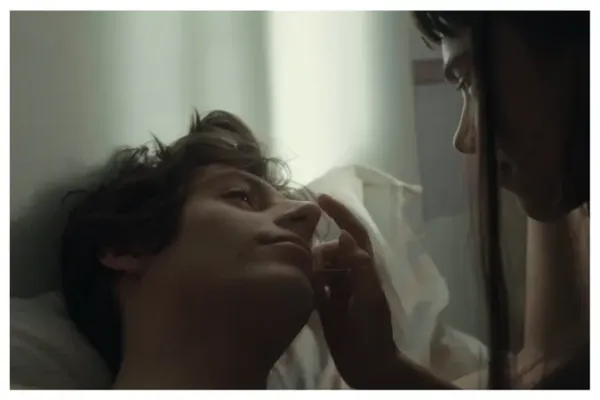
| Adam Kubala and Michaela Kostková in Lover, Not A Fighter Photo: Ninja Film |
The film won the Proxima competition prize at Karlovy Vary Film Festival earlier this year and is screening in the Competition 1-2 at Warsaw Film Festival this week. The cast and crew took part in a Q&A at the festival and we also sat down with Buchelová and Kostková to chat further about it.
The dramedy, which was shot in Bratislava, marks the feature debut of Buchelová. Explaining her approach to shooting some footage with a camera and some on a mobile phone, she says: “I wanted to be very playful in the storytelling of this film, and I think that it also fits the concept of this film. I think that mobile phones are part of our lives. We get a lot of information through them, and they capture a lot of the fragile moments that we live.
“I actually came to that idea through the scene in the second chapter where he goes out with his friend and, at first, it's a mosaic of super-fun times, and then the atmosphere or the vibe slightly shifts and it starts to be a little bit weird, and then the outcome is not good.
“We all watch a lot of reels that are mostly very cool and fun, and I just like the shift of the storytelling. It worked for me emotionally, and to be honest, my concept was, whatever works emotionally, I will put in.”
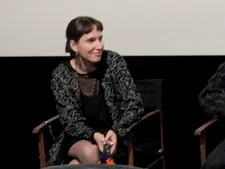 |
| Martina Buchelová at the audience Q&A in Warsaw Photo: Amber Wilkinson |
It’s testimony then to the actors that the end result retains a loose limbed feel, as though some of the events could have happened on the spot. A lot of the humour in the film stems from complex chapter intertitles, which recall the sort of book chapter descriptions which used to be employed by the likes of Henry Fielding and add cohesion between the sometimes meandering vignettes. These often stray away from Andrej or the current moment to consider others in his orbit, including his sweetly hapless cousin Peto (František Beleš), who is also seeking respite with their gran, Miša’s younger sister Mia (Mia Sofia Arpášová) and her father (Jaro Vojtek), who is spending all the family’s cash on building a nuclear bunker.
When it came to casting the film, Buchelová had previously worked with Kostková, who is a documentary photographer rather than an actor by trade, on her short film Magic Moments (2017). Buchelová says that Kostková and Kubala proved to have “a good vibe” but that it was the planning process ahead of shooting which was key.
“We rehearsed all together a lot and analysed the scenes very thoroughly, and they trusted each other because we rehearsed so much. I also think that both are very respectful people, so they.just felt safe, I guess, while playing all these scenes and that's why it worked so well.”
In terms of the shooting style, the director says she used the mobile phone-style footage when she wanted to evoke “high moments or low moments”.
She adds: “I also like that mobile phones are kind of trashy in contrast to the calm storytelling of the regular scenes. They come like a wave.”
All those moments were carefully planned, however, even though they may look spontaneous. “I think we even rehearsed the scenes we shot with mobile phones. We had rehearsed so much that they understood the characters so well, so they found the fun, sad or interesting part about the scenes.”
Another specific tack is taken when scenes concerning child grooming are used, with the mobile phone then taking on a first-person snorricam perspective.
The director says there were a number of reasons why she chose that device.
“One thing was that I wanted the viewer to understand that it's a flashback for Mia. Another thing was that I wanted the viewer to understand how weird it is for her to be in that situation. Even our DoP Adam Mach said how weird it felt when he was shooting the scene as the actor delivered the lines towards him. He said he felt really weird or horrible when the actor was talking to him and he's a grown-up man. So if this happens to a child, it must be super horrible. Also, the whole reason was I never wanted a child to face that, even if they were acting the scenes.”
We often come across men writing from the perspective of women but it’s less common to find a female filmmaker writing a male protagonist.
Buchelová says: “There’s two reasons. One is that before this, I was preparing a historical drama about women in Slovakia, and there were so many women characters. It's an adaptation of a very good Slovak female writer from the beginning of the 20th century and I felt a lot of responsibility to do it well, and there were so many women characters that just naturally, in contrast, this story about young men from the modern era just came to my mind. Also, because it’s a serious adaptation, I was, I think super playful, putting everything in this I couldn’t put in there. Another point is that before I was working on a documentary about young people and how they live in various parts of Europe. We did three documentary short films about young people. One was in Slovakia, one in Coventry in the UK, and one in Istanbul in Turkey.
“And I think that also influenced me, and we had a lot of male protagonists there, and we really did talk a lot. Actually, I think that it was a little bit easier to to work with male protagonists in the documentary because girls or young women in their friendships, they always analyse stuff, their feelings, their dreams. Boys, even though they really like each other, they don't open up so easily, but it when it was structured and when we were the like big sisters who asked them about their dreams about their hopes about their circumstances, they really opened up to us. “Maybe that also inspired me, because actually, they are very sweet.”
As for what comes next, whatever it is it’s likely to be eclectic. “I think it’s good for creativity,” says Buchelová. “When I have a problem with one project, a good idea comes to me for the other project. I do like the mixture.”
Kostková adds that she thinks going from project to project as an actress is a hard life but that she couldn’t resist this particular film. “When I read the script, I felt like I had to do it in order for it to work. I saw the complicated nature of the characters and felt like I could do it well. Maybe I would do another acting job if an interesting project was to come along.”