




 |
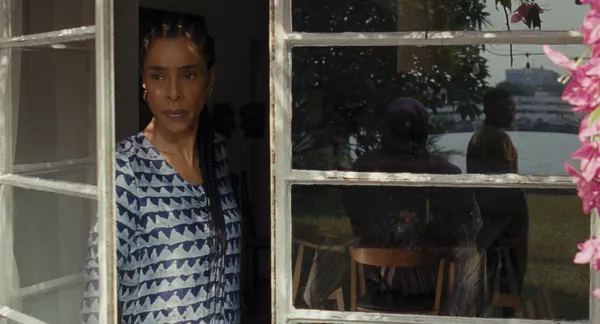
| Sophie Okonedo in Clarissa Photo: courtesy of Neon |
Nigerian sibling directors Chuko and Arie Esiri adapt Virginia Woolf's 1925 novel Mrs Dalloway for their sophomore feature Clarissa. In their reimagining of this literary classic, they transpose post-World War I London for modern day Lagos, Nigeria. Otherwise, the premise of the titular character of the respective stories, in the film played by Sophie Okenado, preparing for a dinner party where she’ll host familiar faces and reunite with old friends remains intact. Woolf’s story is about reflecting on the past and wrestling with one’s identity. The Esiri brothers use it to explore the undercurrents of modern-day Nigeria.
The brothers return to Lagos for their sophomore feature, following their début This Is My Desire (Eyimofe), which was set in the Nigerian capital. It tells the story of characters trying to transform the fortunes of their families, but fate has other intentions, carving a path towards tragedy. The directors have also directed the short films Goose and Besida.
In conversation with Eye For Film, the Esiri brothers discussed ideas of shared humanity, the way cinema connects us to far off places, splicing seamlessly through time, and never stopping growing up.
The following has been edited for clarity.
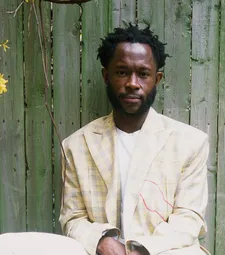 |
| Arie Esiri |
Paul Risker: How would you describe your relationship to cinema, not on a professional but on a personal level?
Chuko Esiri: Cinema is a place of comfort, where the world's chaos can disappear for the length of the film. It can be very inspiring and insightful. You could be going through heartbreak, and by watching a movie you don’t feel so bad because you're not the first person to experience heartbreak — maybe you understand more why you feel the way you do. And there's this idea of stories being an evolutionary utility, where a story says something happened, and it teaches you that there are multiple paths and ways forward. So, for me, it's a source of comfort.
Arie Esiri: I think cinema is therapy, because when I'm engaging with certain characters, I feel I'm engaging with certain parts of myself. I'm able to make sense of life through other people's lived experiences. That’s why global cinema has been so important to me, by understanding that humanity is a common thing and just feeling that I'm part of a greater whole. And that completes me in many ways.
PR: Does this underpin the development of your creative voice?
CE: Honestly, we’re just trying to be as sincere as we can be and tell those stories we know and try to bring other people into our space, in the hope or rather, with the faith that they will feel something.
Thinking about the idea of shared humanity, for many years Arie thought he wanted to be a cinematographer, until he watched Bicycle Thieves. He figured if he could care so much about this Italian man who loses his bicycle in 1940s Italy, then we’d have to tell stories and offer people that are unfamiliar with Nigeria or West Africa a similar experience.
I've adapted Virginia Woolf's novel because it's a book that I’ve read multiple times and it has moved me in many different ways. And we’re just from a part of the world that's underrepresented in terms of what you see, and so, there's that mandate to put our stories in front of people. The hope is that watching a movie about a middle-aged woman in Nigeria, people feel something similar. Did I make the right choices? Am I living my best life? That's it for us, really.
PR: What you’re talking about is the idea that cinema is a transportive medium.
CE: Absolutely. It's even down to how we film and the visual language. We want to have an audience sit in a space for a while, so that over the course of the film it becomes familiar.
I'm always joking with Arie that I feel like I've been to Taipei, even though I never have — it's just that I’ve seen so many films set in Taipei that I feel like I have. So, we put Lagos before you, and we invite you to take a look and to luxuriate in it. And hopefully, over time, Lagos becomes a familiar place, just like New York is familiar. When people visit New York, they say: “Oh, it's just like in the movies.”
PR: This adaptation of Virginia Woolf’s novel speaks about how art doesn't know boundaries. Instead, it transcends these human divisions to communicate the universal.
CE: I completely agree, and there's a Arthur Miller quotation that says: “Art is long, life is short...” And that really is it. We’re all humans, and we all feel the same as one another. The point of art, whether it's a song, poetry, literature, music, or film, is to reach for that thing that exists within all of us. It’s a challenge to explain it in its completeness, but artists try to at least give it some form, which brings us all closer together. And that's the joy and the beauty of art.
AE: Great art is accessible to all and art that's truthful will be reimagined in a million and one ways by a million and one people.
CE: This is the old thing that every tale under the sun has been told, but it's all the little shades that make it interesting.
PR: The back and forth between the past and the present is seamless and effortless. It expresses the way our minds wander as we disappear inside our own thoughts and imagination. In this way, Clarissa captures something intimately human, and also how lives are formed of a series of chapters.
AE: It definitely wasn't effortless; it took a lot of finessing. The intention was there in the script that Chuko wrote — it was always supposed to feel like that, and so, we were always trying to fulfil that ambition of the script with our visual language and montages.
We were very lucky to have a wonderful editor in Blair McClendon, who managed to pull off a similar magic with Aftersun, which also plays a lot with temporality. And he brought that experience into the editing of this film with his great sense of timing and rhythm.
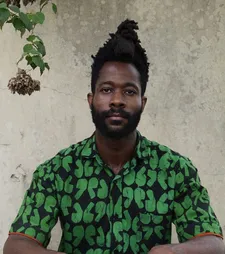 |
| Chuko Esiri |
A lot of the prep work went into how to make it seem seamless and have that feel similar to the novel's stream of consciousness, without confusing the audience and without using lower thirds to say it's now 1990 or the present day, and without having to have the past in sepia or in black and white. And that meant every visual head of department had to be in sync. The costumes had to feel distinctly different when you jump from one period to the next; the production design had to tell a story of history, time, and place. And the cinematography, of course, also had to do its own work. The past is more saturated and bucolic and filled with lushness. Whereas the present day is supposed to have a more real and contemporary feeling. Then, the north, which is desertuous, we treated with a type of bleach bypass, that made it a little harsher. The performances then add to that as well because while the scenes in the north are visually harsh and the aspects of that part of the story are filled with a sense of danger and dread, there’s an aspect of the story that's also filled with romance — the soldier’s courtship with Aisha, the lady that owns a shop. Working with contrast helps to make things feel real.
PR: Clarissa asks its audience to sit with the characters and listen to them. You’re not interested in exposing the characters. Instead, you want them to reveal themselves, which requires trusting the audience. This perhaps utilises Woolf’s process of stream of consciousness.
CE: It's patience and trust, right? Like Arie said, adapting the book, we were working in a different medium, and we had to try to mimic the experience of reading the book. It was probably on my third read of Mrs. Dalloway that I learned how to read it, which is just to let go and don’t worry about whose head you're in and where you are. It'll all gradually make sense, and then you will know, but only gradually. And that's with all the different visual techniques, with all the heads of department, the editor, and everyone else working in unison. You’ll see a location and immediately know we’re in the past for example. I think you’ve got to trust your audience and be patient with them.
I find the story clicks for people at different times, and everyone that we've had that discussion with has spoken about how rewarding it is when they realise: ‘Oh, these people are the same as me.’ And then, they can fully lean into it.
PR: Coming of age stories are often seen as being about adolescence, but Clarissa’s characters remind us that throughout our adult years, we are coming of age.
CE: Like the book, the film deals with reckoning with the past when considering the future. And I completely agree that we are consistently evolving. Life might all of a sudden make sense to you in your mid-50s when you look back at who you were in your mid-20s. You don't regret those decisions because everything has led you to where you are here, at this moment, and there's more stuff to come. But, yes, I completely agree with you that it’s an endless process. It ain't over till it's over, as they say.
Clarissa played in the Journey strand of the 70th BFI London Film Festival.