




 |
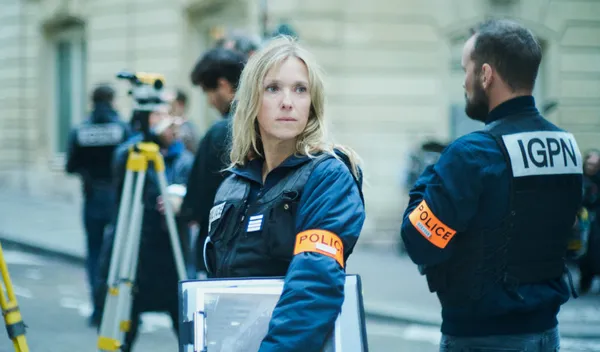
| Léa Drucker in Case 137 as an investigator for France’s police oversight agency (Photo Conic) Photo: Conic |
Her choices indicate just how seriously she takes her roles. Earlier this year she scooped both the César (the Gallic Oscars) and the Lumière Awards (the equivalent of Hollywood’s Golden Globes) with best actress gongs for her performance in Dominik Moll’s much acclaimed Case 137 (Dossier 137) in which she plays an investigator for France’s police oversight agency assigned to a particularly sensitive case involving a critically injured teenager.
 |
| Léa Drucker: 'It’s really being part of stories, that raise questions, shake things up, and challenge the status quo' Photo: Marie Rouge for UniFrance |
"What makes it unique and what interested me was that the entire story is told from the perspective of an investigator with the institution known as the ‘police of the police’. It is often viewed negatively by both police officers and the general public. This singular perspective allows us to examine our relationship with professional roles, ethics, and loyalty. It is a meticulously researched film that opts for raw realism and raises essential questions about today’s society. It is a true cinematic experience - grounded in reality, yet maintaining constant tension.”
She accompanied the film to last year’s [2025] Cannes Film Festival where she was also on view in Laura Wandel’s Adam’s Sake (L’Intérêt d’Adam) which again represented a bold choice. “It was shot entirely from a child’s eye level, with very bold directorial choices. Then there was meeting the director herself; on the surface, she seems very gentle - almost fragile - yet she creates cinema of raw power. The film blends an almost documentary-style approach to the daily life of a paediatric nurse with a more universal reflection on motherhood and one’s calling. And on what happens when everything shifts, and the human element prevails over the role.”
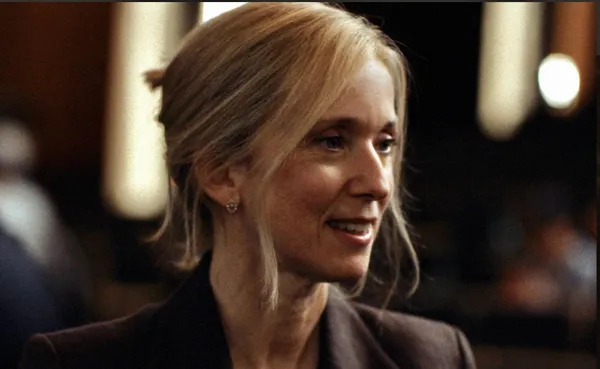 |
| Léa Drucker in A Woman’s Life: 'Women are interesting at any age, and it’s a joy to tell a story like this' Photo: Courtesy of Cannes Film Festival |
She made her cinema debut in 1991 (in La Thune, an unlikely comedy by Philippe Galland) and has worked for the likes of Mathieu Kassovitz, Michel Hazanavicius, Cédric Klapisch, Coline Serreau and Édouard Baer before landing a breakthrough in Zabou Breitman’s The Man Of My Life (L’Homme de sa vie). Other prominent sorties included playing a woman trying to protect her children from their violent father in Xavier Legrand’s Custody (Jusqu’à la grade) for which her first best actress César was bestowed. There was also the controversial role in Catherine Breillat’s Last Summer (L’été denier) as a lawyer involved with her partner’s under-age son. And earlier this year she was back in Cannes in Competition entry A Woman’s Life (La vie d’une femme) by Charline Bourgeois-Tacquet in which she was roundly praised for her performance as a doctor who saves lives while trying to keep her own intact. The Deadline critic enthused: “in Drucker’s hands we have a character who is something special to behold.”
Earlier on in her trajectory she made inroads by embarking on theatre work in a suburb of Paris, putting on shows for school children from where Cédric Klapish saw her and gave her a role in Maybe (Peut-être).
Given her predilection for roles with a hospital backdrop it’s perhaps not surprising to find out that she comes from a family with a medical background. She said: “My father is a doctor, while my aunt and grandmother were nurses. So, without being an expert, I grew up in that atmosphere, surrounded by those stories - even though the reality of hospitals today bears little resemblance to that of the Seventis or Eighties, as conditions have become much harsher.”
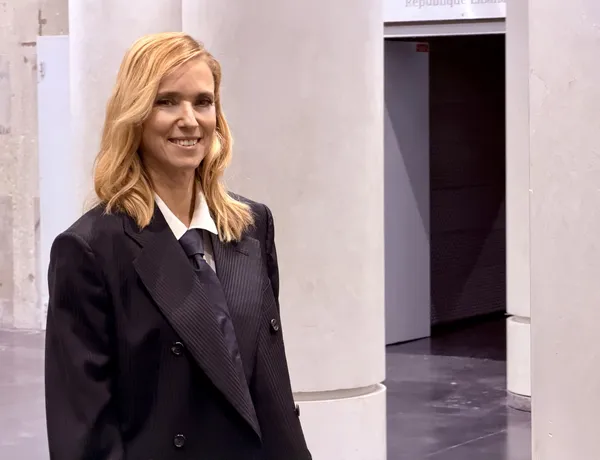 |
| Léa Drucker at the Lumière Awards in Paris where she won best actress for Case 137 (Photo Richard Mowe) Photo: Richard Mowe |
"When I was a very young actress, I came to the Festival for Critics’ Week with a short film by Cédric Klapisch. I was so excited that I arrived far too early and was waiting alone outside a tent. A woman next to me was speaking softly, and it took me a moment to realise it was Nina Simone. So there I was - waiting for an event to open at Cannes… with Nina Simone. I didn’t speak to her. But those are the moments that make the festival magical. It’s the only place where that can happen.”
Drucker seeks to push her professional boundaries. “It’s not so much a conscious effort but rather through the people I meet. My work is constantly evolving - with time, with age, and above all, depending on the people I collaborate with. In recent years, I’ve been fortunate enough to receive powerful projects that tackle socially engaged themes.
“These stories resonate with my own feelings; they compel me to take a stand and to invest myself in new ways. Sometimes I know I need to take a step forward, even without knowing exactly how. It’s the others who help me do that - the fellow actors and the directors. I always feel a sense of artistic interdependence. That collective dynamic allows me to go further and to surpass my own limits.”
She was happy to take on the role of a fifty-something woman in A Woman’s Life. She explained: “t’s rare to see the sensuality of a woman over 50 portrayed on screen… was actually intrigued and happy that the offer came from a director who is just 40 years old. Women are interesting at any age, and it’s a joy to tell a story like this. I find it beautiful how this mature, seemingly unflappable woman finds herself thrown off balance by falling in love - like a young girl experiencing those first stirrings of romance. Many actresses my age are out of work or have to accept whatever comes along. I don’t view ageing as a heavy burden. But I’m lucky enough to have a profession that offers me a life full of adventure, new encounters, and renewal.
“My career path was unusual: my film career didn’t really take off until I was in my forties. That coincided with a growing awareness of the need for more women in all roles on set and for greater complexity in female characters on screen. There is no denying that I’ve landed interesting roles as I’ve matured, but I am an exception to the rule.”
Case 137 is realised by Conic in the UK and Ireland from 16 October. A Woman’s Life screens as part of French Film Festival UK in November and December (dates on website www.frenchfilmfestival.org.uk)