





 |
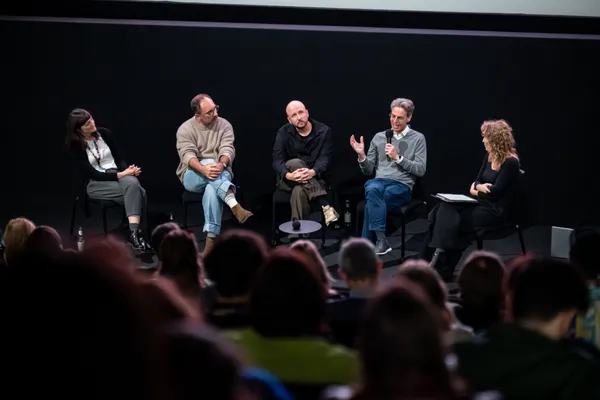
| Eliza Subotowicz, Mariusz Włodarski, Grzegorz Dębowski, Sergio Garcia de Leaniz and Anna Bielak Photo: Courtesy of Warsaw Film Festival |
The Industry Talks programme of the 42nd Warsaw International Film Festival opened with “How Can Stories Travel? Development Strategies for International Audiences”. Moderated by screenwriter and script consultant Anna Bielak, the discussion explored how filmmakers can reach audiences abroad while preserving the local roots that make their stories distinctive.
The panelists were director Grzegorz Dębowski, whose second feature, What Belongs To Others, has travelled from Venice to Busan and is now screening in Warsaw’s International Competition; Eurimages project manager Sergio Garcia de Leaniz; Mariusz Włodarski, producer of the Oscar-nominated The Girl With The Needle; and Eliza Subotowicz, film director and artistic coordinator of HerArts Film Lab.
The panelists tried to pin down what “universal” means in storytelling. “It’s something that speaks to many, resonates with many people, regardless of culture, regardless of country,” said Subotowicz. Włodarski went further, arguing that emotions are the only thing that can make a story universal. “Then you can reach people in other countries,” he said, adding that how to actually do it is “very complicated, but very simple at the same time”.
Dębowski said he has never thought about the audience when starting a project so far. Setting out to make something universal from the first page can be dangerous, he said, and risks producing “some kind of tasteless project.” His approach is the opposite. “I’m always trying to do a story as local as possible, but find emotions that are quite common for all of us,” he said.
Getting those stories in front of audiences, however, also requires practical decisions. “International co-production travel three times more than purely domestic films” says Garcia de Leaniz, stressing the importance of third-countries markets as well as the co-producing ones. By participating in international forums or markets and pitching there, filmmakers can learn what works internationally and what doesn’t. The idea of being open-minded and approachable was also mentioned, and Subotowicz said “Bounce ideas with people when you write. Talk to people from different countries if you want your stories to travel”. Dębowski seems to have disagreed with this method, stating the importance of not losing your identity.
Bielak then asked how genre shapes a film’s international potential. Genre films sometimes tend to follow a check-list that can be region-specific or simply universal. Garcia de Leaniz mentioned that “Some genres travel easier than others. Traditionally, comedies don’t travel well because in many cases, the comedy element of the stories is local. Some genres that travel usually better are horror, sci-fi, because they have more identifiable characteristics that are similar in different countries. Animation is another type of film, not a genre, that travels better”.
Then he added that rather than focusing strictly on the genre of the film, it is important to understand who’s going to be the audience, and take it into account from the first stages of development “doesn’t need to be a broad audience, general audience, it could be a niche audience, especially for auteur films”.
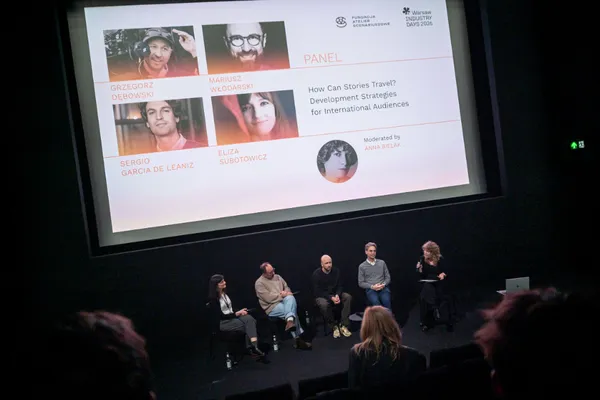 |
| The panellists were tackling what makes a narrative travel Photo: Courtesy of Warsaw Film Festival |
But creating a story that moves audiences is only part of the challenge, filmmakers must also protect what makes it their own. How can they tell whether feedback will strengthen their stories or dilute what made them compelling in the first place? For Subotowicz, the answer lies in knowing what a story is ultimately about. “Feedback can also be damaging,” she warned, stressing the need to distinguish between suggestions worth considering and elements creators are unwilling to compromise on. “You are the gatekeeper of your own story.” This can be particularly difficult for emerging filmmakers, who may feel pressure to accommodate industry expectations.
The challenge is to remain open to collaboration without losing sight of the original impulse behind a project. As Subotowicz said, “If you don't treat yourself as the most important part of the story, you're gonna lose your attachment.” Listening to people from different backgrounds can reveal new dimensions of a script, but final decisions must remain grounded in the filmmaker’s own intentions.
That attachment matters especially when stories tackle uncomfortable subjects. If reality itself resembles a horror film, audiences may find the genre an accessible way into difficult social questions. Rather than softening a story to make it more universally appealing, filmmakers can trust its emotional force to cross cultural boundaries.
International potential, however, cannot be reduced to a formula. A compelling premise still needs thoughtful execution, and collaboration cannot guarantee success. As the host of the panel put it, “Ideas are cheap but the execution is expensive.” The question is not simply how to make a film travel, but how to preserve what makes it worth discovering.
Dębowski offered perhaps the most personal advice to aspiring filmmakers: “Before it's too late, when you're writing in your kitchen or at your computer at home, try to make a movie just for yourself.” This is not a call to ignore audiences or reject collaboration. Film remains a collective art, but its strength begins with a story its creator genuinely wants to tell. In an industry increasingly concerned with international reach, remembering that initial impulse may be the most important point of departure of all.