





Eye For Film >> Movies >> Frost (2026) Film Review



Obsession and addiction run courses in our mind that are so similar, the terms could be almost synonymous. They both treat us with what we crave most, only to leave us craving for more. They can come in various forms, concrete like drugs, booze or unhealthy food, sentimental and emotional, or even metaphorical, so there is not much difference between, for instance, fandom, beliefs and ideology. As we are all first and foremost individuals, our own 'little worlds' driven by our own obsessions, addictions, beliefs, choices and (unfulfilled) needs tend to clash with other people’s, with groups’ and with wider, even global society.
That would be the subtext and the point of Pavle Vučković’s Sitges-premièring sophomore feature Frost, with which he tries to pack those ideas. It's a mix of genres and sub-genres of procedural thriller, backwoods noir, drama, folk horror, mystery and fantasy. However, Vučković takes his sweet time to get to the point of checking most of the genre boxes while attempting to elevate the basic story, disguising it as a slow-burner.
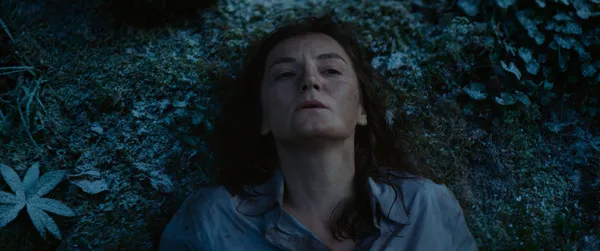
Our heroine is the police investigator Mirjana Stamatović (North Macedonian actress Kamka Tocinovski, seen in, among others, Sundance hit You Won’t Be Alone), who is sent from Belgrade to a village in Eastern Serbia to solve the case of the disappearance of an influencer, Adela (up-and-coming Montenegrin actress Lara Dragović). Apparently, the self-proclaimed Instagram witch disappeared while exploring the rituals based in local folklore known for beliefs in supernatural and dark magic practices. On her way of exploration, she met with a local young man, Milan, who fell hard for her and committed suicide about the time of her disappearance.
Logically, Mirjana’s first step is to interview his mother, Gorica (Serbian thespian Vesna Trivalić), who gets more and more evasive and defensive while trying to shift the blame completely to Adela - who, according to her, cursed not just Milan but the whole village, and now Mirjana is the primary target of her restless spirit. The local priest, Jeremija (Mirko Vlahović), can provide some insight into the locals’ state of mind, but his vision is not aligned to theirs, as he is a man of God. She can take some clues from the local (Jovo Maksić in a stunning bit role) who frequents a cabin in the woods trying to communicate with his late daughter, and even from the local leader (Zlatan Vidović) in order to solve the case. Following the unexpected arrival of another character, seemingly from out of nowhere, for Mirjana this case stops being just a case and becomes an obsession that transcends the borders of her profession, and her life, soul and mind become a battlefield for different projections and desires, as well as the supernatural forces.
With the exception of WW2 epics suited best for propaganda, the genre approach was not deeply rooted in Yugoslav cinema, so the succeeding countries 'imported' it independently from each other. Serbian cinema is no exception in that regard: over time, genre practices developed from vague hints in drama movies and under-financed and under-written attempts, into a scene of their own. Probably the crucial moment for it was the boom in TV series production some 15 years ago, during which local filmmakers tried and largely succeeded in copying the influences from abroad, most notably Scandinavia.
Although he did not work on crime, supernatural and horror shows, Vučković was close enough to witness the trends, as he worked on other TV projects since his under-seen and under-appreciated Cannes-premiered début Panama (2015). That film was a borderline genre piece as well, since it blended relationship drama, romance-driven plot and a thriller-like atmosphere to tell a story of vanity, social networks, pornography and – obsession. The latter is crucial here, as Vučković nails a few important erotic scenes where emotions, cravings and projections are in focus, as opposed to intending to shock the audience with nudity and lesbian sex, still considered somewhat of a taboo both in Serbian society and cinema.
However, the television 'roots' are showing, both for the history of genre cinema in Serbia and for the filmmaker. The characters are functional but rough sketches and, up to the breaking point, the plot is too straightforward, so Vučković and the editor Milena Predić stretch it very thin, which takes a toll on both the runtime and the viewers’ fading attention. On top of that, the 'Scandi-noir' dimly lit colour scheme in Đorđe Arambašić’s cinematography, and the visual effects that are far from top-notch, cement the sense that Frost is a better fiit for television and streamers than it is for festivals and theatres. On the other hand, the production design by Livija Mikić, the costumes by the Serbian fashion designer Magdalena Klašnja, the music by the American duo Filius Blue and the sound design by Ivan Zelić, based on enhanced natural sounds, all feel genuinely inspired and suitable for the film.
All things considered, Frost works better as a metaphor than it does as a straight genre piece, and it shows Vučković’s growth as an auteur who can now, both as a writer and a director, drive his point (that is neither ground-breaking nor banal) sure-handedly and with some flair. Those who can sit through the clichéd parts will be somewhat rewarded in the end.
Reviewed on: 16 Oct 2026


Director: Pavle Vučković
Writer: Pavle Vučković
Starring: Kamka Tocinovski, Lara Dragović, Vesna Trivalić, Mirko Vlahović, Jovo Maksić, Zlatan Vidović
Year: 2026
Runtime: 110 minutes
Country: Serbia, North Macedonia, Croatia, Montenegro, UK, Russia
Festivals:
Search database: