 |
| Penny Lane Is Dead |
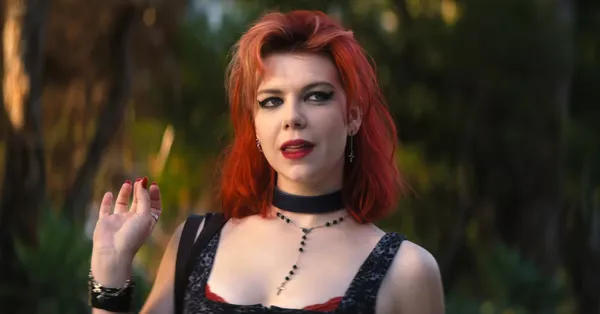
Australian director Mia-Kate Russell's gruelling, blood-soaked horror, Penny Lane Is Dead, is set on a hot summer's night in 1986. When Penny (Bailey Spalding) falls foul of her cousin Kat's (Sophia Wright-Mendelsohn) prank, a beach house party takes a decidedly dark turn for Penny and her two friends, Toni (Tahlee Fereday) and Amy (Alexandra Jensen).
Penny Lane Is Dead is Russell's directorial feature début. She has directed, among others, the short films Swallow, about a gay priest, a werewolf, and a homophobic community, and Maggie May, which revolves around the disintegrating relationship between two sisters after their mother's death. Spalding has starred in the episodic crime series Scrublands and North Shore, and Wright-Mendelsohn has starred in the miniseries Deadlock, and the high school drama Year Of. Penny Lane Is Dead is the first feature for both actresses.
In conversation with Eye For Film, Russell, Spalding and Wright-Mendelsohn discussed non-verbal performance, not giving a fuck, creative depression, the guts of the Australian media, and more.
The following has been edited for clarity.
Paul Risker: Why filmmaking and acting as a means of creative expression? Was there an inspirational or defining moment for you personally?
Mia-Kate Russell: I started out as an actor. I wasn't very good, but what it gave me was a deep respect for acting. Then, because I love horror, I moved onto being a special effects makeup artist. I've done it for 20 years and when on set, I just kept thinking, 'I can do this.'
I love the film community being on set, and it is a circus of freaks, but it's where I feel at home.
Bailey Spalding: I guess I'd always loved performing as a kid. I was always the one doing skits at home for mum and dad, or we'd be putting on little plays, and I'd be roping in as many people as I could.
I did drama throughout primary school and high school, but I didn't really think it was possible to get into this industry. I had a lovely drama teacher, and he said, "You should give this a crack if you really want to." So, I just threw myself in from there and haven't looked back.
Sophia Wright-Mendelsohn: I did after-school theatre as a small child. I was anxious and shy, so my mum said, "Go on, this'll be fun." And it was and I loved it. Much like Bailey, it was just something that came naturally. It was what I wanted to do, and then I was like, yeah, I'm gonna do it.
PR: A director's first narrative feature is a milestone moment. How do you look back on the experience of making Penny Lane Is Dead?
MKR: You know, it's wild. I have a friend, Sandra Sciberras, who is also a filmmaker. We've been friends since we were 18. We talked about it, we made short films, and now we've made our feature. We were on the phone recently, and we said, "If we die tomorrow, we've done that one thing that we always dreamed of doing." No offence to our kids, who are great, but we've made a feature film.
It's a huge process, and I used to be a little more critical of other films, but now you get at least a couple of stars for having made a film. I'm so happy with Penny Lane Is Dead and every time the opening music starts, my little heart sings. It was a really beautiful firstborn.
PR: What was the seed of the idea for Penny Lane Is Dead?
MKR: My grandparents had a holiday house down by the beach in the Eighties. Looking back, how different the Eighties were. No one had mobile phones to record everything, and so we behaved worse, which is great. Throw the phones away and let's see what happens to the teenagers now. So, that was the genesis of it.
PR: When you first read the script, what drew your interest in playing your respective characters?
BS: When I first read the script, I couldn't put it down. I just hadn't read anything like it — it was unique. Getting to read a script where there's so many amazingly powerful female characters involved is refreshingly cool. So, it was addictive to read.
SWM: I had a similar experience. I saw somewhere that it was compared to Puberty Blues From Hell and when I first read the script, it definitely evoked that. The thing about Australian media is that we don't shy away from the really tough things, and I was keen to be a part of something that just told it as it is and didn't tell us to shut up about it.
PR: I remember an actress explaining that the key to unlocking a performance can lie in the smallest details. For example, how a character walks. What was the key to understanding your characters?
SWM: I think the first day I shot there was no dialogue at all. It was purely scenes of me doing the drug thing. I found that I was a little bit wriggly in my costume because there were a few layers. It just worked for the character and then that quickly became Kat. And it just landed really well.
The girls on this film were all a lot more experienced than me and so, I would approach to ask what they thought of something. It must have been annoying for them, but they were so helpful. It truly was a group project.
BS; It's funny you mentioned the walking thing because Mia and I actually spoke about how Penny walks around and doesn't give a fuck, at all. Those types of people are so confident it's like I don't even need to be thinking about the way that I'm walking around right now. I found that to be fun because sometimes you'll get a little self-conscious in real life. But yeah, it was just playing with that utmost confidence and just not caring.
PR: Mia, what did Bailey and Sophia reveal about their characters that surprised you?
MKR: It was wild because I'd had the characters in my head for so long. So, when I first saw their auditions, which were all online, it was like I'd found them. It wasn't like I saw an actor and I thought, 'Oh, yeah, I'll get Penny out of her.' Bailey sat in shot in little shorts and a big smile. She said, "Hi, my name's Bailey", and I knew that was Penny Lane. So, they literally brought me the characters.
In real life, Sophia's a sweet little kitten. But every now and then she gets a twinkle in her eye, and I thought that little twinkle is Kat. So, Sophia was the one that brought that to life, whereas when I met Bailey, she was that beautiful cool girl.
When I met Tahlee, she was already 50% Toni — she had the essence and swagger about her. The biggest change was Alexandra Jensen, who played Amy, because she's another beauty. We put her in that outfit, gave her a perm and she wasn't recognisable. Seeing her after shooting with straight hair and lipstick, I wanted to apologise. I wanted to say, "You're a really stunning woman, thank you for letting us do that to you."
PR: On a thematic level, what were you aiming for with Penny Lane Is Dead?
MKR: I'd love to sound really intelligent and talk about the themes I was going for, but the truth is I write for story and characters, which I want to get the best out of. Later I'll look back on things I've done, and I'll think, 'Oh, that's a comment about empathy.' Whatever it is, I don't realise it at the time.
We all know writing is awful — I don't even want to write. I hate writing — it makes me depressed, but I'm compelled to do it. So, I'm currently doing five hours a day on another film, but it just puts me in a bad mood. People ask: "If you don't enjoy it, why are you doing it?" I answer: "I have to climb that mountain; I have to finish it, and it has to be great, and I can't be embarrassed by it." I don't know why or who I'm proving something to, it's just something I have to do. But anyone that says they enjoy writing; I don't believe them — it's hard.
SWM: On a wider scale, I see it as something like a family drama. It's about what can happen within the same family system and how differently people turn out. It goes back to that idea that everyone grows up different despite being raised by the same family. And then, just the two extremes of the beautiful Penny and the evil Kat.
BS: I also think it's about how far you would go for someone you love. That's a big theme, as is the revenge arc and just fighting for what's important to you. Creating these characters, and especially Penny, you need to create a character that's worth fighting for, that's going to be missed and loved. And that gives Toni the drive to fight for what's important to her and her friends.
It was so much fun working on something so Australian, and with such a beautiful Australian crew. I look back on this job so fondly — it was really one of the best experiences.
Penny Lane Is Dead played the 2026 Fantasia International Film Festival and is streaming on Shudder from 28th August.