 |
| Nervous |
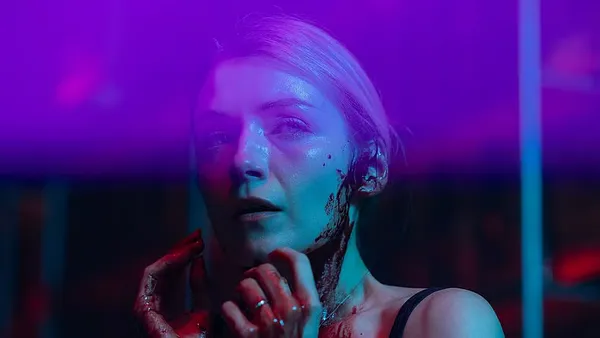
Director Abner Pastoll's Nervous, co-written by Richard Hobley, tells the story of Sarah (Sarah Bolger), who has left her native Ireland and is living in Korea with her Korean husband Sungsoo (Sungsoo Yune). With their marriage fracturing, the pair move to the countryside. After discovering an old gramophone and mysterious vinyl record which Sungsoo plays, Sarah loses her ability to hear men's voices.
Bolger and Pastoll previously worked together on the crime thriller A Good Woman Is Hard To Find, in which the actress played a widow searching for the truth behind her husband's death. Bolger has played a twisted babysitter in the psychological horror Emilie and has starred opposite Olivia Wilde and Mark Duplass in the resurrection horror The Lazarus Effect. On television, she was a main character in Mayans M.C., a spin-off of Kurt Sutter's crime series Sons Of Anarchy and has appeared in the Marvel series Agent Carter.
In conversation with Eye For Film, Bolger discussed being wired for this business, not being a nihilist, and how knowledge is her greatest tool. She also reflected on how each character steals a part of her, the lies we tell ourselves, and her collaboration with Pastoll.
The following has been edited for length and clarity.
Paul Risker: Why acting as a means of creative expression? Was there an inspirational or defining moment for you personally?
Sarah Bolger: I started acting when I was five, so that spark you're talking about was something that happened innately in me. And I say this with all the love in the world, but when I was five, I don't remember reading my first few movies. My memories of youth have only been working on film sets, and they have remained, to this day, the place that brings me the most joy, probably to an unhealthy level. I have gained all my growth, knowledge, and ideas through osmosis, being on film sets and seeing the greats and watching those wonderful individuals. And I can't say a bad thing about my job. There are hardships, but the battles are worth it at the end of the day.
PR: I've always liked the idea that, for creatively minded people, expressing that creativity is as natural as breathing.
SB: Maybe, and to second that concept with something that is inherent, my mother said to me years ago, and she probably said it to me in a funny way, but I've taken it as sort of my oath at this point: "Oh, you were wired for this." And that's what it feels like. It feels like I have been wired or built to do this job. Whatever it is about the way my brain works or the way my ears pick up an accent, or the way I watch the way someone moves and then imitate them, I can't tell you if it's healthy, but it is who I am as a person. And without it, I'm not sure that I am as whole as I would like to be.
PR: One of the difficult things about being human is validation, which sees us emphasise those personality traits we feel define us, especially when recognised by others, and at the same time, we want to be someone we are not.
SB: That's the most human trait: to grow and develop and to learn by doing, by putting on those shoes for a day. The idea of a child putting on their mother's shoes to walk around the house and seeing what that feels like is really just testing out the next stage, right? I feel like I do that all the time. And the wonderful thing about not just being a creator but being a human being in the world is that we are surrounded by different minds. Yet, we're all 99.8% the exact same, with different ways of thinking, different voices, religions, and beliefs. How wonderful that we get to glean from each other all day, every day.
PR: You are the glass is half full to my glass is half empty.
SB: I'm definitely not a nihilist in any capacity. I do try it on for size every now and again, but I'm truly not a nihilist. It's not that I'm shooting out rainbows every day, but I definitely have a today sucks but tomorrow is gonna be better outlook.
PR: Having been acting for so long now, has your approach to playing characters changed?
SB: Every character I've played has stolen from a part of me — not the same but a different part. But in terms of the method I choose, it has evolved throughout the years, but only because I as a person have evolved in the way I learn and the way I accept people. There was ignorance, and probably a rebelliousness in my teens at the incubacy of my career. I'd think: 'Oh, I know exactly who this character is… watch me go.' And then, obviously, in your 20s, you're thinking about who you are, what you are developing into, and what that means for the character.
I'm so grateful that it has never just been a case of playing a character who is my age — playing the exact thing that was happening in my life at that time. I've been able to play a 16-year-old aged 16 and then play a 16-year-old aged 22. And the 16-year-old that I played when I was 22 was far superior, because I got to look at it not just from a 16-year-old's perspective. And I was probably significantly older than that when I was playing a 16-year-old.
As I've grown, my access to learning about people and understanding pain and the gifts of life and seeing things from new perspectives has changed the way I look at and play every character. And it has only developed for the best. Knowledge is the most powerful tool I can possibly have and with age, I only gain more knowledge.
PR: Picking up on your point about a character stealing a part of you, could you elaborate?
SB: It doesn't take from me wholly, but it takes that part for that character. That part is gone and it doesn't come back. Then, the next character gets another little bit of you. And I think what Sarah in Nervous took from me was self-doubt, that little voice in your head that asks: am I or is this good enough? I can accept this, it's acceptable. I should stay; it's fine. I can handle it. Honestly, it would best be described as stoicism and I think that's what Sarah in Nervous took from me.
PR: What was it about the story and the character in Nervous that compelled your interest to go on this journey?
SB: Abner and I have a good dialogue and a lovely thing here was this wasn't even a script when I first got a call about it — it was only a concept. And it was in the marinating of that concept, truly, that hooked me. It was also believing in the idea of what this woman goes through, by being the unreliable narrator of her own fear, trauma and inner thoughts that ransack her brain. Then, getting to live in that pre-page one was a gift, because it allowed me to create a version of Sarah that I was truly excited to see. And then I had a million ideas explode on the page as soon as the script was sent to me. It was such a wonderfully imaginative and unique story, how do you not, as an actor, want to dig in deep into something like that?
PR: Is there anything the audience might find surprising about what you pulled off the page and put up on the screen in your depiction of Sarah?
SB: There's so much about this movie that was interesting from the get-go, like Sarah's uniqueness, where she loses the ability to hear men's voices. And what I love is she stops hearing their bullshit.
It's the idea that she can convince herself for so long. You can believe the stories you're told because they soothe you and they make you feel safe. But they didn't make her feel safe. She wasn't listening to her gut, but her gut won out in the end and that was a powerful thing to get down on the page and put on the screen. There is a pride from myself and Abner for being able to tackle that small part of being human and make it a whole big movie.
PR: Having worked with Abner before, are you developing a shorthand?
SB: Yes, because I know Abner so much better now. I can look at him and ask, "What are you thinking?" We can have a real honest dialogue. In Seoul, we rode in the car every day workshopping things. And he has given me a wonderful lane for hearing my voice and having it be important, where I feel like I can pitch an idea. In his book, the best idea wins and that's always mine. It's a real gift to have that collaborative nature.
His eye has developed as a director. I was looking at the final cut whose colour and vivid nature contrasts to A Good Woman Is Hard To Find, which I felt was maybe a little more saturated. But I just love how his artist's eye is developing, and I love being part of it. And I love that he keeps letting me play different Sarah's, even though I'll have to make him change the name at some point.
PR: One of the things that struck me about your character was the strength that lies beneath her vulnerability.
SB: There's a set of beliefs that you can fool yourself into believing. So, you can fool yourself into believing that you need someone to make you feel whole and chosen. These were core wounds that Sarah was carrying around, but ultimately, throughout this movie, what she's noticing is this deep-seated rage inside of her that exists. She's so angry at the man she has chosen to spend her life with. But ultimately, out of fear, you stay, and you persist — you can convince yourself of anything. Nervous is truly about a woman convincing herself of everything and that's a magical thing to get to put down, I was about to say on 35mm, but HD.
PR: A question that looms over the film is: can Sarah fix things or is any attempt futile? Does she need to accept a chapter in her life has ended and she needs to move on?
SB: You are really on a journey with her, but you're at a stage where she's already made a choice, and you see her grapple and flail. You see she's uncertain and playing pretend. The coolest part of the story is you're not just meeting her in the decisiveness of fuck, yes, that is it; I'm now on the right path. She's flailing a little bit, and you can see she's playing house, wife, and lover.
Is she even attracted to this man anymore? Does she actually want to sleep with him anymore? Having her ask these questions is the interesting part of this, because then, why is she there? But the truth is you can convince yourself of anything. And this character has convinced herself of everything and is now not sure of anything.
PR: And the characters are all in performance mode.
SB: There's a lie afoot, but we don't know what it is. And the characters actually don't know what it is either — they don't know what they're lying about. Is he truly in love with her? Was he always in love with her or was he never in love with her? Did he fight for her to stay and now he resents that decision? There's so much resentment between these two people and at one point there was a deep love. It's interesting to watch this kind of love story play out when it is the antithesis of a love story.
The idea of it originally was just to personify the loneliness of how far you'd go for love. There are these grand gestures where you move to the other side of the globe to prove something that you're not even convinced of yourself. Moving to Seoul and learning Korean was her grand gesture. I can't speak for Abner in terms of the potential themes that may have been prevalent for him in the writing. But just in terms of the character in those scenes, it's the idea that she can do everything in her power to show that she's trying and then her heart to not be in it. So, she can sit there and understand Korean, and she can try and really want to envelop herself in this world and recreate and reinvent herself and disappear, but the truth is she can't. She still sticks out and feels different. She's just not feeling herself and I think that's what we were highlighting.
PR: I always liked the quote that if you love something, set it free.
SB: Well, I think that's a wonderful quote for the movie because Jesus, does she set it free!
Excerpts from this interview have previously been published by FrightFest.
Nervous opens the 2026 edition of London FrightFest.