 |
| The Arrow At Rest At Every Instant Of Its Flight |
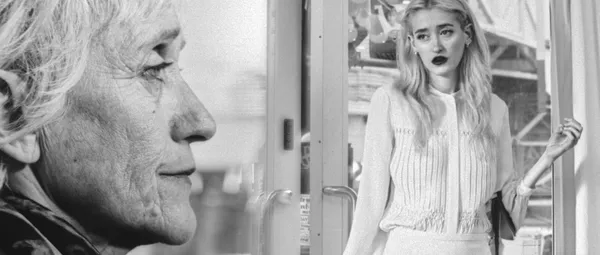
American director Theodore Schaefer's black and white satirical triptych, The Arrow At Rest At Every Instant Of Its Flight, co-written by Patrick Lawler, revolves around three identical young women, played by Gus Birney. While they look identical, each has her own unique story. Violet, who is disillusioned with her dead-end job at the arcade, plans a heist. Meanwhile, Sinopia, a professor, discovers she and her husband share the same lover, while Jade tries to save the life of a suicidal woman. As these three stories unfold, an unnamed woman (Constance Shulman) hauls a suitcase filled with clocks around New York City, searching for the doppelgänger she's convinced is trying to steal her identity.
The Arrow At Rest… is Schaefer's sophomore feature. He made his début with the surreal and visually striking Giving Birth To A Butterfly. It too told a story about identity, in which a woman who is accompanied by her son and his pregnant girlfriend, sets off in pursuit of the thieves that have stolen her identity.
Schaefer has also produced Jane Schoenbrun's We're All Going To The World's Fair, Isabel Hagen's On A String, and John Early's Maddie's Secret, among others.
In conversation with Eye For Film, Schaefer discussed why cinema is the people's medium, Jean-Luc Godard's deceptive simplicity and channeling the vibe of the Sixties, his love of poetry, cinema's fate, and more.
The following has been edited for length and clarity.
Paul Risker: Why filmmaking as a means of creative expression? Was there an inspirational or defining moment for you personally?
Theodore Schaefer: When I was in middle school — this is dating me a little — Netflix had just launched and started shipping DVDs. I grew up with a brother and three step-siblings, and my father decided there was a gap in our knowledge, which was cinema. His brother had studied film and ended up producing news segments. So, we asked him for a list of 100 films that everybody should see. And every one of my siblings bailed except for me.
From the age of 12 or 13, I started watching these movies and I distinctly remember getting into my own film fandom: [Quentin] Tarantino and other classics. I remember wanting to watch Bande À Part [Band Of Outsiders], because that was the name of Tarantino's company. It was watching Bande À Part where I knew I wanted to do this. And it actually seemed like something I could just do. That early Godard stuff had such a playful energy which isn't easy, it just feels easy. It feels like: Oh, yeah, you can just go out with your friends and make a movie. Now, most of the time, that doesn't work as well as it does when you're Godard in France in the Sixties, but that was the moment when I knew. And, then I ended up studying film at college.
I really love director-driven, more sort of challenging works. And the stuff I want to make is obviously not commercial, which led to producing because I had all these friends who were also making films. In the last few years, in New York, it has felt like there's more of a scene than there was when I started working in film 15 years ago. There are people making these very weird little movies which wasn't really happening before. And so, it just became about how can I help people and help myself by trying to get these films out there.
Certainly, the stuff I'm most interested in is just when it feels like no one else could have made that. And I hope, if nothing else, The Arrow At Rest… feels like a uniquely singular movie.
PR: Before we begin discussing the film we're here to discuss, is what makes cinema so singular from the other art forms that it's an amalgamation?
TS: It is that combination. Obviously, there are other visual mediums like photography, painting, and sculpture, some of which can combine language, but cinema allows you to combine language and music, sound and image, in a way that feels wholly unique. And that's what makes it so exciting.
The breadth of cinema's ability is why it's the people's medium. One of the beautiful things about film as an art is someone does not have to study film to have a valid opinion about it, in a way that's harder to do with the other arts — except maybe music. It is so ingrained into our culture, but also because it's a simpler reflection of life than a lot of the other arts and yet can still be more complex, it allows for more of an entry point.
PR: There's so much despairing talk about how we're witnessing the demise of cinema, and YouTube, which is on the ascendancy, is positioning itself as the dominant force. Are these dire days for cinema or does the doom and gloom rhetoric emanate from our fear of the unknown future, as well as we're living in a world filled with change?
TS: Absolutely. Every moment in history is unique, but also similar to other moments. It's certainly not the first time people thought that cinema was going to die. It's hard to know if it will have the same cultural prominence that it has had. When I was growing up, everybody watched movies constantly. That has definitely shrunk, but it seems new generations are re-engaging with it. I always try to take an optimistic look because otherwise, what are you doing?
Change is a really exciting thing. I think people are so afraid because there's so much change and it's the unknown. But that is also an opportunity for things to happen. Some of the most incredible movements in film history from the Sixties and Seventies came out of everyone asking, "What are we?" And questioning how you make art after the Second World War? Then, the Italian neorealists started making these incredible films and that really kickstarted the art house and in the 60s, when the studios were falling apart, they ended up with New Hollywood. So, you never know. That doesn't mean that's going to happen, but it does allow for the opportunity for something surprising and good to happen.
So, there are certainly reasons to be afraid of change generally in the world, but cinema does seem to survive, and I don't think it's going to die. But it might be something different.
PR: So much of the filmmaking process is about visualising what the final film will look like and trusting your instincts. The opening of The Arrow At Rest… is bristling with energy that feels like it could have easily gotten away from you. But that's the magic of movies: how order emerges out of a kind of creative insanity.
TS: To me, that's where that comes from. That opening and a lot of the movie has not only the fingerprints of all these films, but everything that you absorb that creates this worldview. It is almost alchemical the way you do it though, because it is like gut instinct. I've been lucky enough to work on a lot of films that I didn't direct in various forms, and that's super helpful to better understand what might or might not work. And still, there are things you think will work and don't work or things somebody will suggest, and you're like, "I don't think that'll work, but we'll try it." And then you look, and they were right — it totally works.
There's a magic to every film. The trick is to never let yourself get too overwhelmed by that. There has to be something in you that's just guiding you in a direction, and you follow it. You don't necessarily always know why, especially when you're in the moment directing, and you're presented with two options. Later you can unpack why you were right or wrong, but you just have to believe in that gut instinct, because you have no time. It's the same with performance, where you just feel it. You're not going to take the five minutes to determine exactly why and think you know how to get it to ring truer.
PR: What was the genesis of the idea for The Arrow At Rest…?
TS: I have a writing partner, Patrick Lawler, who I've been working with for over 10 years now, and we had been working on another, bigger film. The strikes had happened and there was a bit of a stall. So, I thought, why don't we write something that's a little more contained? It's not, but that was the initial idea.
I wanted to do something with the lead actress, Gus Birney, again. And I've always wanted to make something that has the feel of those Sixties New Wave films. Not just the French, but the Japanese and the Czech. All over Europe, Asia, and South America, there was this movement which gave these films such an energy. It was like rock and roll infused in cinema. There are some weird parallels in time right now, geopolitically, and so, I thought maybe we could try to do that now. And I saw a bunch of Yugoslavian Black Wave films at MOMA [Museum of Modern Art]. The film grew out of all these events, and we thought, let's just see where it takes us.
As we developed the idea, it became clear talking to Gus that we should do it as a triptych because this allows you more freedom to be playful. The ideas started to flow naturally after that, thinking about the energy and emotion and then the themes that we wanted to work with.
PR: I'd describe the dialogue as poetic or even philosophical. Either way, the verbiage has a certain hypnotic quality.
TS: Well, Patrick, my writing partner, is a poet, and he's in his seventies. What drew us to each other is that he's a poet and I've always loved poetry. And some of my favourite films are those that feel like poetry, both visually and verbally. That has always been in the DNA of what we do.
There's something about the surreal and the poetic that, at least for me, works on a subconscious level. You are left with emotions you don't necessarily register and that's something that is fun in any art form, not just film. But you know you can create a scenario for forcing the audience to confront certain thoughts and feelings. It's not a character who says something, and you ask: Oh, how does that make me feel? Instead, you sit with the film, and it starts to make you wonder. As you do, you start to make connections to your own life and to other parts of the film. And that to me is the magic of art.
PR: As human beings, we're programmed to want to understand and films like yours, where we can lose ourselves in the dialogue and not know what we feel or even recognise themes, challenges that.
TS: To me, films and works that do that, stay with you longer because you are forced to wrestle with questions. That's always the stuff that I love the most. I don't have the interest or instinct to make things that don't make sense and where there isn't purpose behind it. But I like taking the ideas and thoughts of what we're trying to share and put it through the lens of poetry or present it in a visual way that opens up the possibilities for what it could mean. While it might mean something specific to me, and everything does, we know that's not the interpretation that everyone's going to have. There is a spectrum and people can take away whatever they want from it. And that's the beautiful contract between the artist and the audience: you think you know what you're conveying, but you're not always certain.
And as much as there are themes and ideas that require a little more excavating, the hope is that it's a film that is still playful and fun, and the story of each of the acts is simple, with very clear, discernible, and definable actions. There are some great works that don't do that. They are dense and do not try to give the audience an inch. But I like stuff that tries to do both.
PR: Speaking with French filmmaker Anna Cazenave Cambet, she reflected on the present-day and told me, "[…] people have difficulty speaking to each other, and cinema enables us to talk." Watching The Arrow At Rest…, I wonder if it is reflecting on something broken about our society right now.
TS: That's something we thought about a lot, especially as it's a film that deals a lot with younger people. It is harder than ever to communicate with people on a personal level and that's very accurate that film is a way to break that barrier. And to a degree, that literally happens in the second story where they cannot talk to each other. Here, the film essentially breaks open, and it becomes a safer space to actually open up.
Especially now, we relate so much in our lives to the things that we consume, which we have made so much of our identities. That can be negative, but ideally there is a positive angle to that by allowing the film and art that really touches us to speak for us.
The Arrow At Rest At Every Instant Of Its Flight premièred at the .