 |
| Pascale Bussières and François Arnaud in Someone's Daughter Photo: Fantasia International Film Festival |
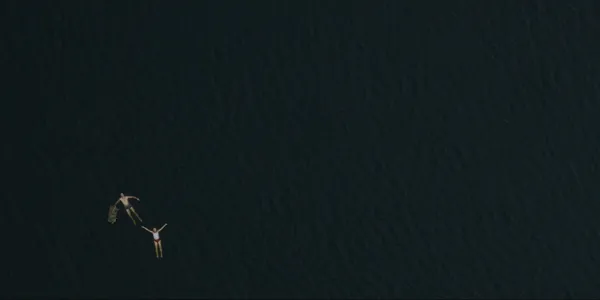
It takes a special kind of director and star to commit themselves to shooting in the middle on the Canadian wilderness with a script that requires constant moving around, but there would really be no other way to address the ideas at the heart of Wiebke von Carolsfeld’s latest work, Someone’s Daughter. Pascale Bussierères, who worked with her on The Saver in 2015, plays Sam, a lawyer who finds herself kidnapped and dumped on an island in the middle of nowhere by a man whose daughter she once cross-examined in court. There with her is Paul (François Arnaud), the man whom she cleared of rape in that case. To have any real hope of survival, the two much work together to get back to civilisation, which forces Sam into a situation where he must call her own past assessment into question and be on her guard.
It’s the day before their screening at the Fantasia International Film Festival when I meet Wiebke and Pascale to discuss the film. They’re joking about working together every ten years, and sharing memories of shooting with Imajyn Cardinal, the young Cree-Dene woman who had the lead role in that film, but we quickly move on to the subject of Someone’s Daughter.
“I guess we have had a crush on that first experience together,” says Pascale. “Wiebke called me to offer me this part, which is not that usual, I have to say, because there's still the process of auditioning – still, after 40 years. I know, I know.” She waves away sympathy from Wiebke. “But sometimes I do understand that process. I do understand that you have to, you know, create a family, or you want to see how the chemistry works between two people. But in this case it was just a great offer and a great script, so I was pleased to jump into that adventure. And it was an adventure.”
“I was very pleased because when I first talked to Pascale, I was like, ‘Oh my God, this is going to be a tough shoot,’ says Wiebke. “I'm like, ‘I know we're going to have fun and we're going to make it as comfortable as possible,’ which you try to do. But it was.”
She began developing the idea a long time ago, she says.
“You're in Scotland, so you might actually not know this case. It's a case of Jian Ghomeshi, who was a very well known radio personality in Canada and he was accused by several women over many years of sexual assault. Not rape, but sexual assault. It was a very high profile case here because everybody knew him and he actually studied Women's Studies or something crazy like that. He hired this amazing woman lawyer and she got him off and...” She sighs. “But there's many of them, like Trump has female lawyer.”
“It's very classical, actually,” notes Pascale.
Wiebke nods. “It very often happens that sexual predators hire these incredibly smart women. And I was like, well, why is this happening? And also often they say, ‘Well, my job is to defend perpetrators and everybody has the right to a fair trial,’ which of course they do. But it still leaves the question, what if the tables were turned and what if you can't hide behind ‘I'm just doing my job’? So this is where this idea came from.”
“Which is out of the justice system,” Pascale adds.
“Yeah, exactly. So taken out of the justice system, out of being able to hide behind ‘I'm just doing my job.’ And this is the way the system works. Make it personal. All of a sudden it's like it's not a question of legality. Is this guy a perpetrator or not? It is something that has very personal consequences to this character. I just thought it would be an interesting way of exploring that question and also getting people to talk about it more, because it's important for me that, you know, all these years after #MeToo, we don't...” She thinks for a moment, then says firmly “I know there's a lot of women that don't get justice in our system. What can we do?. The film doesn't offer answers, but I would like this conversation to remain active.”
I tell her that it seems to me that we know from the start that Paul was guilty, because there wouldn't be much of a story otherwise, and she smiles.
“Men watching the film don't think he's necessarily guilty. Most men think he's not guilty.”
“Interesting,” says Pascale. “They believe him because he's so charming, you know. But perpetrators are very manipulative. A lot of them are very good looking too. I mean, we had the case of Paul Bernardo. He killed several women and he was a very good looking guy. Cops were at his door and he convinced them to leave.”
“It's interesting because even beauty works in the narrative, right?” Pascale says. “It has a complex tension between the characters and the fact that Paul is so handsome and so nice and he's behaving properly just to be in her good graces. And she's also very sensitive to that.”
“He does a lot of things to win her over,” Wiebke points out. “I wrote that in the script. But yeah, it is a question, and in the end we don't know. Nobody actually may know better at the end of the film, what actually happened. Ultimately, it's that, you know, two people no witnesses. Nobody will ever know what actually happened.”
I mention that I like the moment early on where he spots her wedding ring is missing because that tells us that he's paying attention to her body even at that stage, even though he justifies it in a reasonable way.
“Especially this kind of man,” says Wiebke. “They figure out what weakness they can use right away. And he does it right away, even though he's completely also in a terrible state.”
So was it important when casting him to get somebody who could be charming in that way?
“Absolutely, 100%. I mean, we cast Pascale first because obviously she's the lead, and then it had to be somebody that worked with her, so I wanted him to be younger. That was very important to me. But, you know, it had to be within the realm of the believable. And the chemistry between the two of them was immediate and strong and great. But also he's a very good actor. He's very good looking, but he has a layer depth to him that really...”
“A lot of intelligence in his acting,” says Pascale.
“Yeah, but he's a very intelligent person. I think sometimes with very beautiful people we don't understand that there's a whole bunch of other layers underneath also going on, and I think he likes that. I mean, of course, we made the film. You make the film after Heated Rivalry was shot, but long before it became a public sensation.”
“He was really well known, but, you know, not like that,” Pascale adds.
We go on to discuss how Pascale prepared for the role.
“I have a friend who's a lawyer and we talked a little bit about that,” she says. “The principles of justice that are the main lines for a lawyer. And it's not a question of gender, it's beyond that, but in this case, obviously the whole narrative is constructed on that. She is questioning her own ethical issues here. I was really moved by the fact that she was going from this very intellectual, principled, ethical concept of justice to a physical and embodied sense of instinct that suddenly she had to listen to, that was very profound and deep. And that's her truth, right? That's her. When the body talks in that situation, she really had to be connected with that.
“The character is built in a way that's sort of – she is taking off of her past life. Even from the beginning, when she takes off the makeup and everything. So there's a flat layer that comes out to let the real her, her instinct, come out. I thought that was really interesting. And the fact that the part was very physical, it helped me to get into the real sensation of it. I really like it when the body goes into it first and then the rest just follows. But the fact that we had to physically get to the scenes was really helpful to me.
“Wiebke was a really great captain and she knew exactly where to go with the characters. And François was really helpful with me, with my English, because, you know, it's not my first language, so it's much more work for me to get into the precision of the words, of the meaning, the sense. It's subtle sometimes, you know? Well, not sometimes, all the time. But in French, I feel more convinced when I know it's the right take. In English, I'm always like, ‘Oh, I'm not so sure.’ But I kind of like that. Oh, another place where I'm not that comfortable. I take it as a good challenge.”
It’s clear from the script that both the characters are intelligent, I note. When they're deciding what to do once they've got off the island, both the suggestions are quite sensible. Usually we don't get one sensible situation from characters in that kind of situation.
“Yeah, I'm a pretty sensible person myself, and I will admit I imbue my characters with that,” says Wiebke.
I tell her that I like that because it seems more of a battle of wits between the two of them. They have to pay close attention all the time.
“Well, that's it. Thank you for saying that and seeing that because, I mean, in terms of the script, I'm trying to keep it pretty subtle and pretty underexposed, but still have that tension between them. Before were shooting I went through the whole script, both with Pascale and separately, and really talked about the turning points and where it shifts and who's doing what and what a bit of a cat and mouse game it is the whole time while they're walking through the forest.”
Pascale nods. “Because right from the beginning, right, my character, she knows that probably Paul was responsible for the attack on the victim. So from that point, it's a very tricky situation. She has to be manipulative also, and she wants to take control over that situation. She doesn't want to be behind and under his own decision making. So that tension of her wanting to control the situation and being scared of him and at the same time, it can turn up to the point where they're actually going through something difficult together. So that creates some kind of a bond, and that bond becomes the danger zone, actually.”
“There's a tiny little scene in the film, the first night, where she lies in bed and cries,” Wiebke points out. “It’s a small little moment. And that was a really important moment for me because she's so tough and she's so together and she's so, like, in charge, but it's because she can't let her guard down in front of this guy. I think as women, we know that very well. And then we saw that little moment, and in the script she was just thinking all that stuff. But then we took a couple of takes and I was like, ‘Pascale, I'm not actually into people crying on film,’ but I was like, ‘That might be the moment where she really can let go in her own private space.”
“It's very extreme situation,” says Pascale.
“Yeah. So I think that gives us inside into who she is as a person right away from the actual situation.”
We discuss the practicalities of the shoot, and I ask how far away they actually were from civilisation.”Pretty far,” says Wiebke. “It has to be far, actually. You know, Quebec, it's big, but there's cars and ATVs and there's noises around. You can't have any of that. So for one week, we shot in a camp that was really quite remote, and some people would stay in cottages nearby. We stayed in the closest hotel, which was 45 minutes away. It was pretty remote. And then we would have to take the boat across to the island in the lake where we would shoot a whole day. And then the other location was a little bit closer to the eastern townships, but it was still like the actual forest where we actually shot.”
“Every lamp needed to be carried, every beanbag, everything, without destroying the nice forest,” Pascale explains.
“That's the other thing. On the production side, it was very hard, but they did an amazing job, and it helped that you were a small crew. And then finally the cottage that we shot in, it was an amazing find that hadn't really changed much since the 1960s or 1970s. These cottages don't really exist on this lake anymore because it's one of the very prestigious lakes here. Usually it's all million dollar mansions. And we found this one location and I managed to get it. We were very blessed in that way. But it was an extremely tough shoot for sure. The joke was ‘This is the last time we're going to make Pascale wet. Just one more time. One last take. One last time. Maybe not. Sorry.”
Was it cold?
“It's always cold when we're shooting, whenever it is,” says Pascale. “I mean, the water is always too cold. All my life I've been making movies and it's never comfortable. But I think I appreciate it somehow. I like it when it's not too comfortable. When your body has to, you know, get out of it. You have to make something happen.”
Wiebke laughs. “You see why I had to cast her, right?”
“I'm a tiny person, but I'm very physical,” says Pascale. “I like it. It really helps me to get into my character. Like, you know, a wardrobe helps most actors getting into characters. It's a way to really feel the situation.”
“If anything, I had to slow Pascale down. Remember you've been out in the woods for three days. Remember you're starving. You're starving.”
“I didn't starve myself, actually. I didn't go that far into character,” Pascale reassures me.
I ask how they feel about the film being at Fantasia.
“Oh, it's fantastic,” says Wiebke. “Actually I live in Montreal, but it's like a homecoming. It's in a very large theatre that has sold out, and it's very exciting. It's very fun.”
“The public is really going for Fantasia,” says Pascale. “I mean, it's really popular and it's one of the festivals that does the best in terms the audience. So. Yeah. Wow. It’s a big night.”