 |
| Human Tide |
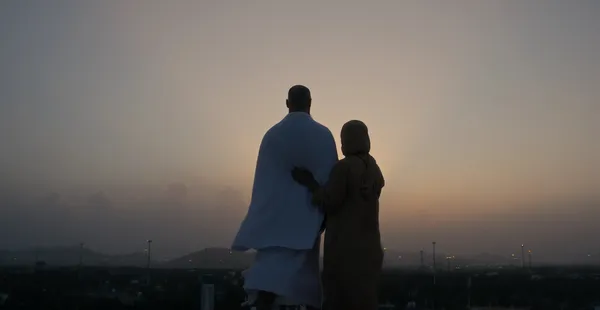
David Andrew Ward has done many different things across the course of his 26-year career as a director, exploring music, sport and true crime. His latest film, however, is something of a departure. Human Tide follows several different groups of people as they prepare for and then undertake the Hajj. It’s the closing film at this year’s Muslim International Film Festival - although the director is not Muslim himself.
“I've always been quite fascinated with the region and I think it's changed so much in recent years,” he says. “I was interested in the spiritual journey and that kind of idea in all of us, that there might be something else. I was interested in making something that wasn't in any way a religious film. I was interested in the fact that I would inevitably have an outsider's eye. And I was interested in trying to document what it is in us as human beings that compels us to perform a pilgrimage like this.
“It is a requirement of all Muslims who are able to do it, but what was it for these people? What were their personal motivations for going? Why now? And why do they want to go with the people they did go with? Because I was also kind of interested in it not always being couples. So I think there was a mother and son and father and son, siblings, and you know, that dynamic. I was interested in that and who these people were going with and why, and how it might change in some way, subtle or otherwise, their relationships.”
Did being an outsider limit his access to the holy city?
“It did for me in that we asked the question, but it was quite clear that there are really no exceptions. If you're a non Muslim, you can't go to Mecca. We at one point were talking about getting a helicopter and I said, well, could I go in the helicopter? And there were various phone calls made and we were told no, it was Muslim airspace, which was quite funny. But we knew that from the get go, so I had a whole host of Muslim crew, a co-director who could go in and you know, it was always going to be a remote shoot for me. So I was in Jeddah, which was the nearest I could be.
“Interestingly, it wasn't as big a factor as it might have been for some other things, simply because we were following six different groups of people, so I couldn't have been everywhere all at once anyway. So actually in some ways it was a benefit, to be able to sit back and take a bit more of an overview about where are these stories going, where the difficulties. And there were difficulties everywhere, as you might imagine. But you know, which stories are feeling the most compelling? Who's having issues and problems that we might want to explore? So for example, Naz got the call that his daughter was ill. That became, inevitably, a big issue for him. That's something we wanted to explore. Would he stay? Would he go? How would it affect his Hajj?
“There were other stories that we knew would unfold. So Hamza getting his exam results: would he become a doctor or not? We knew we wanted to be there when that happened. So there were lots and lots of reasons why actually being slightly removed and allowing the crews to go and do their thing and to feed back to me and to know which stories were developing in ways that appeared interesting was actually very useful.
“I think it also helped that we'd done a lot of shooting prior to Hajj. We had long conversations even before we got a camera out with all of our contributors, and got to know them to some extent. So I think we built that level of trust, the reassurance that we were going to do all we could not to impact their Hajj, their pilgrimage, because these people are not there to make a film for us. They were there to do something that for them was incredibly important, and there was understandably some apprehension and caution around how being involved in a documentary was going to impact their experience of what they were there to do. So there was an awful lot of pre-production conversation and reassurance beforehand.
“I made a decision early on and obviously discussed it at length, of what we wanted this film to be. Whilst there's so much to explore, we decided we definitely didn't want it to be a critique of the materialism, the hotels going up or any of that. I think there's undoubtedly a place for all that. And I think also what we didn't want it to be was ‘this is how you do Hajj’.
“There's a lot of films out there basically explaining what the rituals are, how to form them, where they come from. I didn't want it to be that. And whilst, obviously, we documented our pilgrims performing some of those rituals, for me what was going to be compelling was always the spiritual quest that these individuals had, how that's put under strain in incredibly difficult circumstances.
The Hajj we shot was right in the middle of summer. It was incredibly hot. And then there's basically two million people all trying to do the same thing at the same time in the same places within three square kilometres. So, you know, just logistically, not only for us, but for the pilgrims themselves, regardless of making a film, it's a very demanding journey in every sense. So how do one’s spiritual endeavours play out under those circumstances? Was this Hajj going to be all that they imagined it to be? Were they going to complete it?
“Ultimately, the fundamental question for me was: how does it change people? Are they changed by it? And could we in some way document that? Even if it's subtle changes, which in many cases it was. It wasn't necessarily great life changing events. I mean, in one case there really was, but you know, I think think of the subtle changes in the dynamic, for example, between Yusuf and his father, that almost reverse their roles, where he suddenly saw Yusuf as the man he is rather than the young boy he is. There was an element of softening and forgiveness subtly coming through in that relationship, developing through Hajj. So I was interested in that.
“I was interested in the personal relationships, personal stories and how this landed for people in a spiritual sense. I was well aware that's a challenging goal to set oneself as a filmmaker because it's such a personal thing and, you know, it's intangible really.” He shrugs.
It feels to me like a film that's about faith in a way that's bigger than simply religion, I venture. It looks at ways in which faith can be useful to everyone, whether they're religious or not. Was that an aim as well?
“I think that's a really astute observation,” he says. “I was interested in the spiritual in all of us rather than it being a religious film. I mean, let's not shy away from the fact that this is a Muslim pilgrimage, and these individuals are shaping their spiritual quest within those boundaries. I think most of us to whatever extent have that question, at least, you know, whether we call ourselves people of faith or not. There is always that question of, you know, what's it all about, who's up there? All of that.
“I think just asking that question or experiencing this pilgrimage through the eyes and the journey of these particular people speaks to a far wider audience than just a Muslim audience or even just an audience of people of faith. I think they are very human stories which I hope will resonate with people of all faiths and none.”
There's a lot of diversity within Islam, and the film makes an effort to illustrate that. Its opening scene, in a frozen Swedish wilderness, is likely to surprise people.
“Obviously that was a very deliberate choice, opening the film in the snow. We went to the most remote little mosque in the north of Sweden that we could find. That search was probably the most time consuming, lengthy, in-depth part of the whole process actually. Even the edit, which obviously was incredibly long because there were so many considerations.
“I wanted to ensure that we had diversity in every sense, in terms of age, gender, nationality and reasons for going. There were so many people that we met in that process and yes, I would have loved to have had some Southeast Asians or some, we met some great Indonesian people, two sisters from Malaysia who were going to be on board and one of them sadly was unwell and couldn't go. So there was a very long list, a short list, a shorter short list. There was a very elderly couple from Morocco who we did follow but we just couldn't locate them when they were in Hajj.
“Have people got a compelling story to tell? Are they going to be articulate enough? That sounds judgmental, but are they going to be willing and able to share that story over time within the context of a very demanding pilgrimage? Are they going to open up? Are they going to allow us in? That was the key. I couldn't be happier with the people we ended up following. They were incredible, I have to say, to a man and woman – just incredible in terms of allowing us to document what was an incredibly intimate, important, sacred journey for them.”
How does he feel about getting to ask to be at the Muslim International Film Festival? It must be quite a compliment in the circumstances.
“Absolutely. I'm delighted. A Leicester Square opening in itself is just amazing. I'd always hoped that this film resonated with a wide audience, but first and foremost, if it doesn't resonate or is not deemed to be respectful or authentic to a Muslim audience, then we've got it wrong.
“I'm delighted that a lot of the contributors are going to be able to be there. We premièred the film at the Red Sea Film Festival. Some of the contributors were there and the reaction was actually quite overwhelming by a predominantly, though not exclusively, Muslim audience. I think there is an element of surprise that a non Muslim directed the film. I get that. But I haven't had anything negative yet.”
Looking to the longer term, he says “Obviously we'd love it to have as wide an audience as possible. I'd love it to have a cinema run, even if that's a modest one. And then we look at sales agents and streamers and finding an audience for it beyond the big screen.”