





Eye For Film >> Movies >> The Titfield Thunderbolt (1953) Film Review


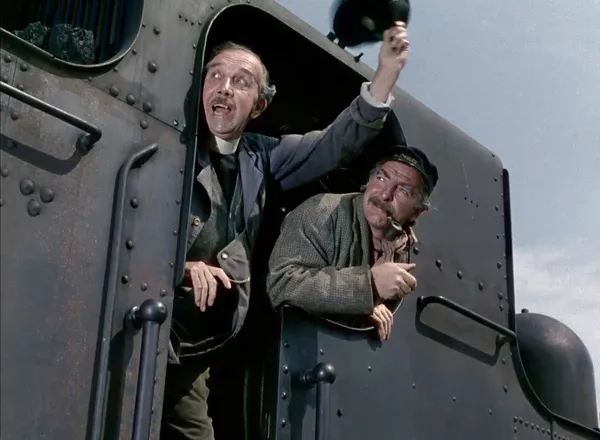

Predating the Beeching railway cuts by a decade, The Titfield Thunderbolt seems oddly prescient in some ways watching it now, although it also offers an absurdly bucolic depiction of England, complete with glorious technicolor. Its whimsical element is in its favour, since by offering up a fairy tale version of rural England it takes on a timeless quality. It was TEB “Tibby” Clarke’s love letter to volunteer-run railways, written after he encountered what at the time would have been a rare example of one in Wales.
It might not be quite as good as his earlier Passport To Pimlico or his Oscar-winner The Lavender Hill Mob but it’s nonetheless an enjoyable charmer. After the news that their branch line – “the oldest in the world!” – is to be axed, the train enthusiast local vicar (George Welch) and local squire Gordon Chesterford (John Gregson) hatch a plan to run it themselves. In fantasy fashion, the stumbling block of cash is swiftly removed thanks to local Mr Valentine (Stanley Holloway), whose deep pockets are matched by a deep desire to drink around the clock – something that will be made possible by the glories of the train buffet car.
Not everyone in the village is thrilled, however. Pearce (Ewan Roberts) and Crump (Jack MacGowran), who run the planned replacement bus service, are soon scheming to ensure the one-month trial of the train, allowed by the Ministry of Transport, is a failure. Thus the scene is set for the sort of comic capers you would expect from Ealing. There are plenty of sight gags, especially when the whole train of passengers finds themselves trying to fill the train engine by hand so it doesn’t blow up, and the character work is also a lot of fun.
Ealing regular Edie Martin only has a handful of lines but steals scenes with them, while Hugh Griffith puts in a lovely outsized turn as retired railwayman and part-time poacher Dan, who reluctantly agrees to help. Naunton Wayne is also great value as the local town clerk. The whole thing is shot with verve by the ever-reliable Douglas Slocombe, who captures runaway train scenes with fluidity and character business with care.
One of the most enjoyable elements of Clarke’s writing and Charles Crichton's direction is the way they set up moments of jeopardy, from that overheating engine to a makeshift coupling, which is surely going to give at any moment, although we’re not sure when. A celebration of eccentricity, community and raising a glass to tradition at any time of day.
Reviewed on: 26 Jun 2026


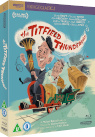
Director: Charles Crichton
Writer: TEB Clarke
Starring: Stanley Holloway, George Relph, Naunton Wayne, John Gregson, Godfrey Tearle, Hugh Griffith, Gabrielle Brune, Sidney James, Reginald Beckwith, Edie Martin, Michael Trubshawe, Jack MacGowran, Ewan Roberts, Herbert C. Walton, John Rudling
Year: 1953
Runtime: 84 minutes
BBFC: 
Country: UK
Festivals:
Search database: