





 |
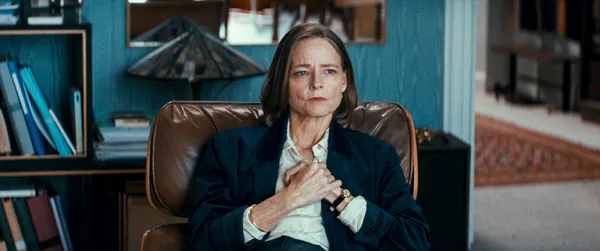
| Jodie Foster in A Private Life Photo: George Lechaptois |
French director Rebecca Zlotowski's A Private Life (Vie Privée), follows psychiatrist Lilian Steiner (a bilingual Jodie Foster), whose suspicious mind pieces together a theory that her patient, Paula Cohen-Solal (Virginie Efira), who committed suicide, was murdered first by her daughter Valérie (Luana Bajrami), then her husband Simon (Mathieu Amalric). Dragging her ex-husband Gabriel Haddad (Daniel Auteuil) along on her wild journey offers an unexpected opportunity for the pair to rekindle their relationship.
Zlotowski made her feature début with Belle Épine, about a drug and alcohol-fuelled friendship between two girls after falling into trouble with the law. Her sophomore feature Grand Central, set at a nuclear power plant in the French Rhone Valley, told the story of an adulterous affair between a new employee and the fiancée of his supervisor. Zlotowski has also directed the fantasy drama Planetarium starring Natalie Portman and Lily-Rose Depp, the coming of age drama An Easy Girl (Une Fille Facile), and the romantic drama Other People’s Children (Les Enfants Des Autres).
In conversation with Eye For Film, Zlotowski discussed Jewish humour, transformational journeys, and making an offer to her audience. She also spoke about building past lives, and Alfred Hitchcock, Fritz Lang and Paul Thomas Anderson, among others.
The following has been edited for clarity.
Paul Risker: You previously told me that with each film you feel freer to get to the core of your emotions, necessities and problems. Are you still on this trajectory with A Private Life?
Rebecca Zlotowski: I felt freer than ever before. This was not only because I had the privilege to work with Jodie Foster, who is someone I've been wanting to work with for so many years, but because in the writing of this film, I allowed myself to delve into those places I would organically go. It was not like writing a thriller, a relationship-centred comedy, a psychological drama or a murder mystery. Instead, I could have it all if I wanted to, and Jodie Foster was super-happy with that. I felt we were on the same page.
And on a personal note, it was probably connected to the therapy I began five years ago. I’ve now stopped therapy, by the way. In my last session, the ceiling literally collapsed. It was after we’d finished shooting, and I thought, ‘Fuck, I could have put that in the film.’
I allow myself to start with personal plots and then hopefully make them meaningful for the audience. And the addition of humour is the best manifestation of this freedom, because it's difficult to do that. I love to laugh, but there has never been laughter in my films, until this one.
PR: From the opening scene, A Private Life shows its sense of humour as Lilian clashes with her upstairs neighbour. The laughter is not at her expense, rather it’s a case that we are laughing at something familiar.
RZ: Absolutely! The starting point was more like a Jewish joke. In Jewish humour, it is not about laughing at something that you should laugh at because no one understands a Jewish joke. It's always like, “And now you’re supposed to laugh.” You either understand it or you don’t.
There's something about connecting with the character that makes us laugh. She's this really bad therapist, cockblocker, and bad mom, but you know what, we love her.
PR: At the same time, we’re not sure whether we are supposed to like Lilian. It’s not that she’s unlikable, but she’s not the warmest of people. A Private Life is a journey of self-discovery, and we gradually warm to her as we witness her transformation.
RZ: I like that, and it’s a good basis for a conversation with an actress. It is always interesting to hear what actors think of a script, and Jodie Foster said, “You know, I like stories.”
I’m definitely part of the French zone of cinema that can be very psychological, with no story and no character arc or transformation. That can be awesome, but for a collaboration with someone like Jodie Foster that is encapsulating Hollywood itself, there had to be an arc even if the story is simple. Here, she’s a bad therapist in the beginning, and by the end, she's a better therapist — that’s it.
I was happy to be questioning this woman's professional crisis because I could totally relate. It’s not about being an alcoholic or a nymphomaniac, which would have been interesting as well. And I love vodka, as you know. What I loved about this story was Lilian doesn't know how to be interested in her work at the beginning of the film, but she reconnects with her job.
PR: This simple story has definite Hitchcockian vibes.
RZ: I thought about it, but I wasn’t sure that I pulled it off, so thank you. It's also Fritz Lang-ish and there's something about the film that connects to Forties cinema, and films like Nightmare Alley and Spellbound.
Psychoanalysis was pretty fresh then — it was this exciting new field filled with symbols, semiotics and cinematic-like things. So, it would lead to amazing collaborations like we see in Spellbound and also with the work of [Salvador] Dalí.
One of the most interesting challenges in A Private Life was to build the inner life of the characters’ past lives, and what that would look like. I had fun crafting that, because it's a moment in the filmmaker's journey where you have to make your film cinematic and to create its unconscious.
It’s Lynchian or Felini-esque because these are two masters I’m always thinking about, and they inspire me. But yes, Hitchcock is more accurate because it’s like a playground where you can have fun opening and closing doors, which is something he always liked to do. He always used those tools in his thrillers.
PR: There’s a wild energy to the film that complements the chaotic adventure Lilian gets caught up in. There have been criticisms that it’s a little confusing, but is this a response to the film’s tone?
RZ: The asperity of a film is the reason why sometimes it's confusing. Sometimes it can just be because it’s new, but I don't think this film is new, I just think it's free. Paul Thomas Anderson’s films are sometimes the same, where you don't know what it is. It's not a parody and it’s not a satire. It's not a sentimental movie and it’s not a biopic. It's just about organically flowing characters. But in A Private Life, I can’t understand being confused by the multiple layers because I really managed to make it modest at the end, where there's a reveal.
In the beginning, we have a question, and we don't know if Lilian’s patient committed suicide, or whether she was killed. But I promised there would be an answer, and you get one.
I read that as well, where people said it was sometimes confusing. But even those people that were confused appear to be happy seeing Daniel Auteuil and Jodie Foster play this ex-couple. And the onscreen chemistry they have makes them an instant classic couple to me.
PR: Could we argue that Gabriel makes her a more sympathetic character through the warmer humour he brings to the film?
RZ: I think in order for the male audience to like her or for her to be more sympathetic, she has to be loved by this man... it’s interesting.
And yes, he brings a certain warmness of the meridional, because Daniel comes from the south of France. So, there is something warmer about him.
Now, this is more technical, but he has the ability to play dramas and comedies — he’s a legend of comedy here in France. There are literally very few actors in the world that can do both, that have the comedic rhythm if they want it, and the drama of diving into a very French type of sentimentality, like the scene when he asks her to give him a cigarette and says let’s talk about our separation. They’re sitting in the car in the rain, and it is such a French scene. Anyway, I really enjoyed filming them.
PR: Returning to the earlier thread of our conversation about tone, is there a need for the audience to be flexible, and accept the film that the filmmaker has decided to make, and not the film they want to see?
RZ: I trust the maturity of the audience because we have reached a point where the audience are narrative-literate. They know everything, and so, we have to play with that.
With A Private Life, there’s a pattern. If you want to open the doors, then open them. If you don't, then don’t. If you want to watch it as a murder mystery, you can do that. Or you can watch it as a marriage-centred comedy or a Jewish psychological drama even. I offer the film to the audience, and you connect to one part of it or not. And by the end, the journey has been a good one.
PR: All artists are in search of their creative voice, and throughout your filmography, it appears you’ve been trying something different. Is this intentional?
RZ: I feel I'm quite obsessive, and I do the same film every time, which is interesting because I know that it's different and it even looks different.
I'm a huge admirer of Sidney Lumet and when you look at his filmography, no films are the same. He works in a totally different way to me, first because he's a genius and then because he doesn't write. When you read about the way he works, he'll read through the script over and over again, and then, he just makes it. This is not the way I work. I have to write to find the story and I feel that's weird because I work with the same producer, composer, director of photography, and so many of the same other people that it's like the same brain. But eventually, the film looks different. It embraces different genres, which is healthy.
I love it when directors are obsessive and they make the same film. I love Hong Sang-soo and Mia Hansen-Løve. That approach works for me, but it's also healthy that films are different.
I'm not getting younger and so, my characters are older. They’re moms now and they have other obsessions. And I have other fears and desires too. So, it creates something new, something different.
I think it was Jane Fonda who said it is not about being an interesting person, rather, you need to continue to be interested in things. And I feel there’s something to that.
A Private Life is in UK cinemas on Friday 26 June.