





Eye For Film >> Movies >> An Irish Atlantic Rainforest (2025) Film Review


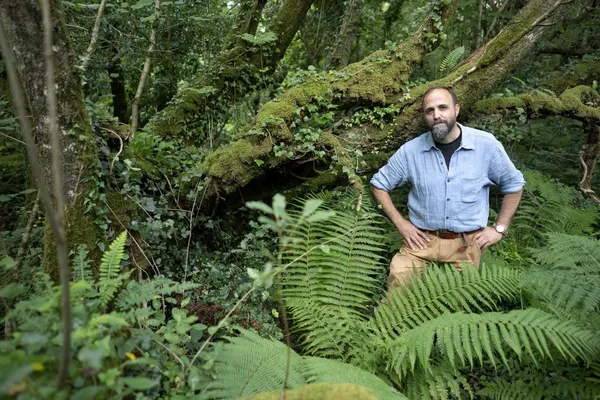

Down on the southernmost tip of Ireland, stretching out with nothing to shelter it from the storms of the Atlantic, is the Beara Peninsula. If you travel there overland, the first impression you’ll get of it is that it’s comprised of the same rugged hills and grassland as much of the rest of the island. Tourists see this as romantic. Eoghan Daltun calls it ‘dead’. But the peninsula has recently become favous for something else – its rainforest – and that is in large part thanks to Daltun himself. Living in a little white cottage with a fine sea view, Daltun might seem to have had all the luck in the world, but he literally built this place for himself, using the recovered stones of its predecessor.
There are moments in Gary Lennon’s documentary that take us back into the past, when Daltun and his single mother were homeless, when they were constantly moving between flats in Dublin, when they were placed on a housing estate rife with drug addiction and vandalism. Rather than crushing him, this experience seems to have instilled in him an ethic of working hard, saving his money and using it wisely – first for the house, then for a farm on the peninsula, which, though it had a fair few trees, was completely lacking in undergrowth. That changed when he succeeded in getting permission to fence out goats and deer, and hacked back the invasive rhodedendra himself. If you’ve ever taken on a rhodedendron bush, you’ll understand something of the sheer physical effort involved in this, and of his determination.
The result of that effort, and of his desire to keep it moving forwards, is the forest of the title, and this film itself. Viewers familiar with Lennin’s previous work, especially I Dream In Photos, will know what he can do with a landscape with this. Working with cinematographers Ross Bartley and Brian O’Leary, he brings it to life in wonderful detail. Around half of the running time is dedicated simply to looking, and marvelling. You won’t find yourself bored. Though he acknowledges that he has never had a formal education in these things, Daltun is full of in-depth knowledge about the forest, and his accompanying narration provides rich context. Particularly interesting is the way this shifts, over timne, from describing species to describing systems, addressing the way that it all works together to create something like a sinle organism.
Temperate rainforest like this does not have the big beasts that make its tropical counterpart exciting. We see a few of its larger animals: a fox, a badger, pine martens and so on. The real magic, however, comes from scaling down to explore the relationships between tiny creatures. Butterflies engage in courtship dances. Gorgeously patterned leopard slugs break down rotting wood. Spiders delicately traverse webs and other surfaces, dewdrops clinging to their feet.
The plants, too, get their moment in the sun (or in some cases the shade). It’s not just the trees, heartening through it is to see new growth of native species. It’s the habitats thy create, as epiphytic plants colonise them, turning their fragile leaves and flowers towards the bright spots in the canopy. Mosses sprawl across bark and earth alike. Ferns sprout up in profusion; and then there are the flowers. Bluebells, violets, wild primrose, knapweed, wood anemones and more, creating vivid pockets of colour on the dappled forest floor. Only the fungi can rival them for show, appearing autumn as the film carries us through four seasons, most spectacular at night when some of them exhibit bioluminescence.
All of these wonders are possible because of the way the forest is shaped not just by Daltun’s careful management but by the force of Atlantic weather. Supplied with plentiful rain, it creates its own microclimate, which may remind some viewers of work being undertaken by indigenous people in the Amazon basin, as they fight climate change by using botany to create islands of cooler temperature. Daltun explains the mechanics of the process well, and points out that it ought to be possible to do this with neglected land all across Ireland, at no great loss to farmers. Why is it that the mountains of Europe are forested and Ireland’s are bare? (It’s not mentioned here, but Scotland is in a similar situation, and has people like Daltun taking the same approach.)
A magnificent testimony to the difference that one man can make, An Irish Atlantic Rainforest is a vital piece of cinema. It leaves no room for excuses, Letting land lie barren is a choice. Watching it, however, you’ll never feel that you’re being preached at. With its endlessly alluring imagery, this is an invitation to fall in love.
Reviewed on: 18 Jun 2026