 |
| Deepfake |
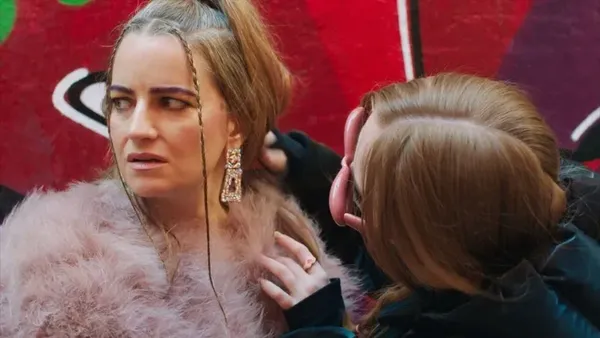
Director Matt Eames' Deepfake follows Jane (Jessica DiGiovanni), who, in the wake of a devastating breakup, makes ill-advised choices that turn her life upside down. Rather than unplugging and valuing time alone and taking time out from friendships, she finds unfulfilling, Jane reaches out to a paid friendship service that connects her with Zoe (Sophia Lucia Parola). Soon, her new friend recommends they seek help from social media guru London (Jocelyn Wiseman), who plans to give Jane a make-over, and, with the help of social media, win back her ex-boyfriend. Trying to be this different version of herself thrusts Jane into an identity crisis. Deepfake is a dark comedy about the clash between Gen-Zers and millennials.
Deepfake is Eames' sophomore feature. He made his début with Till Death, a story about a blind woman, who, scorned by her lover, plots her revenge. It introduces a familiar thematic thread through the early part of Eames' filmography, about doomed relationships.
In conversation with Eye For Film, Eames discussed his creative identity, framing comedy through a dramatic lens, and unpredictable gifts from his leading actress. He also spoke about his dislike of social, Todd Solondz's Welcome To The Dollhouse, a pearl of wisdom from Alfred Hitchcock, and the provocative side of the human brain.
The following has been edited for clarity.
Paul Risker: What distinguishes the experience of a debut from a sophomore feature?
Matt Eames: The first one, without belittling it, was like a student film. I hadn't gone to film school, and I'd never even been on a set before or even been around a camera. But I had spent a lot of time writing scripts, and I was eager to get one going and see what I could do with it.
We had an incredibly small cast and crew. My parents were there making food for everyone, and they both appear in the movie, despite there being only six or seven people in the cast. It was a black and white slow burn thriller, with primarily one location. Deepfake could not be more different in terms of tone. It's a comedy and it's in colour. We definitely had a more professional and seasoned crew, that had gone to film school, and a SAG cast that was fantastic.
I don't think it would be very difficult to see the through line between the two of them, though. There is a dark humour in the first one as well, despite it being a very different experience.
PR: Do you see yourself as a comedy writer and director?
ME: Yes, and I definitely try to mine a little bit of comedy. Out of all of my scripts, the comedy is closer to the surface in this one than most. But I'm not trying to go for big comedic set pieces or anything like that.
I'd say it's a dark comedy, if anything, that appeals to me. I get stressed out writing pure comedies, because I feel there's this pressure to satisfy, where every line has to have something attached to it. That's a lot of pressure to deal with.
PR: Whereas with a feature, it can be paced more slowly.
ME: Yes, you can let it breathe; you can let the characters exist in reality and not get all caught up in just trying to press the audience's buttons whenever you can.
PR; What was the seed of the idea for Deepfake, and what compels you to tell this story now?
ME: I should preface this by saying I am a Luddite. I don't have social media, but I've been exposed to it here and there over the years. I've always had this mix of fascination and horror towards it. And as an impartial observer, I always thought there was a great deal of humour in it, alongside the disconnect between how people perceive themselves and how they're perceived by the way they present themselves online. There seems to be this huge gulf that exists, especially for certain people, like influencers. They project a certain image, and I think a large portion of the world is snickering at them. So, there's a lot to be mined in the separation that exists between those two perceptions.
PR: I left social media some years ago, which highlighted to me how detrimental it can be to one's mental and emotional health and wellbeing. A question confronting all of us is whether we are willing to create a private space for ourselves or are we going to stay plugged into this digital collective hive, which Jane gets lost in.
ME: Absolutely, and I get anxious thinking about it on other people's behalf. Writing one text stresses me out, so, doing that to the entire world is something I just can't begin to imagine.
One of the things that troubles me about interacting with people online is you don't get that real-time feedback that you would in a normal conversation. And there's so much that gets conveyed in terms of context and subtext and with your eyes.
There's that famous quote from Hitchcock about dialogue just being the sounds the characters make. This is because they tell the story with the eyes. You don't get that at all with social media. Instead, it's strictly the words taken out of context, which are subjected to so much interpretation and may lose the original intent. And the idea of losing that original intent makes me really uncomfortable.
So, yes, something the character in this movie is experiencing is trying to say what she needs. But then, it's what is actually coming out of her mouth and being projected onto the world.
And you need to be a friend to yourself before you can be friends with other people.
PR: Jane's obsessive behaviour is universal and Deepfake isn't only critiquing social media but human nature. How often do we all find ourselves in obsessive behavioural patterns, whether it be after an unsuccessful job interview thinking about which of the other candidates got the job, or the way our insecurities can affect our personal relationships?
ME: You hit the nail on the head. It exploits a certain insecurity. You get that brief rush from it, but when that rush goes away, there's a bigger vacuum left in its place. And suddenly you've got to fill that vacuum, which, like any addiction, gets harder to fill.
PR: Zoe, the so-called friend, is just an echo chamber for Jane to find self-validation and self-worth. A friend is not only someone who agrees with you but tells you when you're wrong. Jane and Zoe are only playing at being friends.
ME: Oh my God, yes. A true friendship is a two-way street, and, in this movie, Jane is not really being a true friend. And this person she's paying to be her friend is clearly not a friend either. Being a friend is a grassroots movement; it has to be grown organically. You can't pay for it, and it can't be transactional. And you can't just hear what you think you need to hear; you have to hear what you need to hear. So, yes, this is friendship in name only. It's a friendship in its most superficial form, where someone is there singing your praises, but that's not what a friend really is.
PR: In the broader political context, here in the UK, one channel during the daytime airs one show after another that sees people, representing two opposing points of view, argue with one another. There used to be drama programming in this broadcasting window, and this shift suggests there's a genuine appetite for conflict. We have become a society built around polarising silos and echo chambers. You see it too in the US with left-wing pundits arguing with MAGA influencers. It achieves nothing and can sink you into a miserable headspace.
ME: It's horribly depressing. You read about the way political discourse used to be 100 years ago, where they'd have these three-hour-long debates that weren't just talking (or rather shouting points) for sound bites. Instead, it was about people engaging with ideas and trying to persuade one another based on the power and logic of their arguments, as opposed to who can score the pithiest, most quotable remark that doesn't really represent any of the nuance of the debate.
PR: When Jane gives a social media post the thumbs up and blames it on a finger slip, this reminded me of the joke in the comedy series Frasier that there are no such things as accidents. And of course, Jane does orchestrate the scenario where something like this could happen.
ME: There's that part of the brain that can't help resisting stirring the pot to see what happens. I find myself in that position all the time. There's that part of my brain that says I shouldn't do something, and yet, I want to see what happens if I do. I immediately regret it and I never learn my lesson.
PR: What was the thought process behind the visual language of the film, and specifically nurturing a raw and grittier tone that felt necessary to mirror Jane's journey?
ME: I spoke with Rob [Bevis], our DP, quite a bit about it, and we storyboarded the whole thing through before shooting. We definitely wanted a more measured approach at the beginning, when her life is a little bit simpler and less chaotic. We also wanted the camera work to represent her emotional state as it progressed as it became more erratic.
On top of the technical issues of shooting, we spent a great deal of time in Jane's apartment, and so there was the challenge of trying to keep it visually interesting despite being primarily in one location. So, we relied a little on the camera work and also on Jess's performance, which really helped create a compelling visual sensor for the film. Just the way she emotes and carries herself, she has such a magnetic screen presence.
She just breathes so much life into the film. It's not necessarily a backstory element per se, but she would give different line readings each time that would inform the character in a different way. She's such a versatile and flexible actress.
We talked a lot about restraint because we wanted it to feel grounded and not to feel like a comedy, where she's delivering punch lines. Instead, we wanted it to feel like her character's emotional experience and shoot it almost like a drama, despite the absurdity of some of what happens.
PR: Did Jessica's versatility give you a lot to play with in the edit for shaping the film?
ME: It definitely gave me enough to sculpt the film in ways that I wasn't necessarily anticipating going in. She is so good at hitting certain notes and lines that it sometimes makes it difficult to decide which of the very different readings you're going to go with.
You could have easily cut this movie a different way and gotten a completely different feel out of it. And it would have been interesting to see how people would have reacted. So, the film did change quite a bit as we made it.
The rough cut was originally close to two hours and the final version is closer to 87 minutes. So, it was substantially trimmed, storylines were excised and plots compacted. But I think it really benefited the story, and it tightened up nicely in the end.
PR; The humour tends to lean into the uncomfortable less so than being at Jane's expense.
ME: That's my favourite kind of humour. We talked quite a bit about Welcome to the Dollhouse before we shot this, in terms of having a character who's mercilessly bullied by the world and yet still tries to keep her bearings as she goes through it all. That was a great reference point for this film.
PR: If you're right, there's also a sense that Jane doesn't want to pick herself up after this latest setback. This opens her up to being objectified by Zoe and London.
ME: She's offloading the responsibilities of picking herself up onto other people who don't necessarily have her best interests at heart, or maybe, in an AI sense, are carrying her goals out to the letter without understanding the human intent behind them. There's definitely a little resignation in the way she's giving up and passing the responsibility to everyone else.
One of the original taglines we considered was, "Life is hard. Get someone else to do it for you." It's that idea of busting your hands, giving up, and letting other people, who see you as more of a product than a person, take over.
PR: One of the prominent themes of the film is how our lives become prisons, whether it be our relationships or jobs. Deepfake could be read as a prison-set story, with a philosophical slant.
ME: Sometimes we build our own prisons and sometimes the bars are made of gold — those things we covet. We can be trapped by our obsessions and our vanity, but we don't always know it. And Jane has created this world that she has trapped herself in. Instead of trying to rectify the situation, she embeds herself deeper, and the walls keep closing in as the story progresses.
I told Jess during production that we wanted Jane to be the smartest person in the room, yet consistently incorrect. She's always making the biggest mistakes and, hopefully, some of the humour comes from these self-imposed errors. And it's the difference between what we want and what we need, and she's far too focused on the former.
Deepfake premièred in the Viewpoints strand at the 25th Tribeca Film Festival.