





Eye For Film >> Movies >> Angel's Egg (1985) Film Review



Peter Greenaway has spoken of film as a sort of animated painting, or a medium which might aspire thereto; and yet ever since the mid-1910s it has concentrated almost exclusively on narrative storytelling. Oshii Mamoru’s experimental 1985 work, recently remastered and screened at BeyondFest, is an attempt to get away from that. Though it does contain narrative elements – a simple fable about a scavenger girl who guards an egg and a young man who dreams of a bird – Oshii has stripped this down to the bare bones in order to focus instead on imagery and abstract ideas.
Who is the girl? Prepubescent, delicately built, with pale skin and big eyes, she embodies a naïve idea of feminine prettiness, running around in layered skirts that make her lower body look like a bell. Her dress is a blend of soft pinks and lilacs, the only remotely warm colours to be seen in the vast wasteland she inhabits, whether forest, swamp or city. The latter is a ruin inhabited only by soldiers, who she avoids with the acute wariness of one who has directly witnessed their violence. We see them marching, parading for an absent crowd; rushing into action with gigantic, shadowy nets when fish appear above; but, for the most part, slumped on walls and at the side of streets, waiting for something to give them purpose.

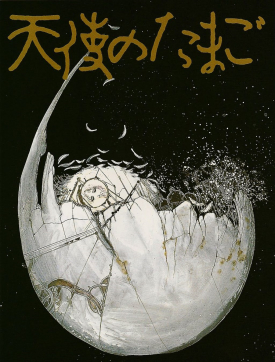
The girl’s purpose revolves entirely around the egg. When she meets and talks with the young man, we will learn that she believes it was laid by an angel. She is protecting it and keeping it warm against her body in the hope that one day it will hatch and usher in a better world. We will see here the first image of the fossilised angel that went on to appear in several later Oshii works – but still the young man is disinclined to believe her. He wants to see what’s inside. Can’t they break it?
Oshii’s work is heavily influenced by his academic fascination with Christianity. The desire to break the egg would seem to represent a rejection of faith , perhaps stemming from a desire to bring this fallen, fantastical world into some kind of order. The intact egg gives the girl purpose and hope; not knowing means that she is free to imagine. Still, she gradually lets the young man get closer to her, extending her trust. They discuss their ignorance of where they came from, of what existed before this, but is he telling the truth? Where her movements are light and fluid, his are firm; he is animated with more rigid shapes, less yielding lines. He too has a purpose, and she will pay a heavy price for this intimacy – but, perhaps, a necessary one, if that better world is to be possible.
Bleak as this may sound, it is unutterably beautiful. Hand-painted cel animation utilises techniques from traditional Japanese woodblock printing and much more delicate sumi-e, combined with diluted ink washes which give us heavy, threatening skies, and later a watery world. The visual journey evolves slowly, so absorbing that it can afford to take its time. Sombre landscapes reveal hidden glory as they are softly illuminated from single points of light. Our heroine briefly takes refuge in what might have been a church, where a fish-like figure glimmers in stained glass. Outside, higher up, a Dagon-like gargoyle presides over the city with its tightly packed houses and cobbled streets, its fountains and great pillared halls, all gone quietly to ruin with no-one left to mourn.
Is there any possibility of redemption for this place? Oshii seemed to think so – though it is suggested in such an alien way as to be beyond the imaginative capacity of the girl. The very different imagery which bookends the film suggests the very different perspectives of the mortal and the divine. Only an egg, with its abstract promise, might bridge such different worlds. And yet the film’s concluding shot steps outside this framework to present yet another layer of abstraction – one which might call the value of narrative itself into question. In the absence of any other philosophic anchor, one might become lost in the aesthetic. The beauty of the film becomes all the more compelling. It is its own justification.
Struggling to pull in big audiences on its release, Angel’s Egg has become something of a cult classic. It now looks better than ever. Don’t miss your chance to see it.
Angel’s Egg will be released across North America for the first time on 19 November.
Reviewed on: 12 Oct 2025



Director: Mamoru Oshii
Writer: Mamoru Oshii, Yoshitaka Amano
Starring: Mako Hyôdô, Jinpachi Nezu, Keiichi Noda
Year: 1985
Runtime: 71 minutes
Country: Japan
Search database:
