





 |
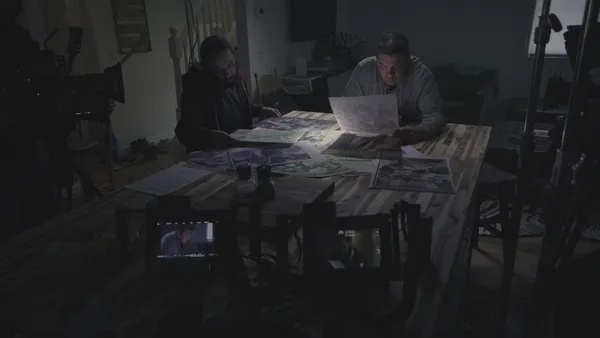
| Ni-Naadamaadiz: Red Power Rising Photo: courtesy of ImagineNative |
It was summer 1974 when a group of young Anishinaabe warriors led by Louis Cameron established an armed occupation of Anicinabe Park. They called for the return of the land, which had always been theirs, and for better housing and employment opportunities in Kenora, Ontario. Although they were only able to hold on for a month, it was a pivotal moment in the struggle for equality, propelling the wider movement forwards. It made Cameron a hero, but at great personal cost.
Shane Belcourt's documentary Ni-Naadamaadiz: Red Power Rising, which screened as part of ImagineNative 2026, uses interviews, archive footage and Cameron’s own writings to explore this historic moment. He’s explored a lot of different subjects in his time, so I asked him what it was that drew him to this one.
“I grew up in a political household,” he explains. “My dad, Tony Belcourt, is an Indigenous rights leader and advocate. In 1971 the leadership of Alberta asked my dad to leave Alberta and go with Harry Daniels and others to Ottawa to start the Native Council of Canada. The idea was to fight for and advocate for off reserve, non status and Métis rights in urban environments as well as land-back measures in Métis communities across the Métis homeland, most notably the prairies. So I grew up around a whole bunch of, I guess you could call them rabble rousers, you know, because I was born in Ottawa after they had my dad and the family relocated there.
“Growing up around all that politics in that era of people in the early Seventies, and seeing the rock n’ roll nature of that crowd, you know – when I heard about this project, it was just one of those things that was like, yeah, this would be a great one to work on because it's almost a tribute to a generation. That’s one major element of the story. Another part of the story is that I kind of gravitated towards this one because I was doing Historical Canada Minutes. I did a couple of them: one on a treaty and one on residential school. While we were determining, with the Heritage Canada team, which one to do, they pulled out this article from Dimensions Canada magazine in 1974 that did a 12 page spread on the occupation and all the things that led to it.
“What was it about? They interviewed Louis Cameron within that publication. I had read it at that time and we were going to make a possibly historic Minute about that before. I was just blown away by it. I had heard about Cash Creek and I'd heard about Anishinaabe Park, but it wasn't with any clarity. And here was this article, step by step: what happened, what the situation was like. And then the voice of Louis Cameron was in there and I was just like, ‘Oh, this guy is a rock star.’ His intellect, his articulation, his clarity of spirit. I was like, ‘This is a really amazing character.’
Now, obviously we didn't make that historic Minute, but it lingered in my mind as that's just an incredible story. And then it was many years later when Tanya Talaga and her team were thinking about doing a narrative series on the occupation and they reached out to me to join the running room and take part. It was realised pretty quickly that we didn't have enough information to make a narrative series on what happened day to day, who did what. So I said to the team, ‘Why don't we make a documentary?’ And in the process of making a documentary, we'll have an enormous amount of research done that will enable us to make the scripted version of the series.
“I wanted to make a tribute to the generation of people that I grew up around as a very young child that I thought were heroic, courageous and full of love.”
I tell him it’s interesting that he uses that language around rock stars because the film has the same kind of spirit. People in it talk about Louis Cameron as if he was a huge rock star celebrity they always admired.
“Yeah. When you think about the idea of a rock star, one part of it is the rebellious nature that is ‘I'm okay to be different and I'm not going to hide who I really am.’ Another part of rock star is that you have something to say, you know, and the way you say it is just moving to people. Whether that's like a Bob Dylan style rock star, so to speak, or a twisted sister, we're not going to take it. You know what I mean? You're getting in this world of people who are so charismatic because of their clarity of vision and their clarity of words, and they're anchored.
“Louis Cameron is anchored deeply in being an Anishinaabe person. He knows exactly who he is, he knows exactly what is at stake, and when he speaks from his heart, it's grounded in a place that is just so deeply moving and engaging. So I’d definitely call him, and all the people around that movement in that era, rock stars. It was a rock star movement and he happens to be one of them.”
Did that make it easy to find people connected with it who could to him? Not really, he says. His journey was not an easy one.
“This film was basically a three time failure. The first one was what we were going to do. I had recently watched MLK Versus The FBI, purely archival, and I and I pitched to the team, ‘I'll do the film purely in archival material, right? There has to be so much archival material from the occupation. The police were there, news was there. We're going to have hours of archival footage. and we'll just live in archive and the art will be in the moment day by day. It'll be great.’
“So then it's like, ‘Alright, what's the pivot? We'll go interview all the people that were there, and we'll ask them about what it was like. And many of them had succumbed to what they fought for. They didn't want to have a violent death, and many of them had violent deaths at young ages. So some of the leadership wasn't with us. Louis Cameron was no longer with us, and other people that were there, I’d say ‘So how did they make decisions?’ And they were like, ‘Well, I was the potato peeler.’ So we were like, ‘Oh, what do we do now? What's the next pivot?’
“We had conducted all these interviews over multiple days, you know? And it's not that it's not useful footage, but it still didn't get us inside the park – what happened day to day and the decision-making. I felt like that was going to be necessary. What was Louis Cameron thinking, you know? Where did he come from? We didn't have that stuff. And we had access to the Cameron family, most notably Lynn Skied, his former wife, and Tyler Cameron, one of his sons. We were starting to get comfortable with them; they were starting to get comfortable with us. And then Tyler said to me ‘Hey, Shane, my dad has an unpublished manuscript. Would that be helpful?’
“Oh my God. Immediately everybody on the team, the researchers, everybody, were all so excited about this. So we just started digesting it, and then I wrote a new outline of the film. It kind of goes full circle. I was first explaining what if we had the son of Louis Cameron, Tyler Cameron, trying to understand the manuscript, trying to understand who his father was from a new perspective, from his own words? That's why we have these scenes of Louis reading the manuscript, talking about impromptu things.
“It was super intimate, just a very, very small group of us that got Tyler to this very open, beautiful place. We had this great growing relationship through his dad's words, through his dad's manuscript. And there was the film: the archive that we did have, the interviews that we did have. Great. And the fact that a son is paying tribute to his dad in the documentary was my ambition, I think because of my dad.”
It’s a technique which gives the film intimacy; it addresses a big historical event, but it feels personal and relatable.
“Absolutely. That's a great point. It’s exactly, I think, what we wanted to do when we made the documentary. I've said it before and it sounds half joking, but I feel like I'm a propaganda filmmaker, less of a documentary filmmaker, because I truly love these subjects. I love Louis Cameron. I love Tyler. I love the chance to get to know them, to spend time with them. I love the idea that we can talk about the stuff that indigenous life includes. Talk about the brutality that, writ large, colonialism has brought to multiple generations, and the intergenerational trauma of residential school and all these terrible things. But when we make these things together, we're making love songs to who we really are. We're making ambition about who we want to reclaim and start becoming more and more of.
“We're also making these love songs that are tributes to all the generations of people that allowed us to be who we are today. Our ancestors, our grandparents who held us as babies. All these things are the things that we're trying to pay tribute to through love, as difficult as it is. And we laugh and we cry and we hug it out. That's why it doesn't feel like documentary filmmaking the way I thought it would. It just felt like we're just coming together and hanging out and trying to understand each other.
“One of the things that's sort of interesting about life is when something terrible happens -and anyone in any place can think of that – the next day you’ve got to get up, you’ve just got to get on with whatever it is you're doing, and the day after and so on, and it doesn't take that hurt away. But it's just to say that there is laughter, there is love, there is a continuance, there's a momentum of other things.
“In Louis’ case, you see in the documentary, when Tyler talks about being tied to the goal post [at school], how did that trauma inform the kind of places that they wanted to go to? You think about the pure injustice of being literally tied down. And then the idea of ‘I want to reclaim my own authentic spirit and voice’, you know? When he does that, what's so beautiful about it when you think about this, in Louis Cameron's case, is his idea was not to go tie down other people, his idea was only ‘Can you please back off and let me and my community be whole’? That's it.
“You think about the act of love that takes. It's not vengeance. He and the others standing up, all these young warriors, they were standing up just to say ‘Please give us space to be us. That's all we want. We don't want your thing. You do your thing. Just let us have our thing.’ I know from watching my dad and his friends that that was exactly what they would say. over and over again. As a young person, I was like, ‘Come on, don't you want to get back?’ And my dad would always say ‘No, son, that's not what we're about. That's not who we are. We don't do that. We just want our space for us.’ That's a beautiful thing coming out of a lot of trauma for generations of people.”
Will different generations experience this film differently?
“You hope that there's a world in which maybe, three, four generations from now, indigenous people across Canada or the Americas would watch a documentary like that and say ‘I cannot believe how brutal and crazy that was.’ I mean, that would be the best place ever for indigenous people to find themselves. That great, great grandkids would watch this documentary and just can't even fathom how there was such a dire need to stand up, how there was so much heartache and trauma. It’s exactly what Tyler says at the end of the documentary: ‘I don't want my kids to carry this.’ You know, we're not there yet.
“People in the Kenora area will watch this documentary and say ‘Do we have to do that again? How close are we to having to do that again?’ It’s not exactly the place we want to find ourselves. You know, my dad moved, as I noted, from the Métis communities of Alberta to go fight for land rights and rights in Ottawa for Métis people. Those things are still going on. The Alberta land claims from the Métis scrip are not settled.
“I think about people watching like a documentary like MLK Versus The FBI and going ‘Well, the civil rights movement that settled that question.’ He laughs. ‘You know, we're in a continued cycle of this. But what I would say is different, and what's really great, is more and more young indigenous people are finding their way to speaking their own individual indigenous languages, which helps change worldview and grounding. As long as that is taking place, you can't say things are not better or things haven't changed. It's slower than I think I would like, but it is definitely happening.”
In recent years, there has been a boom in film made by Indigenous people. Does he think that's something that helps directly? People can see role models like this and can learn the history that would be more difficult for them to access outside of their own immediate communities.
“There is a staggering increase of indigenous cinema and TV over the last decade,” he says. “There is no doubt about that. And ImagineNative - so many of my contemporary filmmakers say ‘I would not have a career if it weren't for the ImagineNative Film Festival. My first feature narrative that I made was inspired, was a complete reaction to watching Blackhorse Lowe's 5th World, which I saw at ImagineNative. I was just like, ‘This is amazing. I need to make a movie tomorrow.’ I just started writing based on watching his movie. So that's like a thing that happened.
“Another big one is when APTN became a national broadcaster. The first television thing I ever did in my life was for APTN, and that's a thrilling thing as a young person. The groundwork that was done there feels exciting to be a part of. And then to see it kept up with all these young filmmakers. Trevor Soloway pops to mind. There's so many others. We're kind of jumping lily pad to lily pad. So we're at this one moment, which is only going to continue to grow because I think what's exciting for an audience is how many genres of story are there.
“How many things can you watch about a superhero, for example? And then it's like, ‘Oh, what about if we did this twist and it's an African American superhero?’ Oh, okay, cool. Well, kind of wicked. ‘What if it's an indigenous superhero?’ Oh, cool. You know, you're taking some of these same story types, but now if you indigenise them for a global audience, it's an exciting new version of something. Why isn't there an indigenous Hallmark movie, you know? That should be made. There's exciting possibilities.
“What's also super exciting, I’d say, is indigenous is like a writ large term. There's individual communities. I mean like a Mohawk and a Haida – these are two very different worlds. Not world views per se, but different worlds, different locations, different geographies, different specific histories. So indigenous is new, and then all these layers of specific indigenous experience, let alone personal indigenous experience – it's a massive web of possibility and artistry and voices and it's super exciting.”